Facts
On 24 August 2005, Shahin Praveen, the appellant’s wife, was allegedly knocked down by a Toyota Corolla driven by Respondent No. 1 near Bhisham Pitamah Marg, Sai Baba Mandir Bus Stand, New Delhi.
Source reference: p.2Shahin later succumbed to her injuries, while her daughter Ayesha was also injured.
Source reference: p.2The prosecution alleged that Respondent No. 1 had driven the vehicle rashly and negligently, attracting Sections 279, 337 and 304A IPC.
Source reference: p.2After investigation, the police filed a charge-sheet, and the accused was tried by the Metropolitan Magistrate, who acquitted him under Section 255(1) Cr.P.C. on 5 November 2015.
Source reference: pp.3–5The appellant, claiming to be the deceased’s husband and victim, filed an appeal before the Sessions Court. That appeal was dismissed and the acquittal was affirmed on 28 October 2022.
Source reference: p.5The appellant thereafter filed the present appeal under the proviso to Section 372 Cr.P.C., challenging the appellate court’s order confirming the acquittal.
Source reference: p.1Issues
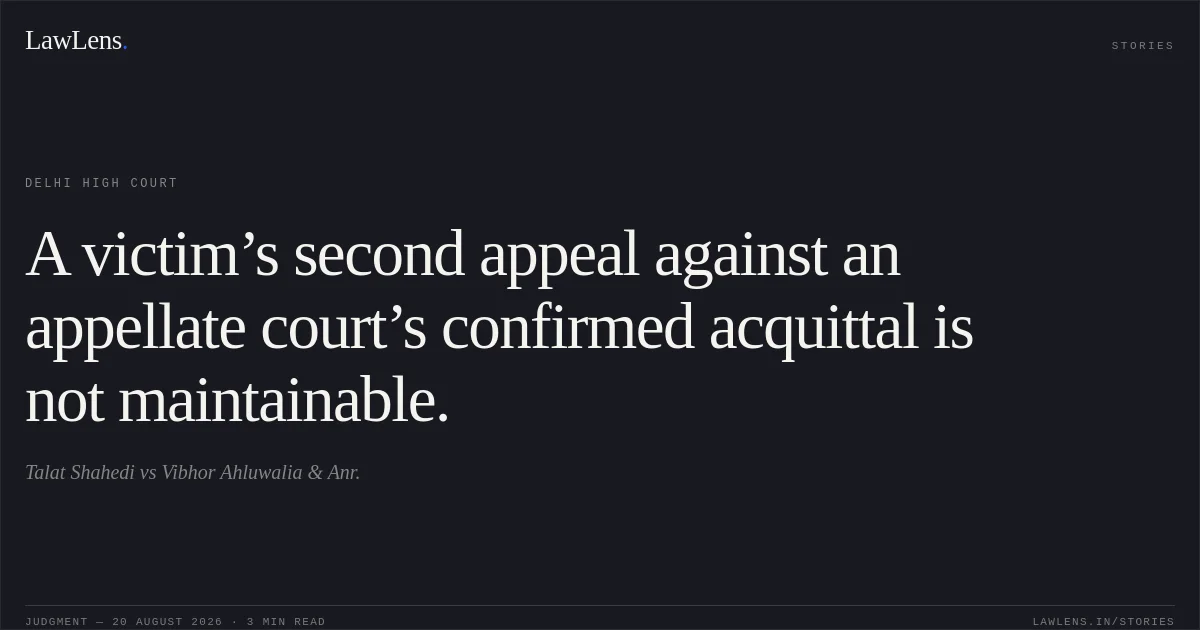
Whether an appeal filed by a victim under the proviso to Section 372 Cr.P.C. is maintainable after the appellate court has dismissed an earlier victim’s appeal and confirmed the trial court’s order of acquittal?
Source reference: paras. 10–14; pp.5–9Whether the victim can invoke the statutory right of appeal under Section 372 Cr.P.C. successively against the same order of acquittal?
Source reference: paras. 10, 13–14; pp.5–9Law Applied
The proviso to Section 372 Cr.P.C. confers on a victim a statutory right to appeal against an order acquitting the accused, convicting the accused for a lesser offence, or imposing inadequate compensation; such appeal lies to the court to which an appeal ordinarily lies against an order of conviction.
Source reference: paras. 10–11; pp.5–6Section 401(3) Cr.P.C. prohibits the High Court, while exercising revisional jurisdiction, from converting an acquittal into a conviction, while Section 401(4) bars revision where an appeal lies and has not been filed; Section 401(5) permits a revisional application to be treated as an appeal in appropriate circumstances.
Source reference: para. 12.1; pp.7–9In Joseph Stephen v. Santhanasamy, (2022) 12 SCC 115, the Supreme Court recognised the victim’s statutory right of appeal and permitted a revisional application to be treated as an appeal where no appeal had been filed.
Source reference: paras. 11–12.1; pp.6–9The Court also relied on Asian Paints Ltd. v. Ram Babu, (2025) 10 SCC 372, Gopala Krishnan v. State of Kerala, 2026:KER:81, and Mahesh v. Gunderao, 2026 SCC OnLine Kar 932, for the principle that the proviso to Section 372 Cr.P.C. does not authorise successive appeals against the same acquittal.
Source reference: para. 10; pp.5–6Reasoning
The Court distinguished Joseph Stephen, observing that the Supreme Court there dealt with a situation in which the victim had not previously pursued an appeal against the acquittal and had instead invoked revisional jurisdiction.
Source reference: paras. 12–13; pp.6–9In the present case, the appellant had already exercised the statutory appellate remedy under the proviso to Section 372 Cr.P.C.; that appeal had been dismissed by the Sessions Court, which confirmed the trial court’s acquittal.
Source reference: paras. 12–13; pp.6–9The Court held that once the appellate court had affirmed the acquittal, the appellant could not maintain a second appeal against the same order.
Source reference: para. 13; p.9The statutory right of appeal under Section 372 is a right to one appellate remedy and cannot be treated as authorising successive challenges to an acquittal.
Source reference: para. 13; p.9Holding
The appeal was held to be not maintainable because the appellant had already exhausted the remedy under the proviso to Section 372 Cr.P.C. and the Sessions Court had affirmed the trial court’s acquittal.
The High Court accordingly disposed of the appeal without examining the merits of the alleged offences under Sections 279, 337 and 304A IPC.
Source reference: para. 14; p.9The Registry was directed to return the certified copy of the impugned judgment to the appellant, and any pending applications were ordered to stand closed.
Source reference: paras. 15–16; p.10Acts & Sections Cited
16 provisions across 2 statutes referred to in this judgment. Each provision opens on LawLens.
Code of Criminal Procedure, 19737
Original Court PDF
Talat ShahedivsVibhor Ahluwalia & Anr.
Click to open original judgment
Original judgment, available to read, download and summarize on LawLens.in