Facts
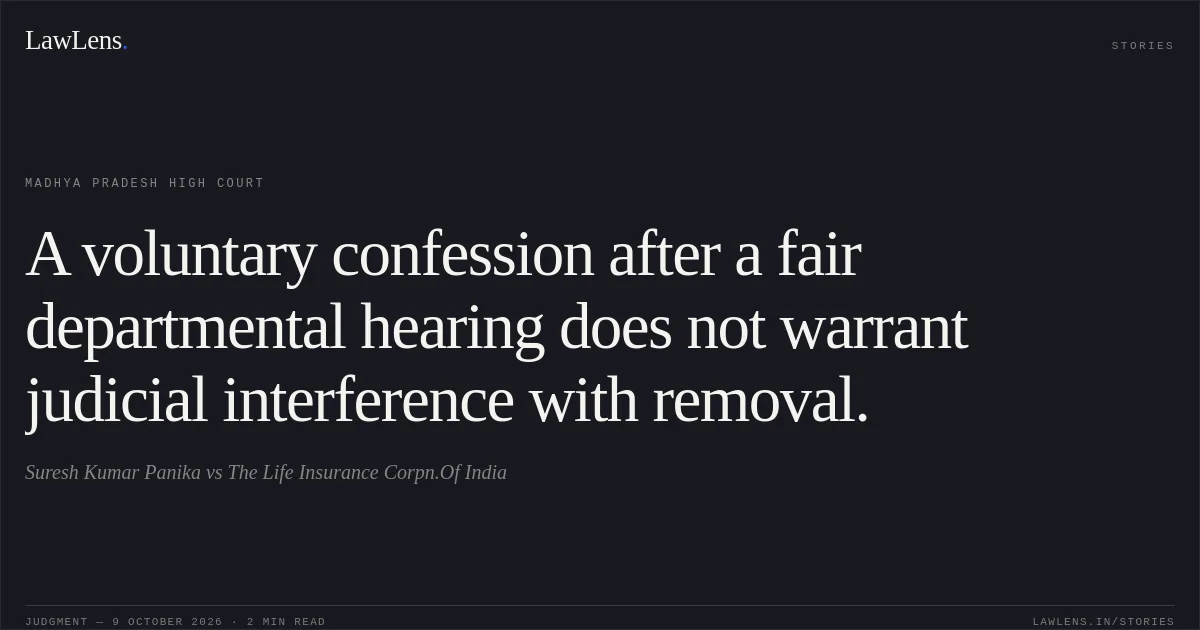
The petitioner challenged the order dated 30 June 2003 removing him from service and the appellate order dated 18 December 2003, invoking Articles 226 and 227 of the Constitution
Source reference: para. 1In the writ petition, he alleged that he had not received a proper opportunity of hearing in the departmental enquiry and that his confession had been obtained by coercion
Source reference: para. 2At the hearing, he also argued that other employees received lesser penalties and that he was not permitted to cross-examine a key witness
Source reference: para. 2The respondents maintained that the petitioner had been allowed to participate in the enquiry and had confessed voluntarily
Source reference: paras. 3, 5–6Issues
Whether the petitioner was denied a proper opportunity of hearing in the departmental enquiry
Source reference: paras. 2, 5Whether the petitioner’s confession was obtained by coercion and therefore could not be relied upon
Source reference: paras. 2, 6–7Whether the petitioner’s arguments concerning unequal punishment and the opportunity to cross-examine a key witness warranted interference
Source reference: paras. 2–3, 5Law Applied
The Court considered the petitioner’s challenge under Articles 226 and 227 of the Constitution
Source reference: para. 1It applied the principles of procedural fairness in a departmental enquiry, including the opportunity to respond to the case and examine witnesses, and assessed whether the confession was voluntary or coerced
Source reference: paras. 5–7The judgment cites no statute, precedent, or separate legal test governing unequal punishment; the respondents also objected that discrimination had not been pleaded in the writ petition
Source reference: para. 3Reasoning
The Court found that the enquiry record showed the petitioner had an opportunity to participate, submit his defence, and cross-examine witnesses; it therefore rejected the claim that he had been denied a hearing
Source reference: para. 5It also considered the enquiry proceedings of 19 October 2001, in which the petitioner acknowledged participating in the forged-payment misconduct, agreed to make a written confession, and stated that he knew the conduct was illegal
Source reference: para. 6Because he confessed to his own involvement and also implicated other employees, the Court found no basis to conclude that the confession had been coerced
Source reference: para. 7The judgment records the arguments about unequal punishment and the Manager’s cross-examination but does not separately analyse them; the respondents had objected that discrimination was not pleaded
Source reference: paras. 2–3Holding
The Court held that the petitioner had not established a denial of hearing or coercion in obtaining his confession, and found no ground for judicial interference
The writ petition was dismissed
Source reference: para. 8Original Court PDF
Suresh Kumar PanikavsThe Life Insurance Corpn.Of India
Click to open original judgment
Original judgment, available to read, download and summarize on LawLens.in