Facts
The petitioner, a Senior Superintendent at IIT Guwahati, applied pursuant to the internal advertisement dated 5 January 2022 for four unreserved posts of Assistant Registrar.
Source reference: p.4, para. 2The DPC met on 18 February 2022, recommended four selected candidates and prepared a waitlist on which the petitioner stood first and private respondent No. 7 stood second.
Source reference: p.4, para. 2The selected candidates were appointed, but the petitioner alleged that the select list and waitlist were not communicated or published.
Source reference: p.5, paras. 3–4IIT Guwahati subsequently issued an internal advertisement dated 12 December 2022 for, inter alia, one post of Assistant Registrar.
Source reference: p.5, paras. 3–4Both the petitioner and respondent No. 7 participated; respondent No. 7 was selected and promoted.
Source reference: p.5, paras. 3–4The petitioner contended that the subsequent vacancy arose during the one-year validity of the earlier panel and was required to be filled from the waitlist under Clause 6.2.3 of the IIT Guwahati Recruitment and Promotion Rules.
Source reference: p.5, paras. 3–4IIT Guwahati argued that the vacancy resulted from a fresh rearrangement of the direct-recruitment/promotional quota from 75:25 to 50:50 and was therefore a freshly sanctioned or otherwise new vacancy outside the earlier panel.
Source reference: pp.8–9, para. 6The petitioner also participated in the subsequent process but clarified that he was not challenging that process or the appointment of respondent No. 7.
Source reference: pp.23–24, para. 21Issues
1. Whether the Assistant Registrar vacancy filled through the 12 December 2022 recruitment process was a freshly sanctioned post excluded from the operation of Clause 6.2.3, or an existing vacancy arising during the validity of the earlier panel.
Source reference: pp.22–27, paras. 21, 24–262. Whether the petitioner, being placed first in the waitlist prepared pursuant to the 18 February 2022 DPC, was entitled to consideration against the subsequent vacancy under Clause 6.2.3 and the DoPT Office Memorandum dated 27 March 2023.
Source reference: pp.24–26, paras. 23–253. Whether the petitioner’s participation in the subsequent selection process barred him from claiming the benefit of the earlier waitlist.
Source reference: pp.20–24, paras. 16, 20–224. What consequential relief, if any, could be granted without disturbing respondent No. 7’s existing promotion.
Source reference: pp.23–28, paras. 21, 26–30Law Applied
The Court applied the Indian Institute of Technology Guwahati Recruitment and Promotion Rules for Non-Teaching Posts, particularly Clause 6.2.3, under which a DPC panel/waitlist remains valid for one year and candidates must be promoted according to merit if a vacancy arises during that period, except where the vacancy results from a fresh sanction of posts after the advertisement.
Source reference: pp.11–13, para. 9It also considered the DoPT Office Memorandum dated 27 March 2023, which permits empanelled or extended-panel officers who could not be promoted because vacancies were not actually available to be appointed against additional vacancies of the same vacancy year without reassessment where the assessment matrix remains unchanged.
Source reference: pp.15–16, paras. 12–13The Court relied on Gujarat State Deputy Executive Engineers’ Association v. State of Gujarat, Subit Kumar Das v. Union of India, and State of Rajasthan v. R. Dayal for the principles that a waitlist ordinarily creates no vested right, operates only within its prescribed period, and that vacancies must be governed by the applicable recruitment rules.
Source reference: pp.16–21, paras. 14–20It applied Pradeep Kumar Rai v. Dinesh Kumar Pandey for the general rule against challenging a selection process after participating and failing, while recognising the qualification in Dr. (Major) Meeta Sahai v. State of Bihar that participation does not prevent challenge to an illegality or misapplication of statutory rules.
Source reference: pp.16–21, paras. 14–20The interpretive principles in Bhavnagar University v. Palitana Sugar Mills and Nazir Ahmed v. King Emperor were also noted.
Source reference: pp.21–22, paras. 17–18Reasoning
The Court found that the records did not establish that a new Assistant Registrar post had been freshly sanctioned.
Source reference: pp.22–27, paras. 21, 24–26Instead, the additional promotional vacancy became available because the Board of Governors altered the recruitment quota from 75% direct recruitment and 25% promotion to an equal 50:50 ratio; the post itself already existed in the Assistant Registrar cadre.
Source reference: pp.22–27, paras. 21, 24–26Consequently, the vacancy fell within the scope of Clause 6.2.3 and arose during the currency of the earlier panel.
Source reference: pp.24–26, paras. 24–25The authorities had failed to examine whether the petitioner’s first position in the waitlist entitled him to consideration under that rule and the DoPT memorandum.
Source reference: pp.24–26, paras. 24–25The Court did not decide that the petitioner was automatically entitled to promotion, since his eligibility under the applicable criteria still required examination.
Source reference: pp.27–28, paras. 26–30It also held that the participation objection did not require determination because the petitioner had not specifically challenged the subsequent selection process or respondent No. 7’s appointment; his challenge was directed principally to the failure to consider the earlier waitlist.
Source reference: pp.23–24, para. 22Holding
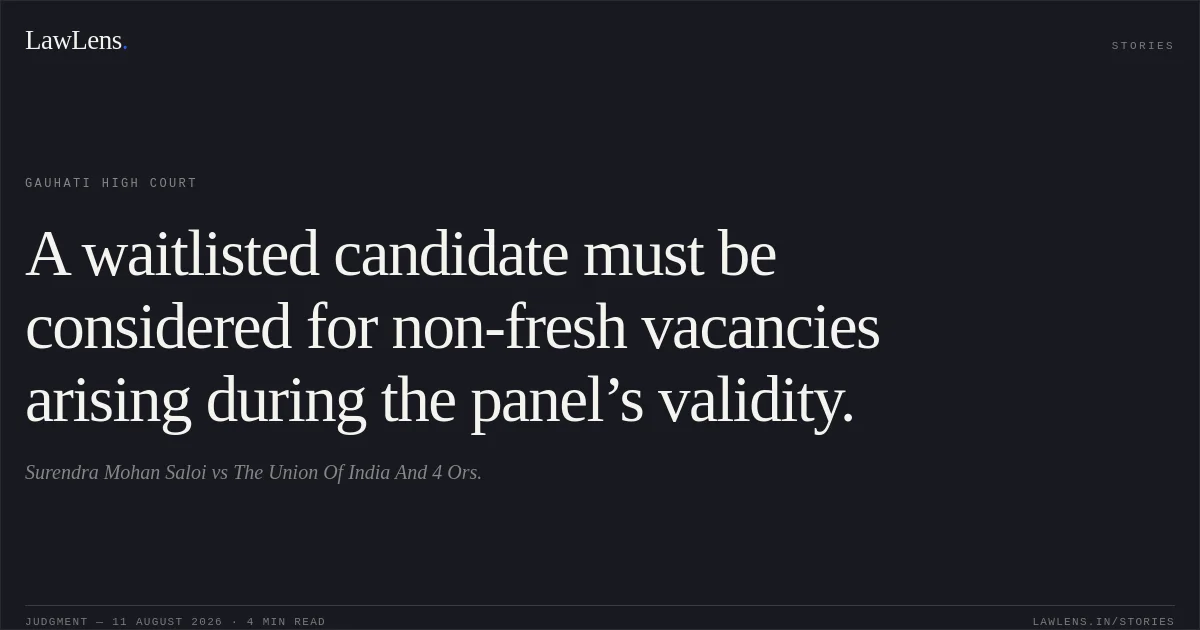
The Court held that the subsequent Assistant Registrar vacancy was not a freshly sanctioned post and could not, merely because of the quota rearrangement, be excluded from Clause 6.2.3.
The respondents were directed to constitute a review DPC within 60 days to examine whether the petitioner was eligible for consideration as the first waitlisted candidate under the earlier panel and the applicable eligibility criteria.
Source reference: p.27, paras. 26, 29If found eligible and entitled, the authorities were directed to grant him notional promotion/service benefits from the date on which the vacancy was identified, with no arrears or back wages; seniority, pay-scale enhancement and pensionary benefits were to follow as applicable.
Source reference: pp.27–28, paras. 26–30Respondent No. 7’s existing promotion was not to be disturbed, as it had not been specifically challenged.
Source reference: p.27, para. 27Both writ petitions were accordingly disposed of.
Source reference: no citationActs & Sections Cited
2 provisions across 2 statutes referred to in this judgment. Each provision opens on LawLens.
Institutes of Technology Act, 19611
Code of Criminal Procedure, 19731
Original Court PDF
Surendra Mohan SaloivsThe Union Of India And 4 Ors.
Click to open original judgment
Original judgment, available to read, download and summarize on LawLens.in