Facts
The petitioner, Shanti Devi, claimed to be the second wife of late Sukhdeo Bhaiya, a Class-III employee in the office of the Superintendent, Press and Forms, Gaya, who died in harness on 13 June 2012.
Source reference: p. 3–4, para. 6She asserted that the deceased’s first wife had died issueless in 1990 and that he thereafter married her in 1995, with four children born from the marriage.
Source reference: p. 3–4, para. 6The Accountant General issued a pension payment order and gratuity payment order in her favour on 19 March 2024, but the Superintendent of Press and Forms subsequently directed the Treasury Officer to stop family pension PPO No. 202412211666 and prevent withdrawals from the bank through Letter No. 140/स dated 16 July 2024.
Source reference: p. 2–4, paras. 5–6During the writ proceedings, Pagava Devi @ Pago Devi sought impleadment, claiming to be the deceased employee’s adopted daughter.
Source reference: p. 1–2, paras. 1–3Issues
Whether the petitioner, claiming to be the deceased employee’s second wife, could be denied family pension and other retiral benefits merely because the second marriage raised questions under the applicable service rules.
Source reference: p. 4–7, paras. 6–9Whether the administrative direction dated 16 July 2024 stopping the petitioner’s family pension and bank withdrawals could stand without determination of the legally entitled heirs and without authority of law.
Source reference: p. 2–4, 7–9, paras. 5, 9–11Whether the claim of Pagava Devi to be the deceased employee’s adopted daughter could be adjudicated in the writ proceedings or required determination by a competent civil court.
Source reference: p. 1–2, paras. 1–3Law Applied
The Court applied Rule 23 of the Bihar Government Service Conduct Rules, 1976, concerning restrictions on contracting a second marriage while a spouse is living, subject to the prescribed governmental permission.
Source reference: p. 4–5, para. 7It relied on Rameshwari Devi v. State of Bihar, AIR 2000 SC 735, for the principle that questions concerning a second marriage may be examined by departmental authorities for service-law purposes, although matrimonial status may ultimately require adjudication by a civil or matrimonial court.
Source reference: p. 5–6, para. 8The Court further held that a widow’s entitlement to family pension must be considered under the applicable pension rules, including Rule 23(2) as referred to in the judgment, and that a spouse who lived with and was cared for by the deceased could not be denied recognition merely because she was described as the second wife.
Source reference: p. 6–7, para. 9Relying on State of Jharkhand v. Jitendra Kumar Srivastava, AIR 2013 SC 3383, and the principles in D.S. Nakara v. Union of India, (1983) 1 SCC 305, and Deokinandan Prasad v. State of Bihar, (1971) 2 SCC 330, the Court reiterated that pension and gratuity are earned benefits and constitute property protected under Article 300-A; they cannot be withheld without statutory authority.
Source reference: p. 7–8, para. 10The Court also held that the disputed adoption claim could be decided only by a competent civil court.
Source reference: p. 1–2, paras. 1–3Reasoning
The Court noted that the petitioner’s status as the deceased employee’s second wife was admitted in the enquiry report and that the first wife had died before the petitioner’s marriage.
Source reference: p. 6–7, para. 9The petitioner had lived with the deceased for many years and had four children from the relationship.
Source reference: p. 6–7, para. 9Applying the relevant service and pension principles, the Court held that she could not, at her advanced age, be denied the status of spouse for family-pension consideration solely on the ground that she was the second wife.
Source reference: p. 6–7, para. 9At the same time, because competing claims existed, including the claim of an alleged adopted daughter, the Court did not conclusively determine the final entitlement of each claimant in the writ jurisdiction.
Source reference: p. 7–9, paras. 10–11It held that the competent authority must determine the legal heirs and release the admissible retiral dues in accordance with the applicable rules.
Source reference: p. 7–9, paras. 10–11The Court also found that pensionary benefits could not be stopped through an administrative direction unsupported by lawful authority, consistent with Article 300-A and Jitendra Kumar Srivastava.
Source reference: p. 7–9, paras. 10–11Holding
The Court rejected the impleadment application of Pagava Devi @ Pago Devi because the validity of her alleged adoption was a disputed question requiring adjudication by a competent civil court.
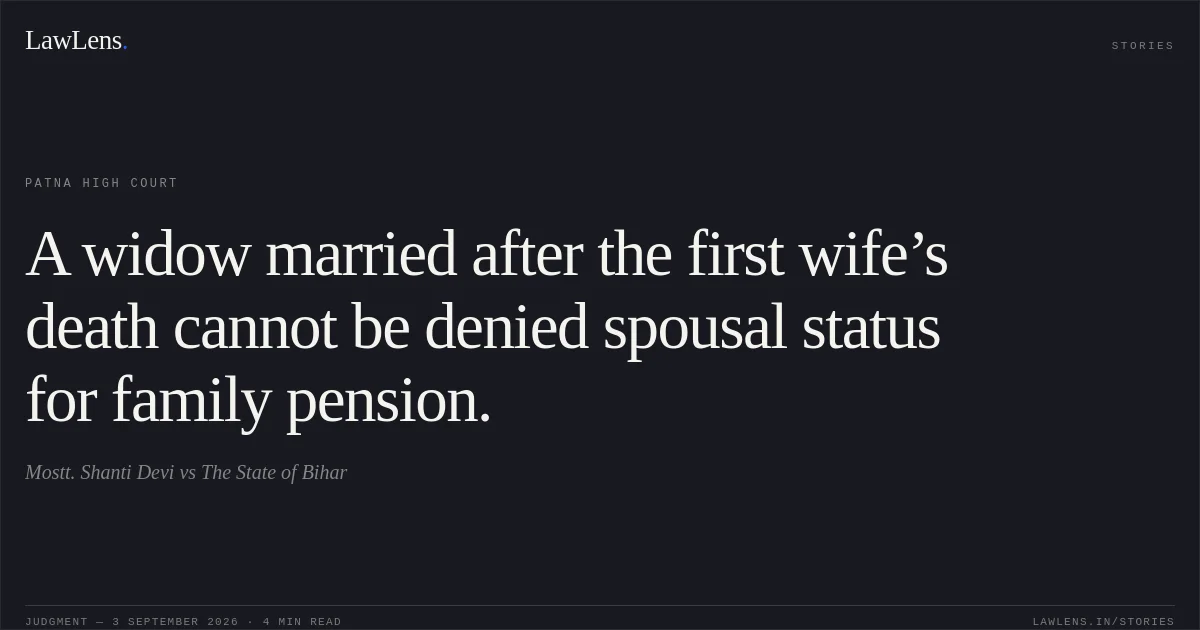
On the writ petition, the Court held that the petitioner’s claim as the deceased employee’s spouse could not be disregarded merely because she was the second wife, particularly where the first wife had died and the petitioner had lived with the deceased and had children with him.
Source reference: p. 6–7, para. 9However, instead of directing immediate payment exclusively to the petitioner, it directed the competent authority to determine the entitlement of all legal heirs and release the admissible pensionary and retiral dues in accordance with law.
Source reference: p. 8–9, para. 11The writ petition was accordingly disposed of.
Source reference: p. 9, para. 12Original Court PDF
Mostt. Shanti DevivsThe State of Bihar
Click to open original judgment
Original judgment, available to read, download and summarize on LawLens.in