Facts
The first respondent, the appellant’s wife, and their minor son sued for monthly maintenance, past arrears, a charge over the appellant’s property to secure those arrears, and an injunction against alienation.
Source reference: paras. 2–6The Sub Court awarded maintenance of ₹3,000 per month to the wife and ₹2,000 per month to the son, fixed past arrears at ₹1,20,000, and created a charge over the property. The first appellate court dismissed the appellant’s appeal.
Source reference: paras. 2–6In the second appeal, the appellant disputed the period for which maintenance was due and the continuation of the charge.
Source reference: paras. 2–6The High Court considered evidence that the wife and child had lived with the appellant’s family until December 2015, and noted that the appellant had paid ₹1,50,000 by demand draft during the appeal.
Source reference: paras. 9–11, 15–16Issues
Whether the plaintiffs were entitled to maintenance for the period from 1 November 2014 to 1 October 2016, or only from January 2016
Source reference: paras. 7, 9–11Whether the charge over the suit property should continue after payment of the original past-maintenance arrears
Source reference: paras. 7, 15–17What consequential relief and directions were appropriate concerning the outstanding amount, future maintenance, and possession of the property
Source reference: paras. 16–19Law Applied
The judgment identifies no specific maintenance statute, statutory provision governing the property charge, or precedent as the basis for its decision.
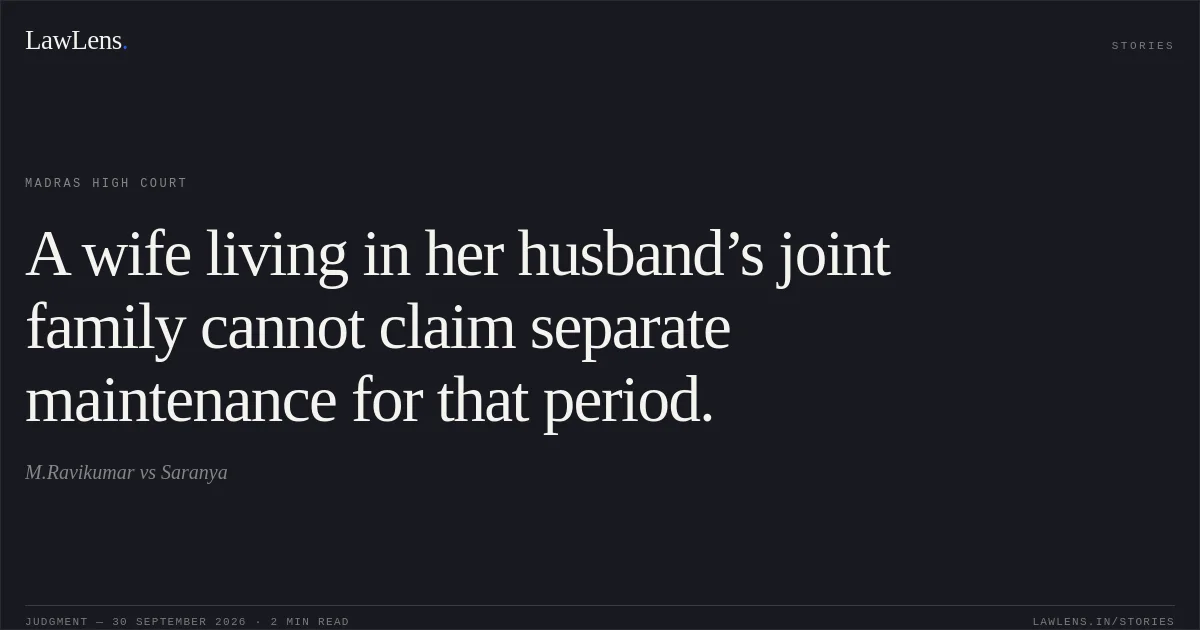
Source reference: paras. 9–11, 15–17It proceeds on the case-specific view that the wife was not entitled to separate maintenance for the period when she and the child lived with the husband’s family, and that maintenance was payable from January 2016 onwards.
Source reference: paras. 9–11It further holds that the charge created to secure the original arrears should be released once those arrears had been paid.
Source reference: paras. 15–17The appeal was brought under Section 100 of the Code of Civil Procedure, as stated in the prayer; the judgment does not separately discuss the provision’s governing test.
Source reference: prayer; para. 7Reasoning
The Court relied on the wife’s testimony and the judgment in the domestic-violence proceeding to find that she had lived with the appellant and his parents until February 2015, and assessed the surrounding evidence as supporting her continued residence with the in-laws until December 2015. It therefore rejected the claim to maintenance for the earlier period and held that maintenance was due from January 2016.
Source reference: paras. 9–11The Court calculated maintenance at ₹5,000 per month through 2026, added ₹19,499 in case expenses, and deducted the appellant’s ₹1,50,000 payment, leaving ₹5,29,499 payable. Because the charge secured the original arrears of ₹1,20,000, which the Court found had been paid, it ordered the charge released.
Source reference: paras. 11, 15–17Holding
The Court held that maintenance was payable from January 2016.
The second appeal was partly allowed. The Court directed the appellant to pay the balance of ₹5,29,499 by 30 October 2026, and ordered future annual maintenance of ₹60,000 to be paid in advance each January.
Source reference: paras. 16–20It directed release of the charge and required the wife to hand over the property keys by 30 October 2026, simultaneously with payment of the balance. It also stated that the son could live with the appellant and his mother if he wished.
Source reference: paras. 16–20Acts & Sections Cited
1 provisions across 1 statute referred to in this judgment. Each provision opens on LawLens.
Code of Civil Procedure, 19081
Original Court PDF
M.RavikumarvsSaranya
Click to open original judgment
Original judgment, available to read, download and summarize on LawLens.in