Facts
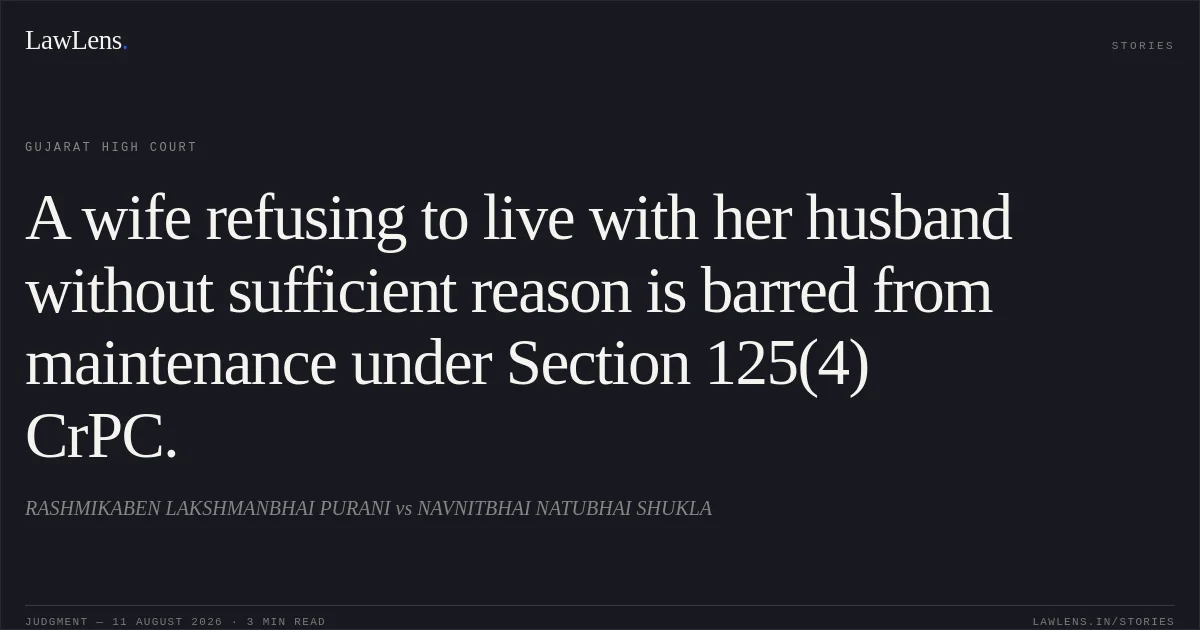
The applicants claimed that Applicant No. 1 married Respondent No. 1 on 10 February 2018 according to Hindu rites and thereafter resided with him at the matrimonial home. She alleged that Respondent No. 1 subjected her to mental and physical cruelty, compelling her to leave the matrimonial home and reside with her parents. She further asserted that Respondent No. 1, a teacher and professional singer, had sufficient means to maintain her and her minor son and claimed maintenance of ₹30,000 per month under Section 125 of the Code of Criminal Procedure, 1973 (“CrPC”).
Source reference: paras. 4.1, 7; pp. 2–3, 5The Family Court, Nadiad, found that the applicant had voluntarily left the matrimonial home, failed to prove cruelty or ill-treatment, and was residing separately without sufficient reason. It consequently rejected her application under Section 125 CrPC by order dated 3 December 2019 in Criminal Misc. Application No. 202 of 2019. The applicants challenged that order in revision under Sections 397 and 401 CrPC.
Source reference: paras. 2, 4.3; pp. 2, 4Issues
Whether the Family Court erred in holding that Applicant No. 1 had voluntarily left the matrimonial home and was residing separately without sufficient reason, thereby attracting the bar under Section 125(4) CrPC?
Source reference: paras. 12–15; pp. 10–13Whether the findings of the Family Court were perverse, illegal, or materially irregular so as to warrant interference by the High Court in its limited revisional jurisdiction under Sections 397 and 401 CrPC?
Source reference: paras. 9–10, 17–18; pp. 6–8, 14–15Whether the disputed divorce deed dated 20 March 2018 was required to be independently adjudicated for deciding the maintenance claim?
Source reference: para. 16; p. 14Law Applied
Section 125 CrPC is a measure of social justice intended to prevent destitution and vagrancy, but entitlement is subject to the statutory limitations in Section 125(4), under which a wife is disentitled to maintenance if she is living in adultery, refuses to live with her husband without sufficient reason, or the parties are living separately by mutual consent.
Source reference: paras. 11–11.2; pp. 9–10Under Sections 397 and 401 CrPC, revisional jurisdiction is supervisory and does not permit routine reappreciation of evidence or substitution of a different factual conclusion unless the impugned order suffers from perversity, patent illegality, jurisdictional error, material irregularity, or causes a gross miscarriage of justice. The Court relied on State of Kerala v. Puttumana Illath Jathavedan Namboodiri, (1999) 2 SCC 452, and Amit Kapoor v. Ramesh Chander, (2012) 9 SCC 460, for the limited scope of revisional jurisdiction.
Source reference: paras. 9–10, 9.1–9.2, 17–18; pp. 6–8, 14–15Reasoning
The High Court held that the Family Court had considered the oral and documentary evidence and had relied, inter alia, on the applicant’s admission that she did not return to the matrimonial home after leaving for her sister’s marriage.
Source reference: para. 12; p. 10The finding that she voluntarily remained at her parental home and declined to resume cohabitation, without establishing a sufficient reason, was therefore supported by the record and attracted Section 125(4) CrPC. The Court clarified that failure to prove cruelty does not automatically disentitle a wife to maintenance; the decisive question is whether the statutory conditions under Section 125(4) are established on the evidence in the particular case.
Source reference: paras. 13–15; pp. 12–13Since the Family Court’s conclusion was a possible and reasoned view of the evidence, reassessment of the evidence in revision was impermissible. The High Court also declined to independently determine the legal validity of the divorce deed, observing that rejection of the maintenance claim rested principally on the factual finding of voluntary separation and absence of sufficient cause.
Source reference: para. 16; p. 14Holding
The High Court answered the issues against the applicants. It held that the Family Court’s finding that Applicant No. 1 was living separately without sufficient reason was legally sustainable and attracted the bar under Section 125(4) CrPC. No perversity, patent illegality, jurisdictional error, or material irregularity was established to justify revisional interference.
The Criminal Revision Application was accordingly rejected, and the Family Court’s order dated 3 December 2019 dismissing the Section 125 CrPC maintenance application was confirmed. The rule was discharged and any interim relief was vacated.
Source reference: paras. 19–20; p. 15Acts & Sections Cited
4 provisions across 1 statute referred to in this judgment. Each provision opens on LawLens.
Code of Criminal Procedure, 19734
Original Court PDF
RASHMIKABEN LAKSHMANBHAI PURANIvsNAVNITBHAI NATUBHAI SHUKLA
Click to open original judgment
Original judgment, available to read, download and summarize on LawLens.in