Facts
The respondent-wife filed OP No. 1211 of 2025 before the Family Court, Malappuram, seeking a declaration of khula.
Source reference: para. 3The petitioner-husband filed a separate OP before the Family Court, Tirur, seeking to have the khula declared void, among other reliefs.
Source reference: para. 3In the wife’s proceeding, the husband sought to have the legal validity of khula tried as a preliminary issue, to produce documents and examine witnesses, and to keep the proceeding in abeyance. The Family Court dismissed those applications.
Source reference: para. 4Although the husband had filed a counter, he had not filed a sworn statement despite several postings.
Source reference: para. 10He challenged the dismissal orders before the High Court.
Source reference: no citationIssues
Whether a detailed inquiry, including the opportunity for the husband to adduce evidence, is required when a Family Court is asked to endorse an extrajudicial khula and declare the parties’ marital status.
Source reference: paras. 10–11Whether the Family Court’s dismissal of the husband’s applications for a preliminary issue, evidence, and abeyance warranted interference.
Source reference: paras. 10, 15Law Applied
Under Section 7(d) of the Family Courts Act, 1984, the Family Court may declare a person’s matrimonial status.
Source reference: no citationIn X and Others v. Y and Others [2021 (2) KLT 967], the Kerala High Court held that khula is valid where there is (i) the wife’s declaration repudiating or terminating the marriage, (ii) an offer to return the dower or other material gain received during the marriage, and (iii) an effective attempt at reconciliation before the declaration.
Source reference: para. 12Asbi K.N. v. Hashim M.U. [2021 (6) KLT 292], following X, prescribes a summary inquiry: after notice, the Family Court considers the parties’ statements and any relevant khula nama or communication, and, on prima facie satisfaction of a valid pronouncement and the applicable requirements, declares the parties’ status without further inquiry.
Source reference: para. 13Sudheer v. Surumiya [2024 KHC OnLine 1269] and Muhammed Ashar K. v. Muhsina P.K. [2025 (7) KHC 119] reaffirmed that limited scope.
Source reference: para. 12The Court distinguished Shamim Ara v. State of U.P. [2002 (3) KLT 537] and Shayara Bano v. Union of India [2017 (4) KHC SN 19] as concerning instantaneous/triple talaq, rather than khula.
Source reference: para. 12Reasoning
The Court held that the authorities relied on by the husband did not require a full trial in a proceeding seeking endorsement of khula: the Supreme Court decisions concerned triple talaq, while X and Asbi specifically addressed khula and limited the Family Court’s inquiry.
Source reference: para. 12The husband’s right to challenge the effectiveness of the khula remained available through an appropriate proceeding, but did not entitle him to convert the endorsement proceeding into a detailed evidentiary inquiry.
Source reference: paras. 11–12The Court also noted that he had not filed a sworn statement in the Family Court despite repeated opportunities.
Source reference: para. 10It therefore found no basis to disturb the challenged orders.
Source reference: para. 15Holding
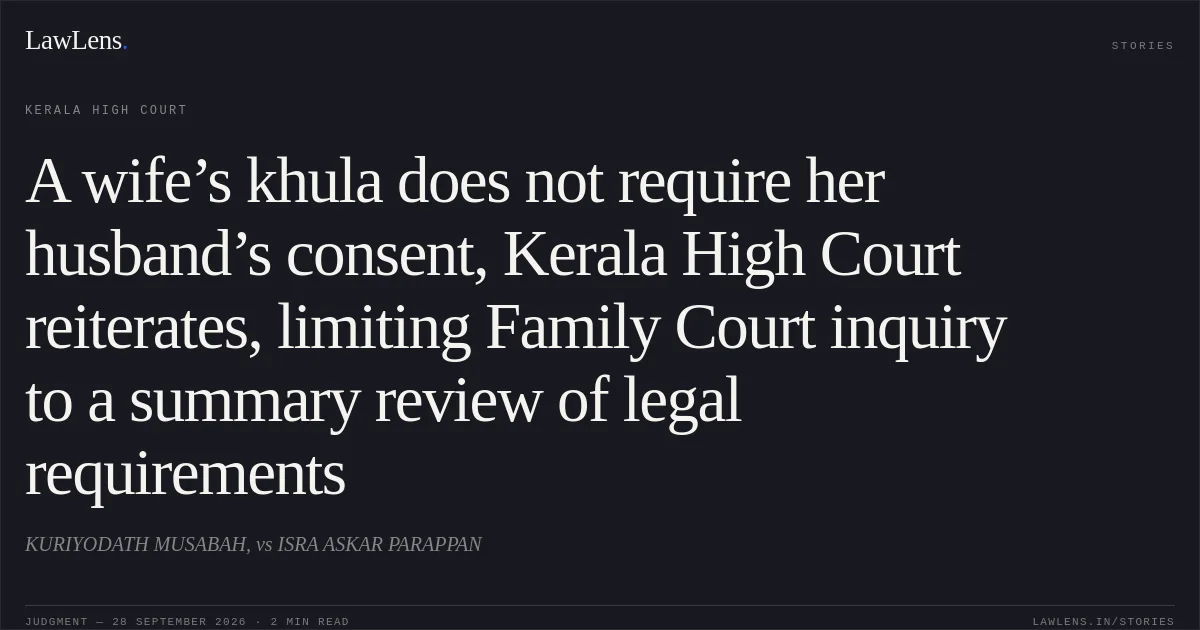
The Court held that a detailed inquiry is neither essential nor desirable in a proceeding for endorsement of an extrajudicial divorce; the Family Court need only consider whether the three requirements identified in X have been met.
It dismissed the original petition and declined to interfere with the Family Court’s orders.
Source reference: para. 15Acts & Sections Cited
1 provisions across 1 statute referred to in this judgment. Each provision opens on LawLens.
Family Courts Act, 19841
Original Court PDF
KURIYODATH MUSABAH,vsISRA ASKAR PARAPPAN
Click to open original judgment
Original judgment, available to read, download and summarize on LawLens.in