01Facts
The revisionist’s marriage with respondent no. 2 was solemnised on 17 February 2002. A son was born in 2003 and was subsequently given in adoption to the revisionist’s elder brother; a daughter, respondent no. 3, was born in 2005.
¶ 2Owing to matrimonial discord, respondent no. 2 and the minor daughter began residing separately from the revisionist from 29 May 2014. They instituted proceedings under Section 125 Cr.P.C. in 2015 alleging neglect and failure to maintain them.
¶ 2The Principal Judge, Family Court, Dehradun, by order dated 23 September 2019, awarded maintenance of ₹12,500 per month each to respondent nos. 2 and 3 from the date of judgment.
¶ 3The revisionist challenged the order, contending that the amount was excessive, that his income had ceased from 2022, and that respondent no. 2 was educated and had subsequently obtained contractual employment through UPNL.
¶ 4Respondent no. 2 relied on the revisionist’s income-tax returns, which disclosed an average annual income of approximately ₹20,00,000 during the financial years 2018–2019 to 2020–2021.
¶ 502Issues
i.1. Whether the maintenance of ₹12,500 per month awarded to each respondent under Section 125 Cr.P.C. was excessive or disproportionate to the revisionist’s income and financial capacity.
¶ 4–7ii.2. Whether the revisionist’s assertion that he had ceased earning from 2022 justified interference with the maintenance order.
¶ 7iii.3. Whether respondent no. 2’s educational qualifications and subsequent contractual employment disentitled her from receiving maintenance.
¶ 8iv.4. Whether the Family Court’s order disclosed any illegality or perversity warranting interference in revisional jurisdiction.
¶ 1003Law Applied
Section 125 Cr.P.C. is intended to prevent destitution and vagrancy and to secure basic subsistence for a wife and minor child.
¶ 9The quantum of maintenance must be assessed with reference to the husband’s income and financial capacity, the needs of the wife and child, their standard of living, and the surrounding circumstances.
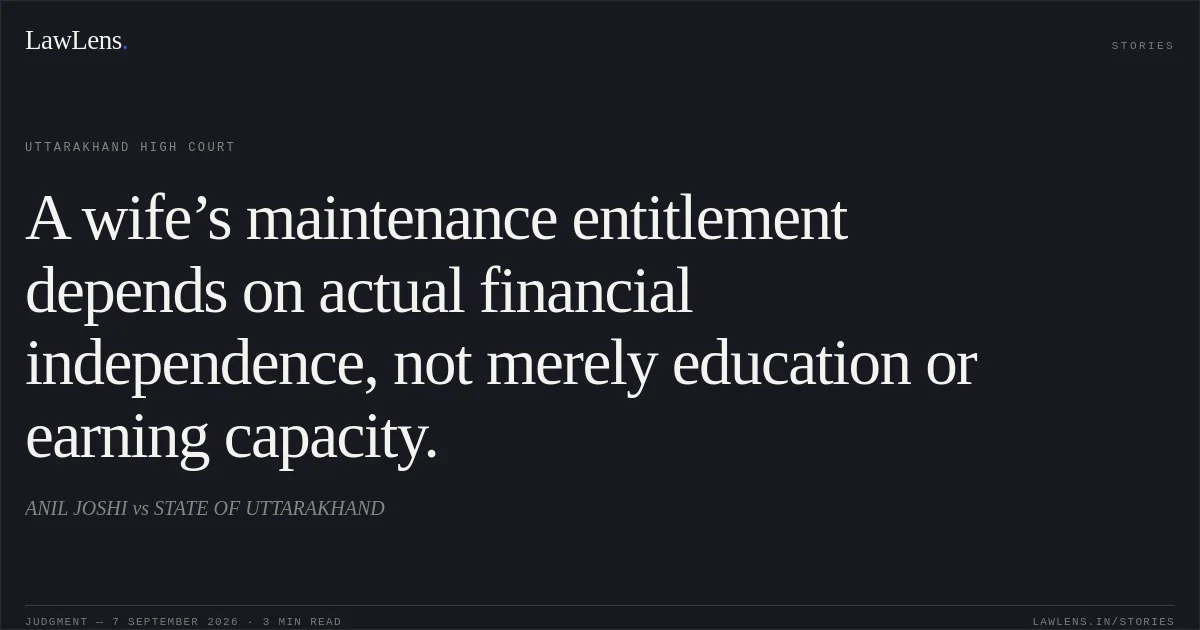
¶ 9Mere educational qualification of a wife does not, by itself, disentitle her to maintenance; the relevant consideration is whether she has sufficient actual and independent income to maintain herself.
¶ 8A subsequent change in the financial circumstances of either party may support an application for alteration of maintenance in appropriate proceedings, but does not automatically invalidate an order validly made on the material available before the court.
¶ 8The Court also considered the disclosure of financial information in accordance with the principles referred to in Rajnesh v. Neha, (2021) 2 SCC 324.
¶ 5Provisions in the judgment · 1 · Linked ones open on LawLens
Code of Criminal Procedure, 1973 Section 125
04Reasoning
The revisionist’s income-tax returns showed an average annual income of approximately ₹20,00,000, equivalent to about ₹1,66,000 per month. Against this income, maintenance of ₹12,500 per month each for the wife and daughter was not excessive or disproportionate, particularly because respondent no. 2 was maintaining herself and the minor daughter.
¶ 6The assertion that the revisionist had stopped earning from 2022 was unsupported by cogent and reliable material establishing a substantial and permanent change in financial circumstances; therefore, it could not discharge his statutory obligation to maintain the respondents.
¶ 7The relevant assessment was the revisionist’s financial position during the pendency and adjudication of the Section 125 proceedings, including changes up to disposal of the application.
¶ 7Similarly, respondent no. 2’s education did not establish actual financial independence. Her subsequent contractual employment through UPNL in 2021 was a later development and did not render the 2019 order legally unsustainable, though such changed circumstances could be raised in appropriate proceedings for alteration of maintenance.
¶ 8The Family Court’s determination was consequently neither perverse nor unsupported by the record.
¶ 1005Holding
The High Court held that the maintenance awarded to respondent nos. 2 and 3 was neither excessive nor disproportionate, and that the revisionist failed to prove any substantial change in circumstances warranting reduction.
¶ 10–11The Court further held that respondent no. 2’s educational qualifications and subsequent contractual employment did not invalidate the maintenance order.
¶ 10–11Finding no illegality or perversity in the Family Court’s order dated 23 September 2019, the Court dismissed the criminal revision and affirmed maintenance of ₹12,500 per month each for respondent nos. 2 and 3.
¶ 10–11Original Court PDF
ANIL JOSHIvsSTATE OF UTTARAKHAND
Click to open original judgment
Original judgment, available to read, download and summarize on LawLens.in