Facts
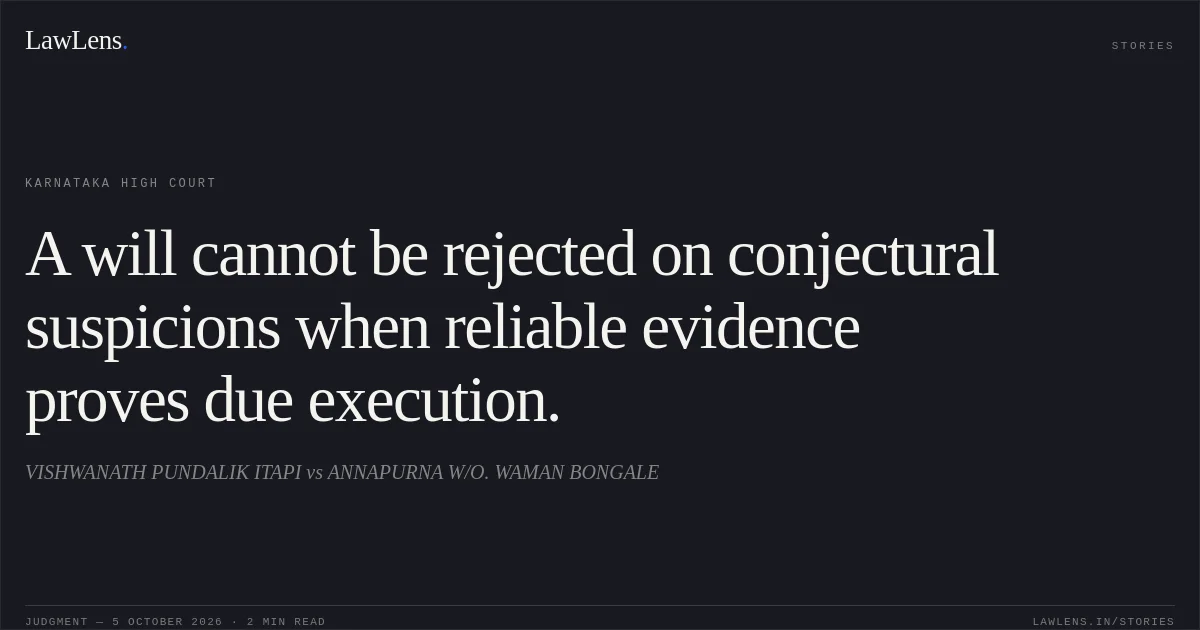
The plaintiff, a daughter of Wasudev, sought partition of several properties, including 11 acres 35 guntas in Survey No. 643/1.
Source reference: pp. 3–15, 36–39She claimed that the land had been purchased with proceeds from the sale of family property; the courts below found that it was Wasudev’s self-acquired property.
Source reference: pp. 3–15, 36–39Wasudev’s grandsons and another grandson claimed under two registered Wills executed by him on the same day, which divided the land between them.
Source reference: pp. 3–15, 36–39The trial court accepted the Wills and dismissed the partition claim concerning this property.
Source reference: pp. 3–15, 36–39The First Appellate Court found the Wills surrounded by suspicious circumstances and awarded the plaintiff a 1/5 share.
Source reference: pp. 3–15, 36–39The grandsons appealed, challenging that reversal.
Source reference: pp. 3–15, 36–39Issues
Whether the First Appellate Court was justified in treating the reasons it identified as grounds to suspect the valid execution of the Wills.
Source reference: para. 16, p. 10Whether the appellants had discharged their burden of proving the valid execution of the Wills.
Source reference: para. 16, p. 10Whether the First Appellate Court was right to reverse the trial court’s findings on the facts.
Source reference: para. 16, p. 10Law Applied
Under Section 63 of the Indian Succession Act, 1925, a Will must be executed and attested as prescribed; Section 68 of the Indian Evidence Act, 1872 requires an attesting witness to be called to prove its execution, where one is available and capable of giving evidence.
Source reference: paras. 25–38, pp. 17–30The propounder bears the initial burden of proving execution and, where legitimate suspicious circumstances arise, must remove them to the court’s satisfaction.
Source reference: paras. 25–38, pp. 17–30Suspicion must be real and grounded in the case, not conjectural.
Source reference: paras. 25–38, pp. 17–30The Court relied principally on Shivakumar v. Sharanabasappa, which summarised these principles, and also referred to Kalyan Singh v. Chhoti, Madhukar D. Shende v. Tarabai Aba Shedage, and Leela v. Muruganantham.
Source reference: paras. 25–38, pp. 17–30Registration alone does not prove a Will, though the Court treated the registration endorsements as relevant corroborative evidence in this case.
Source reference: paras. 25–38, pp. 17–30Reasoning
The Court held that the propounders discharged their burden through the testimony of two attesting witnesses and the scribe, who supported execution, attestation, and presentation for registration; the Wills also bore the testator’s photograph and signature and contained the Sub-Registrar’s endorsements.
Source reference: paras. 27–30, 39–54, pp. 19–49The plaintiff and the supporting defendant had not pleaded or proved most of the alleged suspicious circumstances, and the evidence did not establish that the testator was mentally or physically incapable of executing the Wills.
Source reference: paras. 27–30, 39–54, pp. 19–49The Court found that executing two Wills on the same day for separate portions and beneficiaries was not inherently suspicious; nor did exclusion of the testator’s children, the witnesses’ connections, the recitals, or minor testimonial discrepancies, in the circumstances, justify rejecting the documents.
Source reference: paras. 27–30, 39–54, pp. 19–49It concluded that the First Appellate Court relied substantially on conjecture and misread the evidence.
Source reference: paras. 27–30, 39–54, pp. 19–49Holding
The Court answered the first and third substantial questions of law in the negative and the second in the affirmative.
It allowed the appeal, set aside the First Appellate Court’s decree insofar as it awarded the plaintiff a 1/5 share in Survey No. 643/1, and confirmed the trial court’s decree concerning that property.
Source reference: para. 56, pp. 50–51Acts & Sections Cited
3 provisions across 3 statutes referred to in this judgment. Each provision opens on LawLens.
Code of Civil Procedure, 19081
Indian Succession Act, 19251
Registration Act, 19081
Original Court PDF
VISHWANATH PUNDALIK ITAPIvsANNAPURNA W/O. WAMAN BONGALE
Click to open original judgment
Original judgment, available to read, download and summarize on LawLens.in