Facts
The plaintiffs, the wife and daughter of Kunjupillai Nadar, claimed rights in the suit properties principally under a registered Will dated 19 December 1995 (Ex.A3).
Source reference: para. 2–4The defendants denied that Will and relied on a settlement deed dated 1 March 1996 (Ex.B2), which they said Kunjupillai Nadar had executed in their favour.
Source reference: para. 2–4The plaintiffs alleged that Ex.B2 was forged or obtained by impersonation and also sought damages for alleged removal of trees and building materials.
Source reference: para. 2–4The trial court dismissed the suit, and the first appellate court affirmed.
Source reference: para. 2–4Issues
Whether examination of one attesting witness was sufficient to prove due execution of Ex.A3 under Section 68 of the Indian Evidence Act, 1872, read with Section 63 of the Indian Succession Act, 1925.
Source reference: para. 4(i)Whether Ex.B2 was invalid or not binding on the plaintiffs where it included property allegedly gifted by Ponnachi to the second plaintiff and Thangaswami, which Kunjupillai Nadar did not own.
Source reference: para. 4(ii)Law Applied
Under Section 63 of the Indian Succession Act, 1925, a Will must be executed and attested in the prescribed manner; under Section 68 of the Indian Evidence Act, 1872, at least one attesting witness must ordinarily be called to prove its execution.
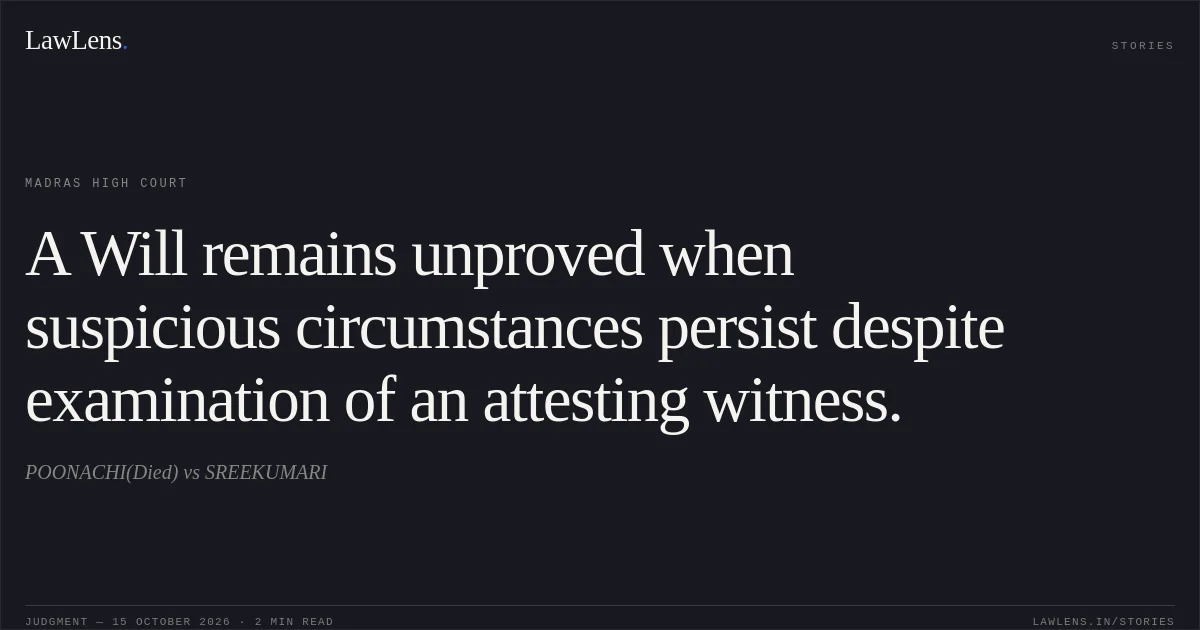
Source reference: para. 6Although one attesting witness may suffice, the propounder must also dispel legitimate suspicious circumstances surrounding the Will.
Source reference: para. 6A party alleging forgery or impersonation bears the burden of proving that allegation.
Source reference: para. 6Further, an executant can convey only the right, title and interest that the executant lawfully possesses.
Source reference: para. 6In a second appeal under Section 100 CPC, concurrent factual findings are not to be disturbed absent perversity or illegality.
Source reference: para. 6Reasoning
The Court accepted that one attesting witness had been examined, but held that proof of the testator’s thumb impression alone did not resolve the suspicious circumstances surrounding Ex.A3.
Source reference: para. 7–10The unexplained change from the disposition in the earlier Will, together with the unsatisfactory evidence concerning the execution, meant the plaintiffs had not proved Ex.A3 as Kunjupillai Nadar’s last valid Will.
Source reference: para. 7–10The plaintiffs also failed to establish forgery or impersonation in relation to Ex.B2, including after being given an opportunity to obtain expert examination.
Source reference: para. 11–12However, the Court considered the circumstances surrounding Ex.B2—including Ponnachi’s absence from the registration office and the lack of satisfactory evidence about Kunjupillai Nadar’s health and physical condition—to create serious suspicion about its genuineness and voluntary execution.
Source reference: para. 13–15, 20–21In any event, Ex.B2 could not transfer property Kunjupillai Nadar did not own.
Source reference: para. 13–15, 20–21The alleged damage was not established by satisfactory evidence of the damage or its value.
Source reference: para. 17–18Holding
The Court answered the substantial questions against the plaintiffs insofar as their claim for relief was concerned, held that they had not established entitlement under Ex.A3, and found that the defendants could not claim rights under Ex.B2 as a valid disposition or over property Kunjupillai Nadar did not own.
It dismissed the second appeal, confirmed the dismissal of the suit, and left the parties to their respective rights, if any, under the earlier disposition, subject to its legal validity and enforceability.
Source reference: para. 23–24No costs; connected miscellaneous petitions were closed.
Source reference: para. 23–24Acts & Sections Cited
2 provisions across 2 statutes referred to in this judgment. Each provision opens on LawLens.
Code of Civil Procedure, 19081
Indian Succession Act, 19251
Original Court PDF
POONACHI(Died)vsSREEKUMARI
Click to open original judgment
Original judgment, available to read, download and summarize on LawLens.in