Facts
The petitioners challenged the order dated 13 June 2023 directing them and similarly situated teachers to undergo medical-board examination for verification of their disability certificates.
Source reference: paras. 4–6After pleadings had been completed, petitioner No. 2, Smt. Nisha Tyagi, sought amendment of the writ petition and impleadment of Ms. Nikita Bhargava.
Source reference: paras. 7–9Petitioner No. 1 separately sought withdrawal of the writ petition.
Source reference: para. 2Issues
Whether the principles underlying Order VI Rule 17 of the Code of Civil Procedure apply while considering amendment applications in proceedings under Article 226 of the Constitution?
Source reference: paras. 10–13Whether petitioner No. 2’s proposed amendment, introducing a merit-based claim founded on the comparative ranking and appointment of another candidate, was necessary for determining the controversy in the original writ petition?
Source reference: paras. 17–25Whether the amendment could be permitted after completion of pleadings without causing prejudice to the respondents or substantially altering the nature and scope of the writ petition?
Source reference: paras. 26–34Whether petitioner No. 2 should be left to pursue the proposed independent appointment claim in a separate proceeding?
Source reference: paras. 35–37Law Applied
The Court held that the Code of Civil Procedure does not strictly apply to proceedings under Article 226, but the High Court may keep in view the principles underlying relevant CPC provisions, including Order II Rules 1 and 2 and Order VI Rule 17.
Source reference: paras. 11–12Chapter X Rule 23 of the High Court of Madhya Pradesh Rules, 2008 also requires an Article 226 petition, as far as possible, to conform to Order II Rules 1, 2 and 3 of the CPC and to disclose the challenged order or cause of action, material facts, grounds and relief.
Source reference: para. 13Relying on Smt. Reshma Philip v. State of M.P., W.A. No. 319/2008, decided on 1 April 2008, the Court recognised that amendments may be permitted where they are necessary to determine the real controversy and do not alter the basic nature of the proceedings.
Source reference: paras. 11, 26Under Revajeetu Builders & Developers v. Narayanaswamy & Sons, (2009) 10 SCC 84, and M. Revanna v. Anjanamma (Dead) by LRs., (2019) 4 SCC 332, the Court must consider the necessity of the amendment, whether it changes the nature and character of the case, the stage at which it is sought, and the prejudice likely to be caused to the opposite party.
Source reference: paras. 15–16An amendment introducing a substantially different factual foundation, cause of action or relief after completion of pleadings is not claimable as of right.
Source reference: paras. 14, 16Reasoning
The original writ petition concerned the legality of directing already appointed petitioners to undergo re-medical examination and the procedure governing any consequential action against their appointments.
Source reference: paras. 18–19The proposed amendment was not merely clerical or explanatory. It introduced precise facts regarding petitioner No. 2’s merit position, the lower ranking of Ms. Bhargava and her subsequent appointment, and sought to establish an independent right to appointment on comparative merit.
Source reference: paras. 17–22Determining that claim would require examination of matters not arising from the original controversy, including recruitment rules, category-wise merit, vacancies, the basis of Ms. Bhargava’s appointment and her legal interests.
Source reference: paras. 23–25Unlike Reshma Philip, where the amendment concerned a subsequent order arising from the same controversy, the proposed amendment here altered the factual foundation and substantially enlarged the cause of action.
Source reference: paras. 26–29Since the respondents’ reply and the petitioner’s rejoinder had already been filed, permitting the amendment would require reopening the pleadings and would prejudice the respondents by obliging them to answer a new claim.
Source reference: paras. 30–34The Court therefore held that the proposed merit-based claim was better pursued in a separately constituted proceeding in which all necessary parties and issues could be considered.
Source reference: paras. 35–37Holding
The Court allowed I.A. No. 6046/2023 and dismissed the writ petition as withdrawn insofar as petitioner No. 1 was concerned.
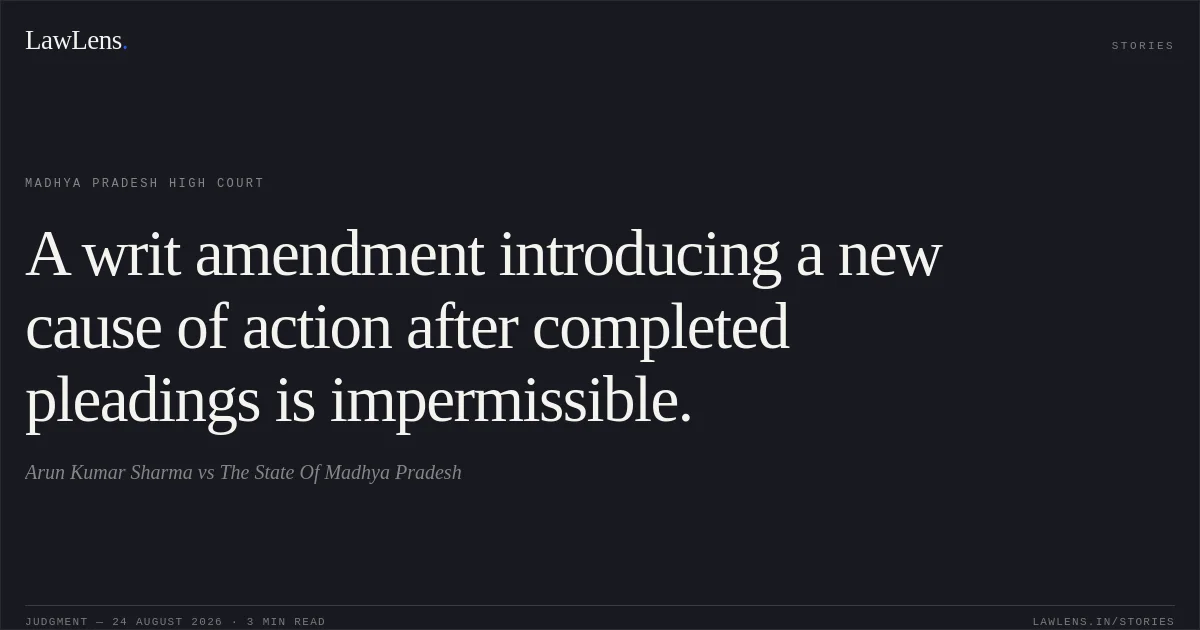
It rejected petitioner No. 2’s amendment application, I.A. No. 10833/2026, the earlier amendment application, I.A. No. 9835/2023, and the impleadment application, I.A. No. 10843/2026, holding that the proposed amendment would introduce a new and substantially different merit-based claim after completion of pleadings.
Source reference: para. 39The Court expressly left the merits, maintainability, delay and laches, necessary-party questions and entitlement to relief open, and granted petitioner No. 2 liberty to file a fresh and properly constituted petition.
Source reference: paras. 36–37, 40–41Pending interlocutory applications were disposed of.
Source reference: para. 42Original Court PDF
Arun Kumar SharmavsThe State Of Madhya Pradesh
Click to open original judgment
Original judgment, available to read, download and summarize on LawLens.in
![Courts will not interfere with transfers absent mala fides or violation of statutory rules.. M Ramya vs EMPLOYEES STATE INSURANCE CORPORATION (ESIC). CAT - ['Chennai']. LawLens](/stories/thumbnails/courts-will-not-interfere-with-transfers-absent-mala-fides-or-violation-of-statutory-rules-a6845e9ca6f548fca284c51c8351957f.webp)
![Courts cannot direct one-time recruitment age relaxation absent authority in the governing rules or advertisement.. UT OF PUDUCHERRY vs M ANDAL. CAT - ['Chennai']. LawLens](/stories/thumbnails/courts-cannot-direct-one-time-recruitment-age-relaxation-absent-authority-in-the-governing-895d78fde47143e2a8ed0207c4b6a44f.webp)
![A review cannot correct an allegedly erroneous decision absent an error apparent on the record.. Ajit Kumar Jha vs RAILWAY BOARD. CAT - ['Delhi']. LawLens](/stories/thumbnails/a-review-cannot-correct-an-allegedly-erroneous-decision-absent-an-error-apparent-on-the-re-8ac952fd4eba470c92f7da20af72a220.webp)