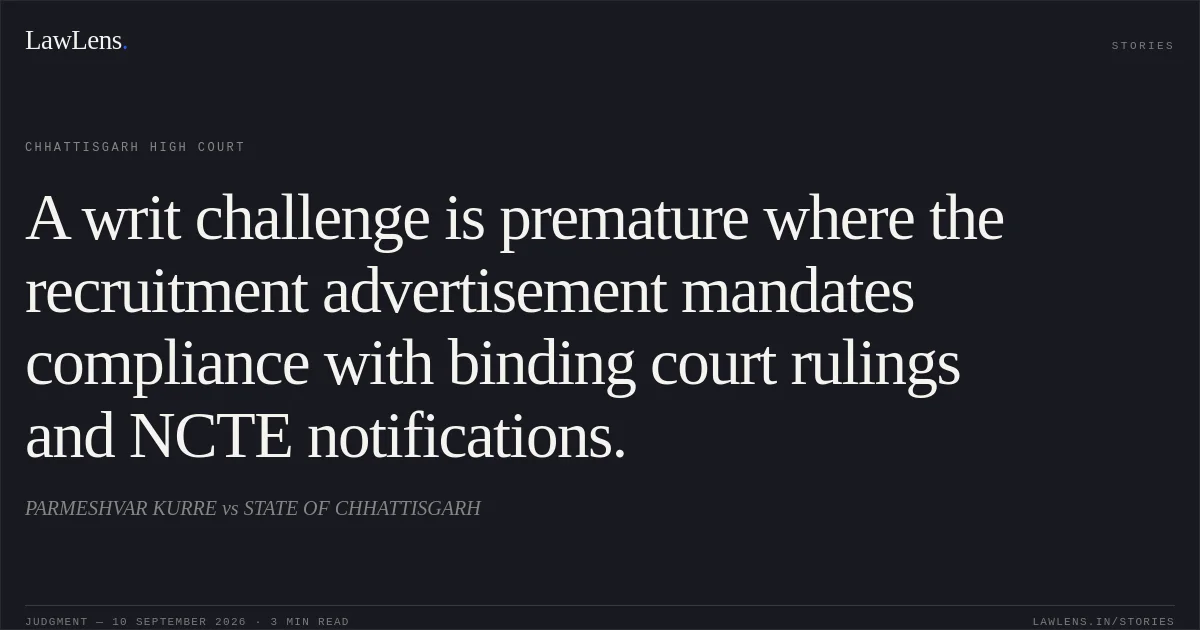
Facts
The petitioner, belonging to a reserved category, challenged the advertisement dated 16 April 2026 issued by the Directorate of Public Instructions for recruitment to the post of Assistant Teacher.
Source reference: paras. 1–2(b); pp. 2–5The petitioner alleged that the advertisement and the corresponding online application portal failed to expressly provide the 5% relaxation in minimum educational qualifications available to SC/ST/OBC candidates under the applicable legal framework.
Source reference: paras. 1–2(b); pp. 2–5The petitioner relied upon the NCTE notification dated 29 July 2011, the provisions of the Right of Children to Free and Compulsory Education Act, and the Division Bench judgment in W.A. No. 501 of 2022, Abhishek Kumar Nirmalkar v. State of Chhattisgarh & Others, decided on 10 February 2023, particularly paragraph 51, which recognised the entitlement of SC/ST/OBC candidates to a 5% relaxation in academic qualifications.
Source reference: para. 2(a), (e); pp. 3, 5–6The State contended that the petition was premature because the advertisement itself stated that applicable NCTE notifications and judicial decisions would be followed.
Source reference: para. 3; p. 6Issues
Whether the advertisement dated 16 April 2026 was legally defective for not expressly incorporating the 5% relaxation in minimum educational qualifications for SC/ST/OBC candidates applying for the post of Assistant Teacher?
Source reference: paras. 1–2(e); pp. 2–6Whether the petitioner had an existing cause of action when the advertisement expressly required compliance with applicable NCTE notifications and judicial decisions, including the law declared in W.A. No. 501 of 2022?
Source reference: paras. 3–5; pp. 6–7Whether the respondents should be directed to treat the petitioner at par with candidates from the 2019 recruitment cycle who were granted the alleged relaxation?
Source reference: para. 1; pp. 2–3Law Applied
The Court applied the legal framework governing eligibility for teacher recruitment under the Right of Children to Free and Compulsory Education Act and the NCTE notification dated 29 July 2011, including the requirement that applicable relaxations in minimum educational qualifications be honoured.
Source reference: paras. 2(a), 2(e), 5; pp. 3, 5–7It also relied upon the binding law declared by the Division Bench in W.A. No. 501 of 2022, Abhishek Kumar Nirmalkar v. State of Chhattisgarh & Others, particularly the principle that SC/ST/OBC candidates are entitled to a 5% relaxation in academic qualifications.
Source reference: para. 2(e); p. 6The Court further applied the principle that a writ petition must disclose an existing and enforceable cause of action; a challenge based only on an apprehension that the recruiting agency may not comply with binding law is premature.
Source reference: paras. 3–5; pp. 6–7Reasoning
The Court noted that the advertisement contained a specific stipulation that the prescribed educational qualifications would be governed by applicable NCTE notifications and the law laid down by the courts.
Source reference: paras. 3, 5; pp. 6–7Consequently, the recruiting agency was bound to apply the 5% relaxation recognised in the NCTE framework and in W.A. No. 501 of 2022, notwithstanding the petitioner’s contention that the relaxation was not separately and expressly reproduced in the advertisement or online portal.
Source reference: paras. 2(b), 2(e), 5; pp. 4–6Since the petitioner had not shown that the respondents had actually rejected or denied the benefit of the relaxation, the Court held that no present cause of action had arisen.
Source reference: paras. 3–5; pp. 6–7The challenge was therefore based on a future apprehension of non-compliance rather than an existing violation of legal or constitutional rights.
Source reference: paras. 3–5; pp. 6–7Holding
The writ petition was disposed of as premature.
The Court observed that the recruiting agency was bound to strictly comply with the applicable NCTE notification and the law declared in W.A. No. 501 of 2022, including the recognised relaxation for eligible reserved-category candidates.
Source reference: para. 5; p. 7No immediate modification of the advertisement or direction for parity with the 2019 recruitment cycle was issued.
Source reference: para. 5; p. 7However, the petitioner was granted liberty to approach the Court afresh if the recruiting agency subsequently failed to apply the applicable relaxation and a concrete cause of action arose.
Source reference: para. 5; p. 7Original Court PDF
PARMESHVAR KURREvsSTATE OF CHHATTISGARH
Click to open original judgment
Original judgment, available to read, download and summarize on LawLens.in
![Respondents must decide promotion representations by a reasoned speaking order within four weeks.. quasar shafi vs SOCIAL WELFARE. CAT - ['Srinagar']. LawLens](/stories/thumbnails/respondents-must-decide-promotion-representations-by-a-reasoned-speaking-order-within-four-8a34c8fac3e74d9d9cf41fca9f207d29.webp)