Facts
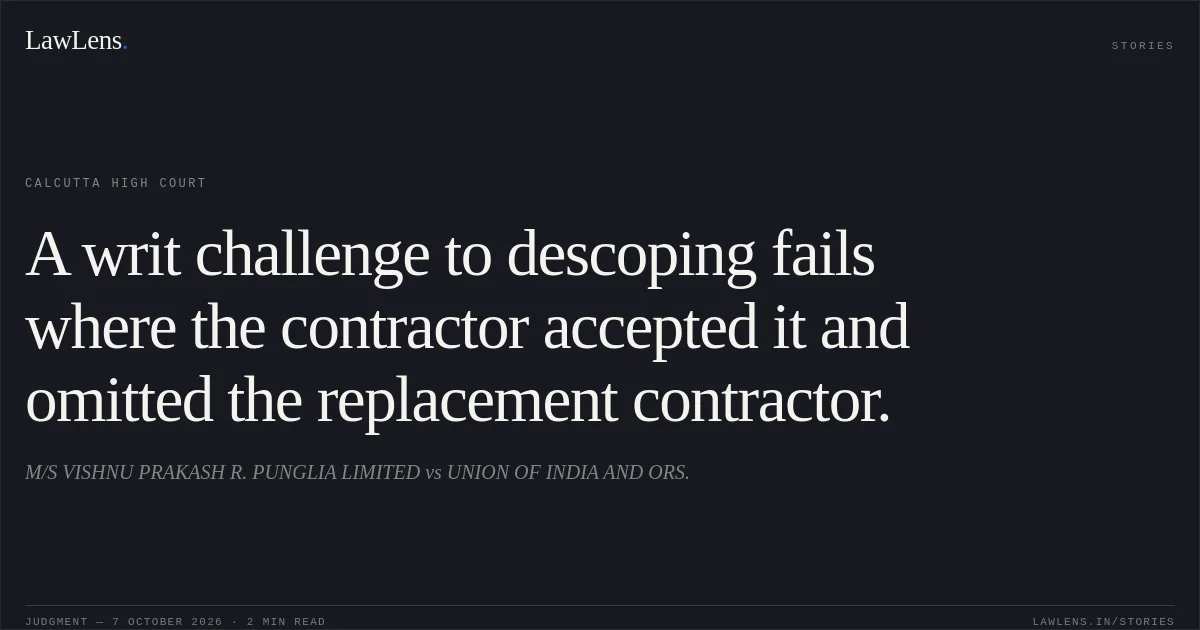
BHEL awarded the petitioner a contract for civil, structural and architectural works at the 1×800 MW NTPC Sipat Project.
Source reference: para. 3–8, 25Following concerns about progress, BHEL issued notices and partially withdrew (“descoped”) portions of the work under Clauses 2.7.1 and 2.7.2 of the General Conditions of Contract (GCC), subsequently seeking recovery of alleged differential costs.
Source reference: para. 3–8, 25The petitioner challenged the descoping decisions and consequential recovery demand, alleging, among other things, that the respondents had not considered its replies or complied with the contractual notice requirements.
Source reference: para. 1, 5–9BHEL relied on the contractual progress-monitoring provisions and the petitioner’s performance records; it also contended that the petitioner had requested permission to remove materials after the descoping and had not joined or challenged the third party to whom the withdrawn work was awarded.
Source reference: para. 11–12, 17–19The Court dismissed the writ petition.
Source reference: para. 30Issues
Whether BHEL’s partial withdrawal of the petitioner’s work and consequential recovery action disclosed illegality warranting interference under writ jurisdiction.
Source reference: para. 1, 5–9, 23–25Whether the petitioner’s conduct after the descoping orders, and its failure to join or challenge the third-party award, affected its challenge to those orders.
Source reference: para. 27–29Law Applied
The Court considered GCC Clause 2.7.1, which reserves BHEL’s right, in specified circumstances, to withdraw or restrict work and have it performed through other agencies, and Clause 2.7.2, which identifies contractual breaches and provides for notice and an opportunity to remedy the breach within 14 days before recourse to contractual remedies.
Source reference: para. 23–25It also considered Clause 2.9, which provides for agreed work programmes, periodic progress reviews, recording of shortfalls and the contractor’s burden to show that shortfalls were not attributable to it.
Source reference: para. 26BHEL cited Section 20A and Section 41(ha) of the Specific Relief Act, 1963, and authorities concerning infrastructure projects, contractual disputes and interim relief; these were recorded as the respondents’ submissions.
Source reference: para. 13–16The Court’s stated reasoning and conclusion, however, rested on its assessment of the contractual record, the petitioner’s post-descoping conduct and the absence of the third-party awardee, rather than an express application of those statutory provisions or cited precedents.
Source reference: para. 27–30Reasoning
The Court noted that the record included monthly plans and progress reviews under Clause 2.9, showing cumulative shortfalls attributed to the contractor, and that the petitioner had not objected to the monthly plans.
Source reference: para. 26–27It further found that, after the descoping orders, the petitioner sought permission to remove materials no longer required for the withdrawn work.
Source reference: para. 27In the Court’s view, that conduct amounted to acceptance of the descoping orders, notwithstanding the subsequent writ challenge.
Source reference: para. 28–29The petitioner also alleged that the withdrawn work had been awarded to a third party but neither joined that party nor challenged the awards made in its favour, despite learning of them.
Source reference: para. 19, 28–29On these grounds, the Court found no illegality in the impugned orders requiring its intervention.
Source reference: para. 30Holding
The Court held that the impugned descoping orders did not warrant interference and dismissed W.P.A. No. 19401 of 2026.
The judgment granted no substantive relief to the petitioner.
Source reference: no citationActs & Sections Cited
3 provisions across 1 statute referred to in this judgment. Each provision opens on LawLens.
Specific Relief Act, 19633
Original Court PDF
M/S VISHNU PRAKASH R. PUNGLIA LIMITEDvsUNION OF INDIA AND ORS.
Click to open original judgment
Original judgment, available to read, download and summarize on LawLens.in