Facts
The petitioners had entered into an OTS with IDBI Bank on 18 November 2025 and paid ₹11,28,76,029, but did not pay the balance within the stipulated time.
Source reference: pp. 2–4, paras. 2–3, 6The Bank rejected their request to restore the OTS on 25 June 2026.
Source reference: pp. 2–4, paras. 2–3, 6It subsequently demanded ₹27,78,32,459 as of 31 May 2026, and later revised the demand to ₹24,82,80,366 as of 1 June 2026.
Source reference: pp. 2–4, paras. 2–3, 6The petitioners sought a writ directing the Bank to revive the OTS without increasing the dues and stated they were willing to pay ₹19 crore to settle the debt.
Source reference: pp. 2–4, paras. 2–3, 6Issues
Whether the High Court could, in a writ petition under Article 226, direct the Bank to revive the lapsed OTS.
Source reference: p. 4, para. 5Whether the Court could direct or require the Bank to accept a settlement amount lower than the dues demanded by the Bank.
Source reference: pp. 3–5, paras. 3, 5, 7Law Applied
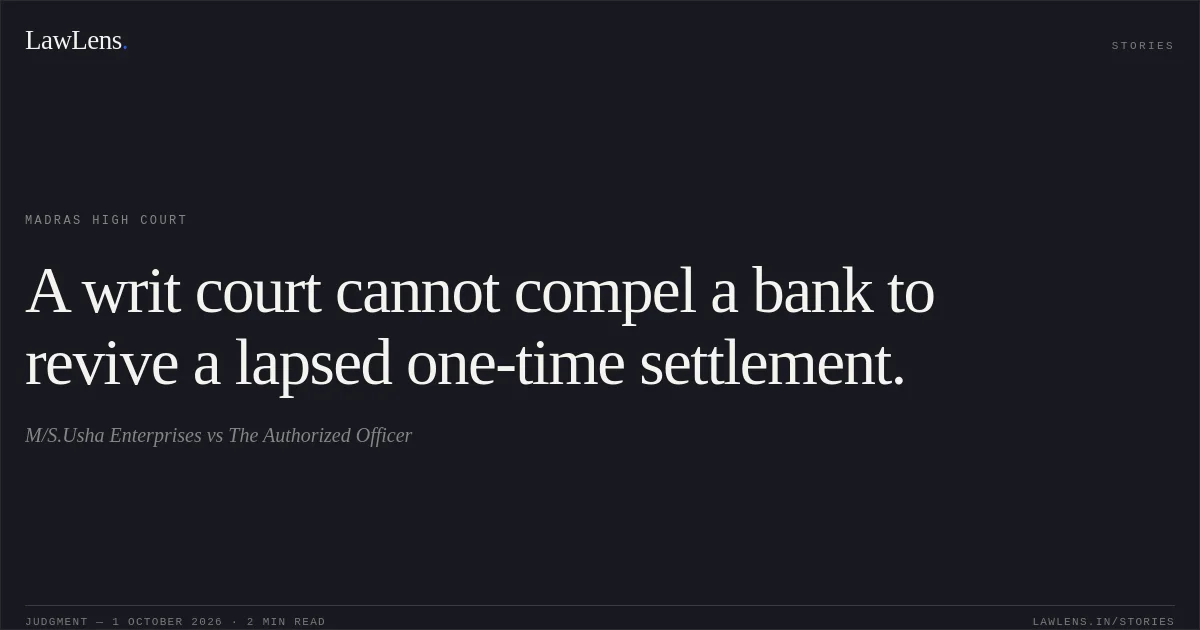
Article 226 does not ordinarily permit the Court to compel a bank to enter into or revive a One Time Settlement, or to require it to settle or close a loan account at a figure proposed by the borrower.
Source reference: p. 4, para. 5; p. 5, para. 7Relying on Bijnor Urban Co-operative Bank Limited, Bijnor v. Meenal Agarwal, (2023) 2 SCC 805, the Court treated the OTS dispute as contractual and held that any proposed settlement below the Bank’s demand may be taken up with the Bank, which may consider it in accordance with applicable rules and regulations.
Source reference: p. 4, para. 5; p. 5, para. 7Reasoning
The OTS had lapsed because the petitioners failed to comply with its terms, and the Bank had rejected their restoration request.
Source reference: pp. 4–5, paras. 5–7That rejection was not challenged.
Source reference: pp. 4–5, paras. 5–7The Bank thereafter stated the amount payable, revising its demand in a subsequent communication.
Source reference: pp. 4–5, paras. 5–7In light of the contractual nature of the dispute and the principle in Bijnor Urban Co-operative Bank, the Court declined to use its writ jurisdiction to revive the OTS or impose the petitioners’ proposed settlement figure.
Source reference: pp. 4–5, paras. 5–7It left any further settlement request to the Bank’s consideration under applicable rules and regulations.
Source reference: pp. 4–5, paras. 5–7Holding
The Court dismissed the writ petition, declining to direct revival of the OTS.
It left the petitioners at liberty to seek a remedy before the Bank or an appropriate forum, if advised.
Source reference: p. 5, para. 8There was no order as to costs, and the interim application was also dismissed.
Source reference: p. 5, para. 8Original Court PDF
M/S.Usha EnterprisesvsThe Authorized Officer
Click to open original judgment
Original judgment, available to read, download and summarize on LawLens.in