Facts
The respondent, a cooperative society employee who served as Managing Director during May 2000, was charged under Rule 17(b) of the Tamil Nadu Civil Services (Discipline and Appeal) Rules over alleged irregularities in pledge loans amounting to ₹2,48,000.
Source reference: pp. 3–6A six-month stoppage of increment with cumulative effect was imposed and upheld in the departmental appeal and revision.
Source reference: pp. 3–6In an earlier writ petition, the High Court remanded the matter to the Government for a reasoned reconsideration, including obtaining the TNPSC’s opinion.
Source reference: pp. 3–6The Government reconsidered the matter and, by G.O.(T) No. 257 dated 3 November 2014, confirmed the punishment.
Source reference: pp. 3–6The respondent challenged that order, and the Single Judge set aside the punishment for want of adequate reasons.
Source reference: pp. 3–6The Government and other officials appealed.
Source reference: pp. 3–6Issues
1. Whether the Single Judge was justified in setting aside the punishment on the ground that the Government had given no adequate reasons, despite the post-remand order.
Source reference: pp. 6–72. Whether the High Court could itself set aside the punishment, or whether, if the punishment were found disproportionate, the matter should be remitted to the disciplinary authority.
Source reference: p. 6Law Applied
The Court noted that the petitioner had been charged under Rule 17(b) of the Tamil Nadu Civil Services (Discipline and Appeal) Rules.
Source reference: p. 3The respondents relied on Section 84 of the Co-operative Societies Act and the applicable Rules concerning the Managing Director’s responsibilities as chief executive officer.
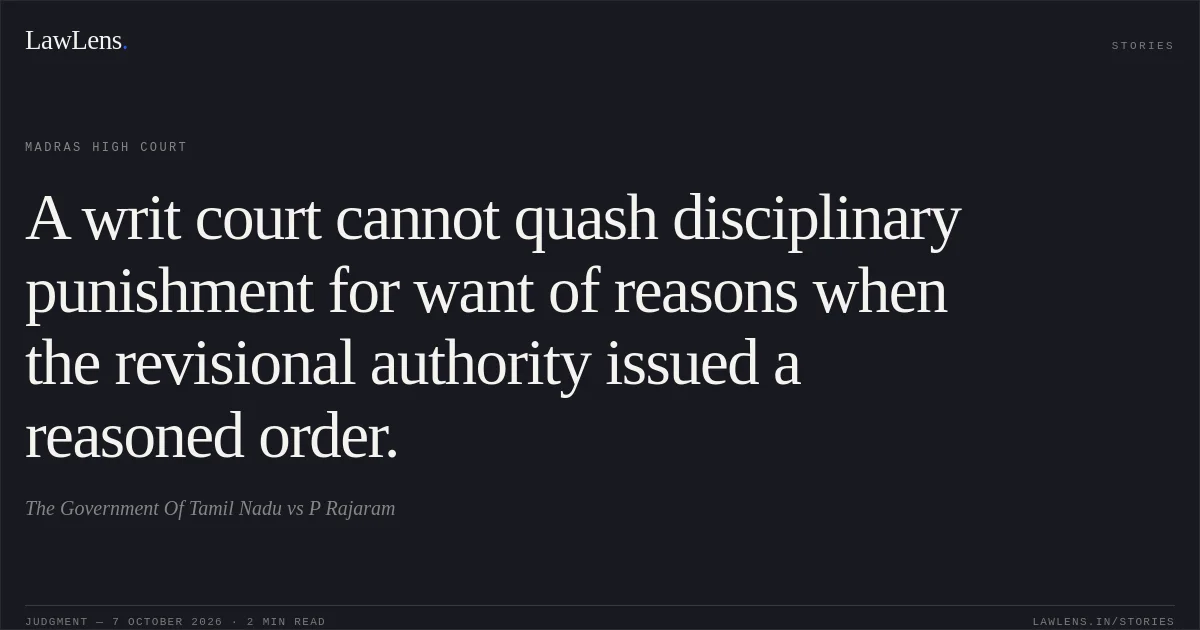
Source reference: p. 5The disciplinary authority determines the appropriate punishment, while writ-court review of punishment is limited to assessing whether it is disproportionate; if the Court finds disproportionality, it should remit the matter to the disciplinary authority to reconsider the quantum of punishment.
Source reference: p. 6Reasoning
The Division Bench found that, following the earlier remand, the Government had considered the charges and the petitioner’s explanation and had issued a reasoned order rejecting his contentions.
Source reference: p. 6It therefore disagreed with the Single Judge’s conclusion that the Government had provided no reasons or discussion.
Source reference: p. 6The Bench held that the Single Judge should not have set aside the punishment on that basis, particularly where the post-remand decision had addressed the matter and the appropriate role of the writ court in reviewing punishment was limited.
Source reference: p. 6Holding
The Court held that the Single Judge erred in setting aside the punishment.
It set aside the order in W.P. No. 1660 of 2015 and allowed the writ appeal, with no order as to costs; the connected miscellaneous petitions were closed.
Source reference: p. 7Acts & Sections Cited
1 provisions across 1 statute referred to in this judgment. Linked provisions open on LawLens.
Co-operative Societies Act (alias, unresolved)1
Original Court PDF
The Government Of Tamil NaduvsP Rajaram
Click to open original judgment
Original judgment, available to read, download and summarize on LawLens.in