01Facts
The ten petitioners approached the Chhattisgarh High Court alleging that candidates from outside Chhattisgarh were obtaining fraudulent domicile certificates and seeking admission to Government and private medical colleges against the Chhattisgarh State domicile quota in NEET-UG 2026 counselling.
¶ 3They sought directions for transparent and uniform verification of domicile/residence eligibility, cross-verification of documents, publication of a State Quota Eligibility List, and examination of genuine complaints before final allotment of seats.
¶ 2The petitioners relied on certain statistical figures and alleged that, unlike in 2025, the State had not published a list of eligible domicile-category candidates.
¶ 3The State authorities contended that the previous year’s list, based on candidates passing Class XII in Chhattisgarh, had led to disputes involving students who had pursued higher studies outside the State.
¶ 4They further submitted that admissions were governed by the Chhattisgarh Medical, Dental, and Physiotherapy Undergraduate Admission Rules, 2018, under which Rule 3 prescribed eligibility and Rule 6 contemplated publication of the eligible-candidate list by the National Testing Agency (NTA).
¶ 4The State and NTA argued that the petition was based only on apprehension, contained no specific allegation of violation of the applicable Rules, and was unsupported by material evidence.
¶ 5–602Issues
i.Whether the petitioners were entitled to directions requiring the State and counselling authorities to establish enhanced verification and transparency mechanisms for determining domicile eligibility under the NEET-UG 2026 State Quota.
¶ 2–4ii.Whether the writ petition could be entertained and relief granted on the basis of general allegations and apprehension of fraudulent domicile claims, without specific instances or supporting material showing deviation from the applicable admission Rules.
¶ 5–703Law Applied
The Court applied the Chhattisgarh Medical, Dental, and Physiotherapy Undergraduate Admission Rules, 2018, particularly Rule 3, which prescribes eligibility criteria for Government quota seats in Government medical and dental colleges and Government quota seats in private dental colleges, and Rule 6, concerning publication of the list of eligible candidates by the NTA in the admission process.
¶ 4The Court further applied the general principle governing writ jurisdiction that relief cannot ordinarily be granted on the basis of mere apprehension or unsubstantiated allegations; the petitioner must place specific facts and supporting material showing an actual legal or procedural violation.
¶ 5–704Reasoning
The Court examined the petitioners’ allegations of fraudulent domicile certificates and lack of transparency against the governing admission framework.
¶ 7It found that the petitioners had not identified any particular candidate, document, or instance in which the admission authorities had departed from the 2018 Rules.
¶ 7The statistical figures and general assertions did not establish an actual violation or demonstrate that the State had unlawfully altered the eligibility process.
¶ 7The Court also noted the State’s explanation that the earlier domicile-related list had generated disputes and that the Rules assigned the relevant publication function to the NTA.
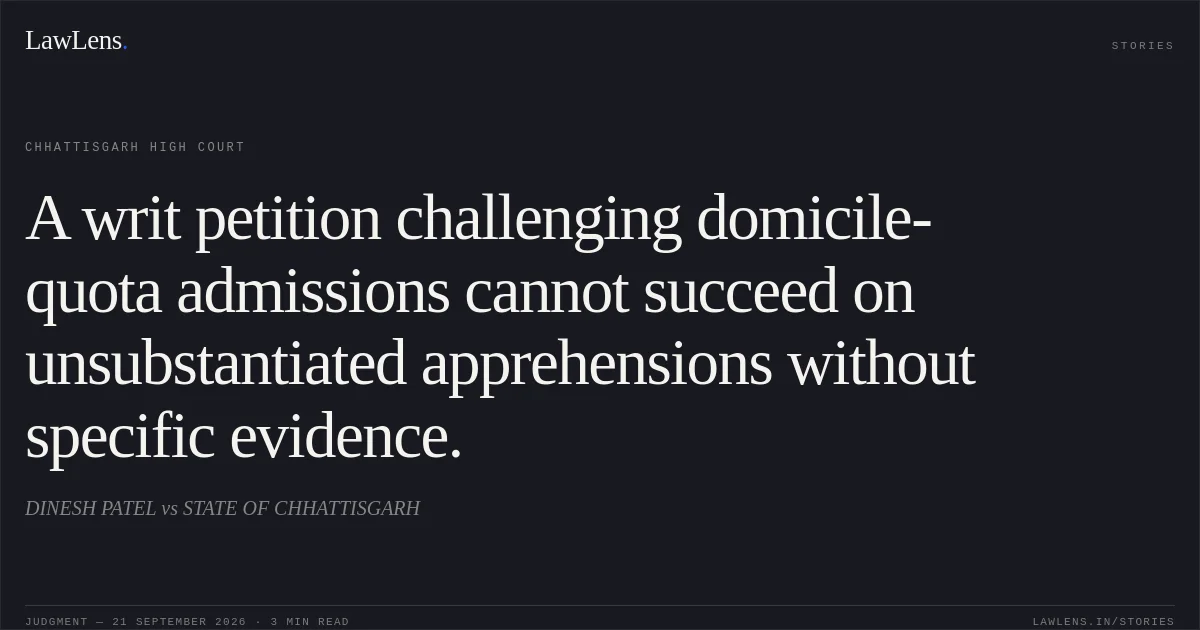
¶ 4In the absence of concrete evidence or a specific procedural illegality, the Court held that the petition was founded only on apprehension and that the requested supervisory directions were unwarranted.
¶ 5–705Holding
The Court answered the issues against the petitioners.
¶ 7It held that no case had been made out for issuing directions for additional domicile verification or for interfering with the NEET-UG 2026 counselling process, as the allegations were unsupported by specific instances or material demonstrating a breach of the applicable Rules.
¶ 7The writ petition was consequently dismissed as devoid of merit.
¶ 8Original Court PDF
DINESH PATELvsSTATE OF CHHATTISGARH
Click to open original judgment
Original judgment, available to read, download and summarize on LawLens.in