Facts
The petitioners challenged communications dated 17.02.2026 issued by the Chief Executive Officer, Zila Panchayat, Morena, and 11.03.2026 issued by the Collector, Morena, concerning a complaint against them under Article 226 of the Constitution.
Source reference: p.1Petitioner No.1 was a Self-Help Group operating at Village Kutrawali and entrusted with work under the Pradhan Mantri Poshan Ahar Scheme.
Source reference: p.1Following the removal of petitioner No.2 as the Group’s President, her biometric particulars were allegedly required to be updated so that the newly elected office-bearers could collect ration; the biometric updation was stated to have been completed in January 2026.
Source reference: p.1Respondent No.6 thereafter complained that petitioner No.2 was no longer a member of the Group and was unlawfully collecting and selling ration in the open market.
Source reference: p.1A preliminary inquiry and fact-finding exercise followed, with the committee recording findings against the petitioners and recommending appropriate action.
Source reference: p.1The petitioners alleged that no notice or show-cause notice was issued, that the relevant materials were not supplied to them, and that the complaint was motivated by a pre-existing land dispute with respondent No.6.
Source reference: p.1The State contended that the impugned communications were merely internal administrative communications issued during a preliminary inquiry and did not finally determine any right or liability.
Source reference: pp.2–3Issues
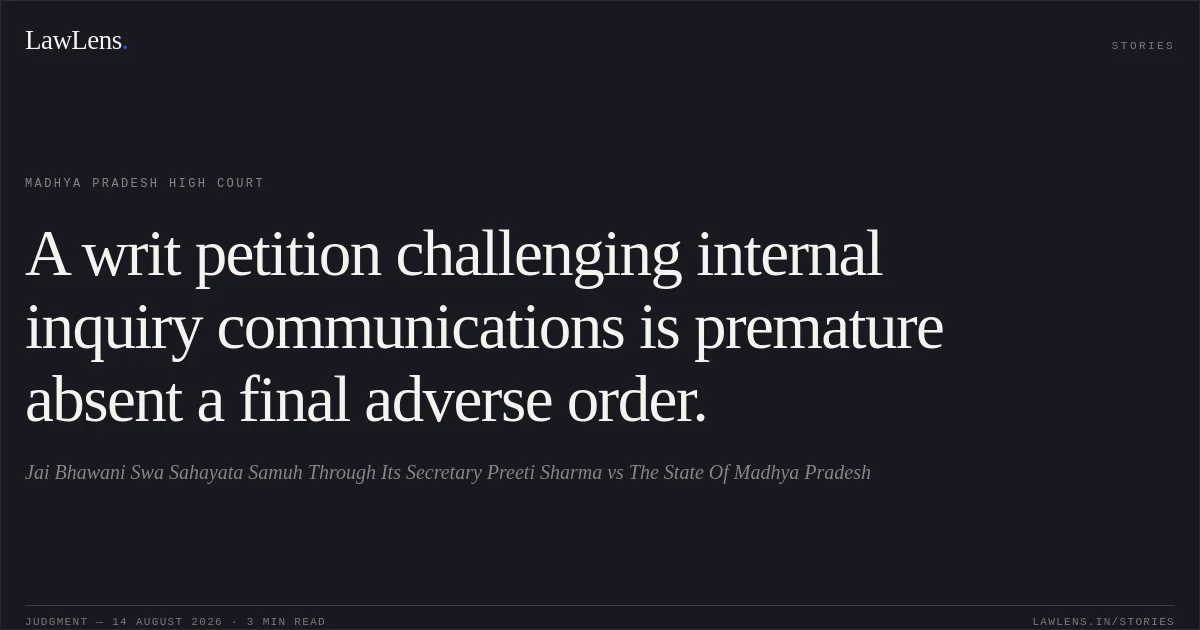
Whether a writ petition under Article 226 is maintainable against communications issued during a preliminary inquiry or fact-finding process when no final adverse order has been passed against the petitioners.
Source reference: pp.2–3Whether the alleged denial of notice, show-cause opportunity, and access to inquiry materials warranted interference at the preliminary stage on the ground of violation of natural justice.
Source reference: pp.1–3Whether an inquiry should be directed into the source and manner by which the internal administrative documents came into the petitioners’ possession.
Source reference: p.4Law Applied
The Court applied Article 226 of the Constitution, recognising that extraordinary writ jurisdiction is ordinarily not invoked against preliminary or interlocutory administrative communications that do not finally determine civil or legal rights.
Source reference: pp.2–3The Court applied the principle that a preliminary inquiry or fact-finding exercise, by itself, does not create a cause of action for writ intervention where the process has not culminated in a final adverse order.
Source reference: pp.2–3It further proceeded on the requirement that, if substantive proceedings are initiated, the competent authority must act in accordance with law and comply with applicable principles of natural justice, including a meaningful opportunity to defend.
Source reference: pp.2–3No specific statutory provision or judicial precedent was cited in the judgment.
Source reference: pp.2–3Reasoning
The Court accepted the State’s preliminary objection that the challenged documents formed part of an internal administrative process initiated pursuant to the complaint and did not impose any penalty or conclusively determine the petitioners’ rights.
Source reference: pp.2–3Accordingly, the alleged absence of notice or opportunity to rebut the allegations did not justify immediate writ intervention, since the inquiry had not yet resulted in a final adverse decision.
Source reference: pp.2–3The Court emphasised that the competent authority would be required to proceed strictly in accordance with law if further substantive action were taken.
Source reference: p.3However, independently of the merits of the complaint, the Court considered it appropriate to address the petitioners’ grievance regarding their possession of the internal documents and directed the Collector to investigate their source and mode of procurement.
Source reference: p.4Holding
The writ petition was dismissed as premature because the impugned communications were only part of a preliminary administrative inquiry and did not finally determine or adversely affect the petitioners’ civil or legal rights.
The Court clarified that it had expressed no opinion on the merits of the allegations and that the dismissal would not prevent the competent authority from proceeding in accordance with law.
Source reference: p.4The Collector, Morena, was directed to conduct an inquiry into the source of the documents, the manner in which they came into the petitioners’ possession, and how they were procured, and to submit a report before the Court within eight weeks.
Source reference: p.4Original Court PDF
Jai Bhawani Swa Sahayata Samuh Through Its Secretary Preeti SharmavsThe State Of Madhya Pradesh
Click to open original judgment
Original judgment, available to read, download and summarize on LawLens.in