Facts
Respondent Canara Bank sanctioned an overdraft facility to respondent company, secured in part by the residential house of Late Prabhat Kumar Verma, a director of the company.
Source reference: para. 2After his death, the petitioners—his parents and brothers—continued to reside in the house; his widow and minor daughter were also legal heirs.
Source reference: para. 3Following an earlier successful challenge to the Bank’s SARFAESI proceedings, the Bank initiated fresh proceedings and obtained an order under Section 14 of the SARFAESI Act to take possession of the mortgaged property.
Source reference: paras. 4–7The petitioners challenged the Bank’s action before the DRT in S.A. No. 59 of 2023, but the DRT dismissed the securitisation application and interlocutory application on 7 July 2023; the petitioners were thereafter dispossessed.
Source reference: para. 8They sought restoration of possession and challenged the DRT’s order and the Bank’s notices, asserting independent possessory rights and relying, among other matters, on a pending partition suit and attachment proceedings under the Recovery of Debts and Bankruptcy Act, 1993.
Source reference: paras. 9–15The Bank disputed their rights and raised the availability of statutory remedies.
Source reference: paras. 16–23Issues
1. Whether the High Court should exercise its jurisdiction under Article 226 when the petitioners could challenge the DRT’s order through the statutory appellate remedy under the SARFAESI Act.
Source reference: paras. 16, 21, 262. Whether the petitioners’ claims concerning possession, title, and the effect of the pending civil and recovery proceedings could be determined in this writ proceeding.
Source reference: paras. 25–27Law Applied
Article 226 jurisdiction is ordinarily not exercised where an effective statutory remedy is available; the rule applies with particular force in bank-recovery matters.
Source reference: paras. 28–31The Court relied on PHR Invent Educational Society v. UCO Bank, Civil Appeal No. 4845 of 2024; Celir LLP v. Bafna Motors (Mumbai) Pvt. Ltd., (2024) 2 SCC 1; and United Bank of India v. Satyawati Tondon, (2010) 8 SCC 110, for that principle.
Source reference: paras. 28–31The Court noted that the petitioners had a statutory appellate remedy under Section 18 of the SARFAESI Act, while the Bank also identified a remedy under Section 30 of the Recovery of Debts and Bankruptcy Act, 1993 concerning the Recovery Officer’s order.
Source reference: paras. 16, 26Disputed questions of title and possession were considered unsuitable for determination in the writ proceeding.
Source reference: para. 26Reasoning
The petitioners’ grievance concerned dispossession pursuant to SARFAESI measures, but the DRT had already dismissed their challenge to those measures.
Source reference: para. 26The Court held that the petitioners could pursue the statutory appellate remedy rather than seek review under Article 226.
Source reference: para. 26Their claims of independent possession, title, and the effect of attachment and pending partition proceedings raised disputed questions and could be taken to the competent statutory forum; the Court therefore declined to decide the merits or the alleged conflict between the attachment and SARFAESI action.
Source reference: paras. 26–27Applying the cited Supreme Court authorities, it found no basis to entertain the writ petition.
Source reference: paras. 28–31Holding
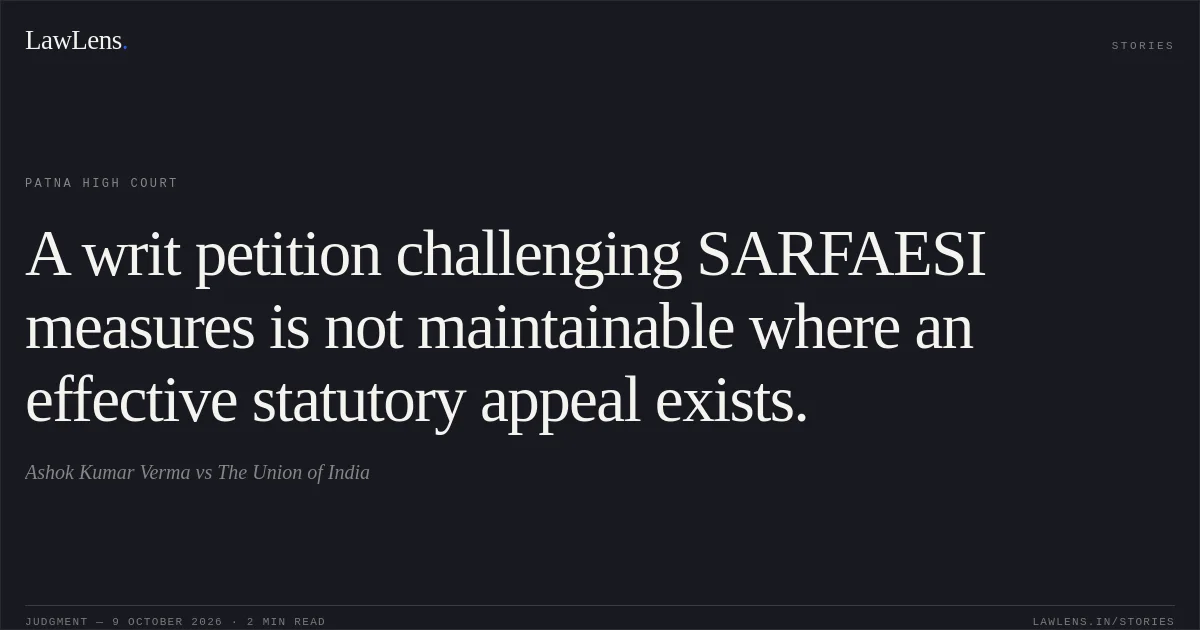
The Court dismissed the writ petition as not maintainable because an effective statutory remedy was available and the disputed property-rights questions were not appropriate for determination under Article 226.
It left the petitioners at liberty to approach the appropriate forum in accordance with law; any interlocutory applications were also disposed of.
Source reference: paras. 33–34Acts & Sections Cited
5 provisions across 4 statutes referred to in this judgment. Each provision opens on LawLens.
Securitisation and Reconstruction of Financial Assets and Enforcement of Security Interest Act, 20022
Indian Contract Act, 18721
Code of Civil Procedure, 19081
Recovery Of Debts And Bankruptcy Act, 19931
Original Court PDF
Ashok Kumar VermavsThe Union of India
Click to open original judgment
Original judgment, available to read, download and summarize on LawLens.in