Facts
The petitioner challenged the order dated 27 March 2026 passed by the Presiding Officer, Debts Recovery Tribunal, Patna, in S.A. No. 142 of 2019.
Source reference: p. 2By that order, the DRT set aside the auction sale dated 16 September 2022 conducted by Punjab National Bank, the consequential sale certificate issued in favour of the petitioner, and directed restoration of possession of the mortgaged property to the guarantor along with compensation at the rate of ₹1,000 per month.
Source reference: p. 2The petitioner directly invoked the writ jurisdiction of the High Court under Article 226 without pursuing the statutory appellate remedy before the Debts Recovery Appellate Tribunal, Allahabad.
Source reference: p. 2–3Issues
1. Whether the writ petition under Article 226 was maintainable against the order of the Debts Recovery Tribunal when an effective statutory appellate remedy was available before the Debts Recovery Appellate Tribunal.
Source reference: p. 2–32. Whether the petitioner should be relegated to the appropriate statutory forum, with the question of limitation left open for consideration by that forum.
Source reference: p. 4–5Law Applied
The Court applied the settled principle that the High Court should ordinarily decline to exercise its jurisdiction under Article 226 where an effective alternative statutory remedy is available, particularly in matters concerning recovery of public dues and bank debts.
Source reference: p. 3–4Relying on United Bank of India v. Satyawati Tondon, (2010) 8 SCC 110, the Court held that recovery statutes constitute a self-contained mechanism providing both procedure and specialised adjudicatory and appellate forums, which must ordinarily be exhausted before invoking writ jurisdiction.
Source reference: p. 3–4The Court further relied on Celir LLP v. Bafna Motors (Mumbai) (P) Ltd., (2024) 2 SCC 1, and PHR Invent Educational Society v. UCO Bank & Ors., 2024 INSC 297, reiterating that writ petitions should not ordinarily be entertained where an effective remedy is available under the SARFAESI framework.
Source reference: p. 4Reasoning
The impugned order had been passed by the DRT and was therefore amenable to challenge before the specialised appellate forum, namely the Debts Recovery Appellate Tribunal, Allahabad.
Source reference: p. 2–3Since the petitioner had bypassed that statutory remedy and had not demonstrated any exceptional circumstance warranting direct intervention under Article 226, the High Court applied the alternative-remedy rule with particular rigour applicable to bank-recovery proceedings.
Source reference: p. 3–5The Court consequently declined to examine the legality or merits of the DRT’s decision concerning the auction sale, sale certificate, possession, or compensation.
Source reference: no citationHolding
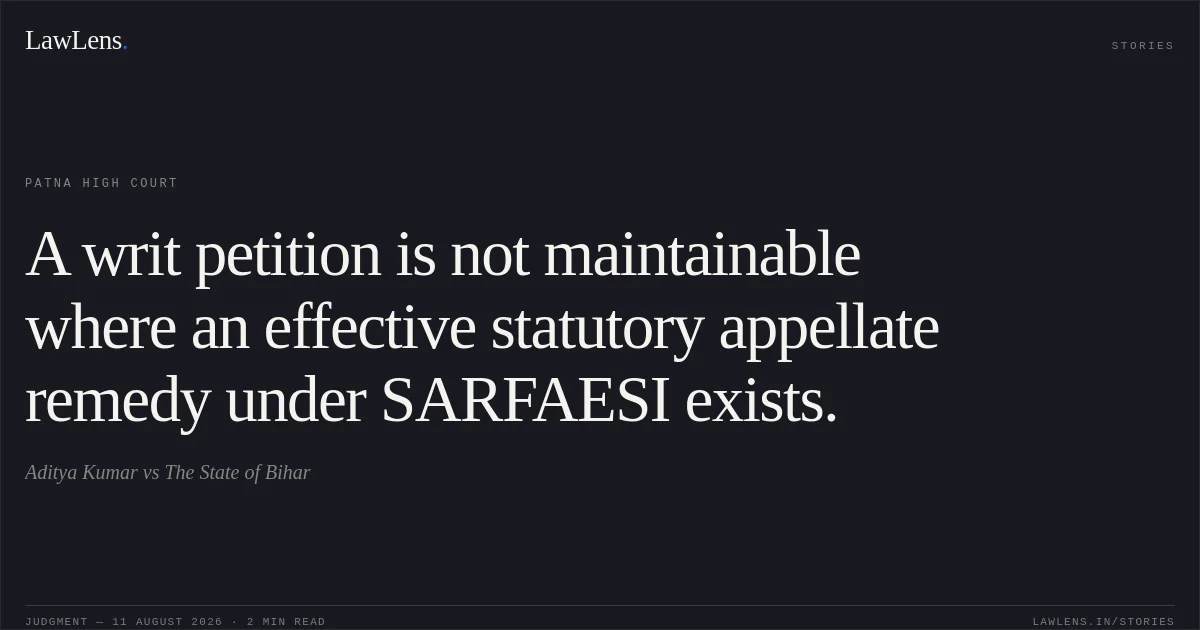
The High Court held that the writ petition was not maintainable at that stage because an alternative and effective statutory remedy was available before the appropriate appellate authority.
The writ petition was disposed of, with liberty to the petitioner to approach the appropriate forum.
Source reference: p. 5The concerned authority was directed to consider the aspect of limitation in accordance with law.
Source reference: p. 5All pending interlocutory applications, if any, were also disposed of.
Source reference: p. 5Original Court PDF
Aditya KumarvsThe State of Bihar
Click to open original judgment
Original judgment, available to read, download and summarize on LawLens.in