Facts
The plaintiffs brought an SCC suit against the defendant, who filed a written statement.
Source reference: para. 1–2After the court framed points for determination, the defendant sought amendment of the written statement under Order VI Rule 17 CPC to plead that the plaintiffs owned 10–15 other commercial and residential properties in Dehradun.
Source reference: para. 1–2The trial court rejected the application on 14 September 2026.
Source reference: para. 1–2The defendant challenged that order under Section 25 of the Provincial Small Cause Courts Act, 1887.
Source reference: para. 1–2The suit was at the plaintiffs’ examination-in-chief stage when the amendment was sought.
Source reference: para. 1–2, 16Issues
1. Whether the proposed amendment concerning the plaintiffs’ other properties was necessary to determine the real controversy in the SCC suit.
Source reference: para. 19, 23–242. Whether the amendment application was a dilatory measure warranting rejection.
Source reference: para. 19, 22, 24Law Applied
Under Order VI Rule 17 CPC, the court’s discretion to allow an amendment is governed by whether it is necessary to determine the real question in controversy; Revajeetu Builders and Developers v. Narayanaswamy and Sons, (2009) 10 SCC 84, identifies this as the basic test.
Source reference: para. 12; para. 23The defendant relied on authorities recognizing a more liberal approach to amendments of written statements, including the ability to raise alternative or inconsistent pleas where no clear admission is withdrawn to the opponent’s prejudice.
Source reference: para. 4–9The revision was brought under Section 25 of the Provincial Small Cause Courts Act, 1887.
Source reference: para. 1Reasoning
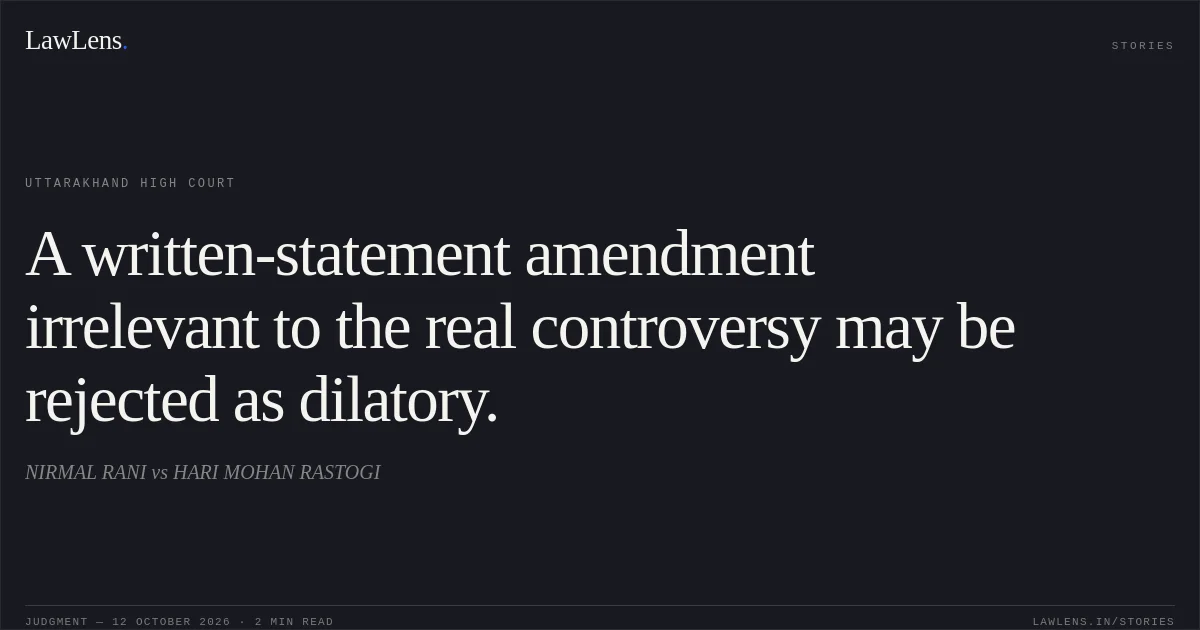
The proposed pleading concerned the plaintiffs’ ownership of other properties, but the Court held that this fact was not relevant to the real controversy in the eviction and arrears-of-rent suit.
Source reference: para. 16–17, 23–24Applying the Revajeetu Builders test, it concluded that the amendment was not necessary for effective adjudication.
Source reference: para. 23–24The Court also relied on the timing and procedural history: the application was made when the plaintiffs’ examination-in-chief was underway, and several adjournments had been sought.
Source reference: para. 16–17, 23–24In those circumstances, it found the application to be a dilatory tactic; the defendant’s argument that the amendment did not withdraw an admission did not overcome its lack of relevance to the dispute.
Source reference: para. 16–17, 23–24Holding
The Court held that the proposed amendment was not necessary to determine the real question in controversy and that the application had been filed to delay the suit.
Finding no error in the trial court’s order, it dismissed the civil revision.
Source reference: para. 24–25Acts & Sections Cited
3 provisions across 2 statutes referred to in this judgment. Each provision opens on LawLens.
Provincial Small Cause Courts Act, 18871
Code of Civil Procedure, 19082
Original Court PDF
NIRMAL RANIvsHARI MOHAN RASTOGI
Click to open original judgment
Original judgment, available to read, download and summarize on LawLens.in