Facts
The respondent-landlord brought a Small Cause Court suit seeking eviction and arrears of rent.
Source reference: pp. 1–3, 14–17The defendants filed a written statement, and the plaintiff’s evidence-in-chief and cross-examination had taken place.
Source reference: pp. 1–3, 14–17During the defendants’ cross-examination, they applied under Order VI Rule 17 CPC to amend their written statement, including to state that defendant no. 1 had never been a tenant or occupant of the disputed property.
Source reference: pp. 1–3, 14–17The trial court rejected the application, and the defendants challenged that order under Section 25 of the Provincial Small Cause Courts Act, 1887.
Source reference: pp. 1–3, 14–17Issues
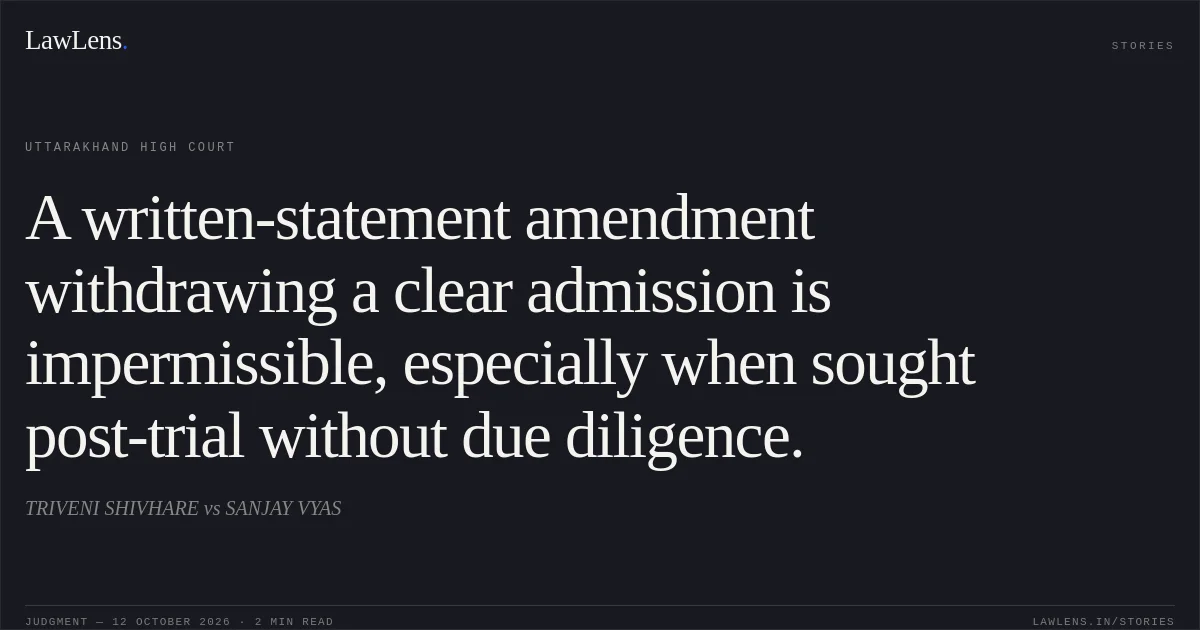
Whether the proposed amendment to the written statement would withdraw an earlier admission that defendant no. 1 was a tenant
Source reference: para. 14(i), pp. 14–16Whether the proposed amendment was barred by the proviso to Order VI Rule 17 CPC because it was sought after commencement of trial and without demonstrating due diligence
Source reference: para. 14(ii), pp. 16–19Law Applied
Section 25 of the Provincial Small Cause Courts Act, 1887 provides the basis for the revision.
Source reference: no citationUnder Order VI Rule 17 CPC, amendments may be allowed to determine the real questions in controversy; after commencement of trial, however, the applicant must satisfy the court that, despite due diligence, the matter could not have been raised earlier.
Source reference: pp. 4–6, 17–18Courts generally take a more liberal approach to amendments of written statements than to amendments of plaints, and new or inconsistent defences may be permissible (Usha Balashaheb Swami v. Kiran Appaso Swami, (2007) 5 SCC 602, paras 19–22, pp. 4–6).
Source reference: pp. 4–6That latitude does not ordinarily permit an amendment that withdraws a clear admission so as to displace the plaintiff’s case and cause prejudice (Heeralal v. Kalyan Mal, (1998) 1 SCC 278, paras 6, 10–12, pp. 9–12; M/s Modi Spinning & Weaving Mills Co. Ltd. v. M/s Lodha Ram & Co., (1976) 4 SCC 320, paras 9–10, pp. 12–13).
Source reference: pp. 9–13The post-trial due-diligence requirement was also addressed in Ajendraprasadji N. Pandey v. Swami Keshavprakeshdasji N., (2006) 12 SCC 1, para 55.
Source reference: pp. 17–18Reasoning
The amendment would have added that defendant no. 1 had never been a tenant or occupant of the property, thereby contradicting the existing admission and the tenancy agreement on record.
Source reference: paras. 15–18, 21, pp. 14–16, 19The Court also noted that a coordinate Bench had already found a landlord–tenant relationship between the parties in Civil Revision No. 56 of 2026, and treated that finding as having attained finality.
Source reference: paras. 15–18, 21, pp. 14–16, 19Although written-statement amendments are generally approached liberally, this proposed amendment would withdraw an admission and materially alter the position on which the plaintiff’s case rested.
Source reference: paras. 19–22, pp. 16–19Further, it was sought at the stage of the defendants’ cross-examination, and the defendants had not shown that due diligence prevented them from raising the matter earlier.
Source reference: paras. 19–22, pp. 16–19The proviso to Order VI Rule 17 therefore applied.
Source reference: paras. 19–22, pp. 16–19Holding
The Court answered both issues against the revisionists: the proposed amendment would withdraw an earlier admission, and the defendants failed to establish due diligence for an amendment sought after commencement of trial.
Finding no error in the trial court’s order, the High Court dismissed the civil revision.
Source reference: para. 23, p. 20Acts & Sections Cited
2 provisions across 2 statutes referred to in this judgment. Each provision opens on LawLens.
Provincial Small Cause Courts Act, 18871
Code of Civil Procedure, 19081
Original Court PDF
TRIVENI SHIVHAREvsSANJAY VYAS
Click to open original judgment
Original judgment, available to read, download and summarize on LawLens.in