01Facts
The Petitioner joined the Respondent as a spray painter on 1 August 1987 and served for approximately nineteen years at a last-drawn wage of ₹3,931 per month.
p. 2 · ¶ 2He proceeded on sanctioned leave from 15 May 2006 to 3 June 2006 and claimed that, having fallen ill at his native village, he informed the Respondent and sent a medical certificate by registered post on 2 June 2006.
p. 2 · ¶ 3The Respondent issued a communication requiring him to report for duty on 15 June 2006 and thereafter terminated his services on 26 June 2006.
p. 2 · ¶ 4The Petitioner issued a demand notice on 17 August 2006 and instituted an industrial dispute seeking reinstatement and back wages.
p. 2 · ¶ 5–6The Respondent pleaded voluntary abandonment of employment but did not lead oral or documentary evidence before the Labour Court.
pp. 2–3 · ¶ 7 · p. 6 · ¶ 22By Award dated 30 August 2008, the Labour Court dismissed the claim, holding that the Petitioner had failed to prove that he had rejoined duty, approached the Management, or submitted the requisite certificates, and therefore had abandoned employment.
p. 3 · ¶ 9During the writ proceedings, the Respondent-Company ceased to function, and the Petitioner’s claim for reinstatement became impracticable.
p. 10 · ¶ 3202Issues
i.1. Whether the Labour Court erred in holding that the Petitioner had voluntarily abandoned his employment merely because he failed to establish his illness, submission of medical/fitness certificates, or attempt to rejoin duty.
pp. 5–7 · ¶ 19–25ii.2. Whether the Respondent’s refusal of employment and termination, without a domestic enquiry or compliance with Section 25F of the Industrial Disputes Act, 1947, were illegal and unjustified.
p. 7 · ¶ 26iii.3. Whether reinstatement with back wages was an appropriate relief, or whether monetary compensation should be awarded in view of the closure of the Company, the long pendency of the proceedings, and the absence of proof of unemployment.
pp. 8–10 · ¶ 28–35iv.4. Whether the name of Mr. Arun Khanna, impleaded as the son and legal representative of the deceased former Director, ought to be deleted from the proceedings.
pp. 10–11 · ¶ 36–4003Law Applied
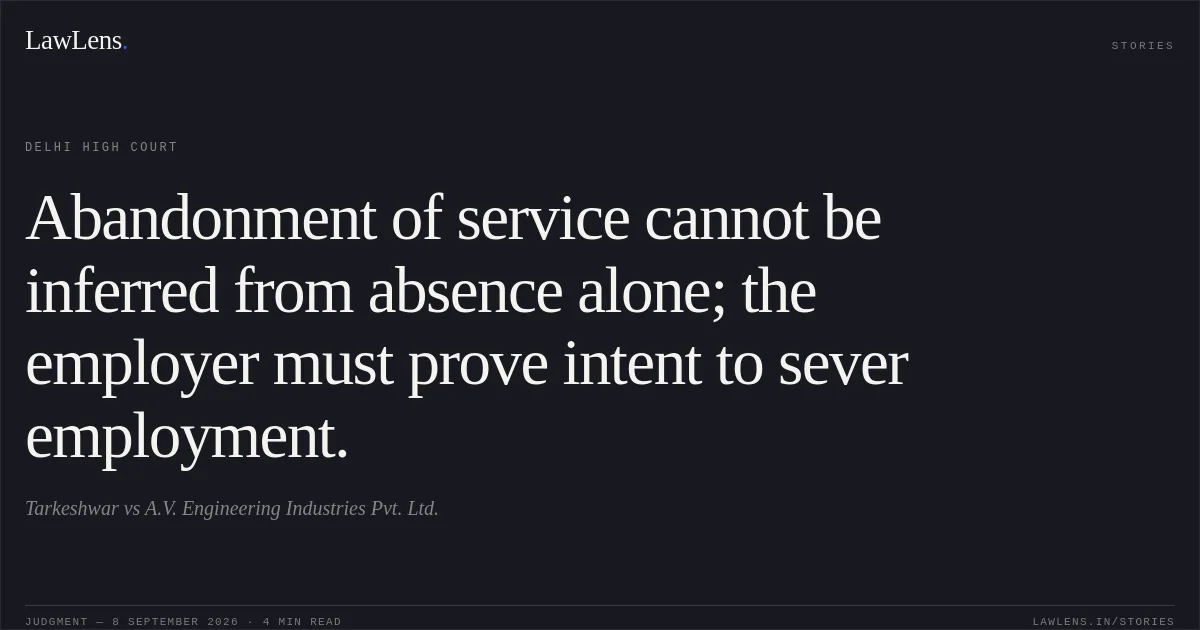
Abandonment of service cannot be inferred merely from absence and must be established by the employer through cogent material demonstrating the employee’s intention permanently to sever the employment relationship; the burden rests on the employer.
pp. 5–6 · ¶ 20–23Where termination is effected without proof of abandonment, the employer must comply with the safeguards under Section 25F of the Industrial Disputes Act, 1947, including the statutory requirements applicable to retrenchment.
p. 7 · ¶ 26The Court relied on Assistant Engineer, Rajasthan Development Corporation v. Gitam Singh, (2013) 5 SCC 136, and BSNL v. Bhurumal, (2014) 7 SCC 177, for the principle that reinstatement and back wages do not follow automatically from illegal termination or violation of Section 25F; relief must be moulded according to the nature and duration of employment and surrounding circumstances, and monetary compensation may be appropriate.
pp. 8–9 · ¶ 29–31The Court also applied the principle that back wages require consideration of the employee’s pleading and proof regarding unemployment or absence of gainful employment.
p. 10 · ¶ 33Provisions in the judgment · 1
Industrial Disputes Act, 1947 Section 25F
04Reasoning
The Labour Court impermissibly shifted the burden onto the Petitioner by treating the absence of medical and fitness certificates and proof of an attempted rejoining as sufficient to establish abandonment.
pp. 5–6 · ¶ 20–23Since the Respondent specifically pleaded abandonment but led no evidence, there was no evidentiary basis to conclude that the Petitioner intended permanently to forsake his employment.
p. 6 · ¶ 22–25The absence was relatively brief: the Petitioner’s leave ended on 3 June 2006, the communication was issued on 15 June 2006, and termination followed on 26 June 2006; this was insufficient, particularly after nearly nineteen years of service, to establish voluntary abandonment without clear and convincing evidence.
pp. 6–7 · ¶ 24The Court therefore found the Labour Court’s decision perverse and unsustainable.
p. 7 · ¶ 25–27Nevertheless, reinstatement was not ordered because the Company had permanently ceased functioning and the litigation had remained pending for nearly two decades.
p. 10 · ¶ 32Back wages were also declined because the Petitioner neither pleaded nor proved continuous unemployment or lack of gainful employment.
p. 10 · ¶ 33As to Mr. Arun Khanna, the Court declined deletion at that stage because he was the son and legal representative of the deceased person who had represented the Company, while expressly leaving questions of personal or successor liability open for execution proceedings.
pp. 10–11 · ¶ 36–4105Holding
The writ petition was allowed to the extent that the Labour Court’s Award dated 30 August 2008 was set aside, the finding of voluntary abandonment was held unsustainable, and the termination was treated as unjustified for want of compliance with the applicable statutory procedure.
p. 7 · ¶ 25–27Reinstatement and back wages were not granted.
p. 10 · ¶ 35In lieu thereof, the Petitioner was awarded lump-sum compensation of ₹4,00,000, payable by the erstwhile employer within eight weeks.
p. 10 · ¶ 35Mr. Arun Khanna was not deleted from the proceedings, but the Court clarified that it had not determined his personal liability or the liability of any legal representative, successor, or person claiming through the Company; those questions were left open for appropriate execution proceedings.
pp. 11–12 · ¶ 39–42Original Court PDF
TarkeshwarvsA.V. Engineering Industries Pvt. Ltd.
Click to open original judgment
Original judgment, available to read, download and summarize on LawLens.in