Facts
The petitioners sought the quashment of FIR Crime No. 106/2023, registered at Police Station Narwar for offences under Sections 306 and 34 of the IPC
Source reference: p.1The deceased, Naresh Batham, consumed poison and died on November 17, 2022
Source reference: p.1Following a marg enquiry under Section 174 Cr.P.C., it was alleged that the petitioners harassed the deceased and his brother, Captain Singh, over financial dealings and unpaid loans related to a fish business
Source reference: p.2The petitioners contended that the dispute was civil, involving a partnership and a dishonoured cheque for Rs. 13,00,000/- for which proceedings under Section 138 of the Negotiable Instruments Act were already pending
Source reference: p.2They further alleged that the FIR was a counterblast to the recovery proceedings and that the deceased had personal domestic issues
Source reference: p.2-3Issues
1. Whether the FIR and consequential proceedings should be quashed under Section 482 Cr.P.C. on the grounds that the dispute is civil in nature and fails to constitute the ingredients of abetment
Source reference: p.1-32. Whether the allegations in the FIR and material collected during the marg enquiry disclose a prima facie case of abetment of suicide under Section 306 IPC
Source reference: p.5-6Law Applied
The court primarily applied Section 482 of the Cr.P.C. regarding the High Court's inherent powers to prevent abuse of the process of law
Source reference: p.4It relied on the landmark categories for quashing established in State of Haryana vs. Bhajan Lal
Source reference: p.4The court further applied the principles from R.P. Kapur vs. State of Punjab, which limits quashing to cases where allegations do not constitute an offence or are manifest with mala fides
Source reference: p.4-5Additionally, the court cited Amit Kapoor vs. Ramesh Chander, prohibiting a "mini-trial" at the quashing stage
Source reference: p.5Neeharika Infrastructure Pvt. Ltd. vs. State of Maharashtra, which mandates non-interference when a cognizable offence is disclosed in the FIR
Source reference: p.5Reasoning
The court observed that the existence of financial and business transactions between the parties was undisputed, as evidenced by the pending Section 138 NI Act proceedings
Source reference: p.5It found that the statements recorded during the marg enquiry indicated persistent demands and alleged harassment by the petitioners
Source reference: p.5The court reasoned that whether such conduct technically constitutes "abetment" under Section 306 IPC is a matter for trial and cannot be adjudicated in a Section 482 petition
Source reference: p.5The petitioners' defense regarding the deceased’s alleged alcoholism or domestic disputes was deemed a disputed question of fact lacking unimpeachable evidence at this stage
Source reference: p.5-6Furthermore, the court held that the delay in filing the FIR was sufficiently explained by the duration of the marg enquiry and the process of obtaining a legal opinion
Source reference: p.6Holding
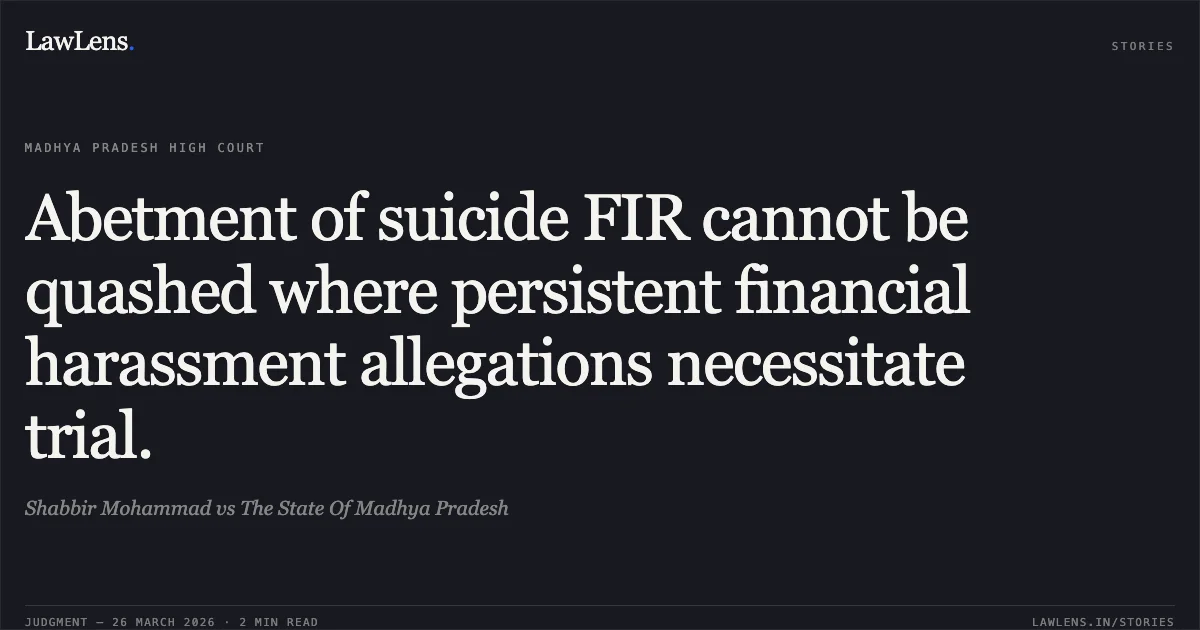
The High Court dismissed the petition, holding that the allegations in the FIR, taken at face value, disclose a prima facie case requiring adjudication through evidence at trial
The court concluded that the case did not fall within the exceptional categories defined in Bhajan Lal that would warrant quashing
Source reference: p.6It was clarified that the observations made were limited to the disposal of the petition and should not influence the trial court’s decision on the merits
Source reference: p.6No order as to costs was made
Source reference: p.6Original Court PDF
Shabbir MohammadvsThe State Of Madhya Pradesh
Click to open original judgment
Original judgment, available to read, download and summarize on LawLens.in