Facts
Sangitaben died after consuming pesticide.
Source reference: para. 1–2; p. 1–2The prosecution alleged that the respondent had entered her home and attempted to outrage her modesty, following which she took poison.
Source reference: para. 1–2; p. 1–2Her brother lodged a complaint the next day, and the respondent was charged under Sections 306, 354 and 452 of the Indian Penal Code (IPC).
Source reference: para. 1–2; p. 1–2The Trial Court acquitted him under Section 306 but convicted him under Sections 354 and 452.
Source reference: para. 6–7, 10; p. 5, 7The State appealed against the acquittal; the respondent did not challenge the convictions.
Source reference: para. 6–7, 10; p. 5, 7Issues
1. Whether the Trial Court was justified in acquitting the respondent of the offence under Section 306 IPC
Source reference: para. 11; p. 72. Whether the Trial Court’s appreciation of the evidence disclosed any illegality, perversity or other ground warranting appellate interference with the acquittal
Source reference: para. 11; p. 7Law Applied
Section 306 IPC requires proof of abetment of suicide, and abetment is defined in Section 107 IPC to include instigation, participation in a conspiracy followed by an act or illegal omission, or intentional aid.
Source reference: para. 19–20; p. 12–13On an appeal against acquittal, the appellate court may review and reappreciate the evidence, but must account for the reinforced presumption of innocence; where two reasonable conclusions are possible, the acquittal should not be disturbed.
Source reference: para. 22–25; p. 14–16The Court relied on Chandrappa v. State of Karnataka, (2007) 4 SCC 415; Rajesh Prasad v. State of Bihar, [2022] 3 SCC 471; Babu Sahebagouda Rudragoudar v. State of Karnataka, AIR 2024 SC 2252, (2024) 8 SCC 149; and Ramesh v. State of Karnataka, [2024] 9 SCC 169.
Source reference: para. 24–25; p. 15–16Reasoning
The Court found no cogent and reliable evidence that the respondent instigated, conspired in, or intentionally aided Sangitaben’s suicide, as required by Sections 107 and 306 IPC.
Source reference: para. 19–20; p. 12–13It also noted weaknesses in the prosecution evidence, including that Jashodaben was not present during the alleged incident and that the nearby witnesses and police witnesses did not provide evidence establishing the prosecution’s case.
Source reference: para. 15–18; p. 10–12Applying the principles governing acquittal appeals, the Court found no perversity or manifest error in the Trial Court’s conclusion and saw no basis to interfere.
Source reference: para. 21–27; p. 13–17It did not examine the correctness of the convictions under Sections 354 and 452 because the respondent had not appealed them.
Source reference: para. 18; p. 12Holding
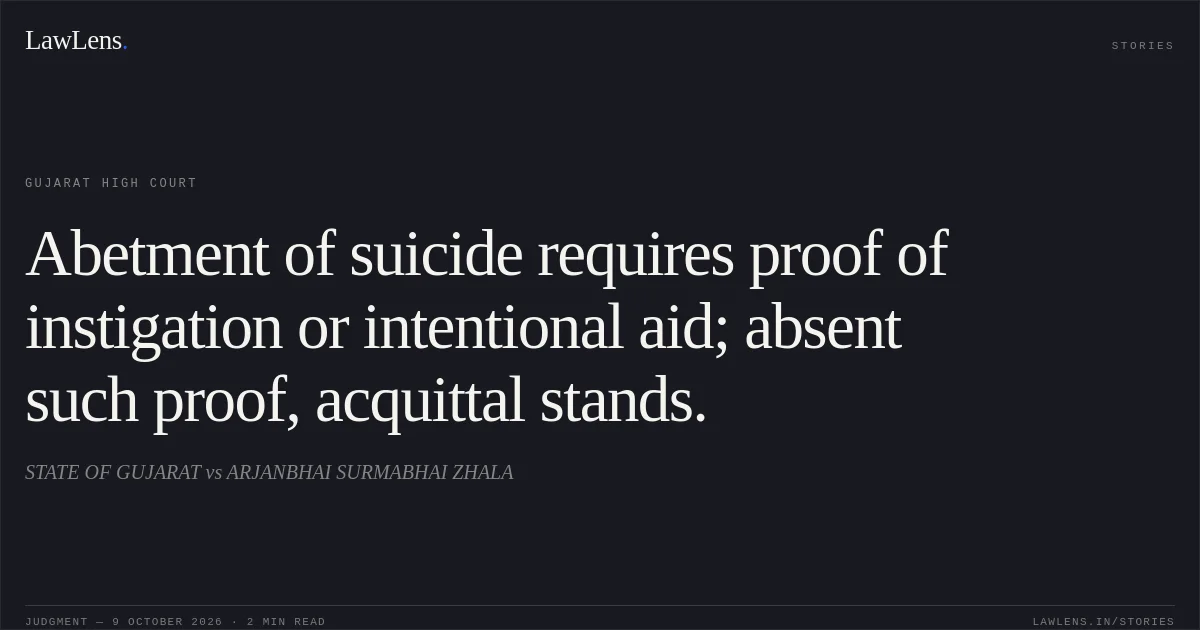
The Court held that the prosecution had failed to prove abetment of suicide beyond reasonable doubt and that the Trial Court’s acquittal under Section 306 IPC warranted no appellate interference.
The State’s appeal was dismissed and the acquittal was confirmed.
Source reference: para. 28; p. 17The respondent’s bail bond was cancelled, and the record and proceedings were directed to be returned to the Trial Court.
Source reference: para. 28; p. 17Acts & Sections Cited
8 provisions across 2 statutes referred to in this judgment. Each provision opens on LawLens.
Code of Criminal Procedure, 19733
Indian Penal Code, 18605
Original Court PDF
STATE OF GUJARATvsARJANBHAI SURMABHAI ZHALA
Click to open original judgment
Original judgment, available to read, download and summarize on LawLens.in