Facts
The applicant (husband) and respondent no. 1 (wife) married on April 30, 2005, according to Muslim rites.
Source reference: p. 2Following allegations of cruelty, harassment, and desertion, the wife filed for maintenance under Section 125 of the Cr.P.C. for herself and their minor son (respondent no. 2).
Source reference: p. 2The wife alleged the husband earned Rs. 20,000–60,000 per month as a truck owner, while the husband contended he was a casual driver earning minimal income, the vehicle belonged to his father, and he supported five other dependents.
Source reference: p. 3-4On August 18, 2011, the Principal Judge, Family Court, Junagadh, directed the applicant to pay a total monthly maintenance of Rs. 7,500.
Source reference: p. 1The husband preferred this revision application challenging the order as exorbitant and based on an incorrect assessment of income.
Source reference: p. 2Issues
1. Whether the Family Court erred in assessing the husband’s income and awarding maintenance of Rs. 7,500 per month.
Source reference: p. 1-32. Whether the High Court, in its revisional jurisdiction, should interfere with the findings of fact recorded by the lower court.
Source reference: p. 7-8Law Applied
Section 125 of the Cr.P.C., characterizing it as beneficial legislation intended to provide maintenance to wives and children unable to support themselves.
Source reference: p. 5-6It relied on Shailja v. Khobbanna and Sunita Kachwaha v. Anil Kachwaha to establish that a wife’s mere capability to earn is not a ground to deny maintenance.
Source reference: p. 5Under Bhuwan Mohan Singh v. Meena and Anju Garg v. Deepak Kumar Garg, the court affirmed the "sacrosanct duty" of an able-bodied husband to support his family, even through physical labor.
Source reference: p. 6The court applied the principles of revisional jurisdiction under Sections 397 and 401 of the Cr.P.C., citing Amit Kapoor v. Ramesh Chander, which restricts the High Court from re-appreciating evidence unless the lower court’s findings are perverse or involve a patent defect of law.
Source reference: p. 7-8Reasoning
The court observed that the marital relationship and the paternity of the minor son were undisputed.
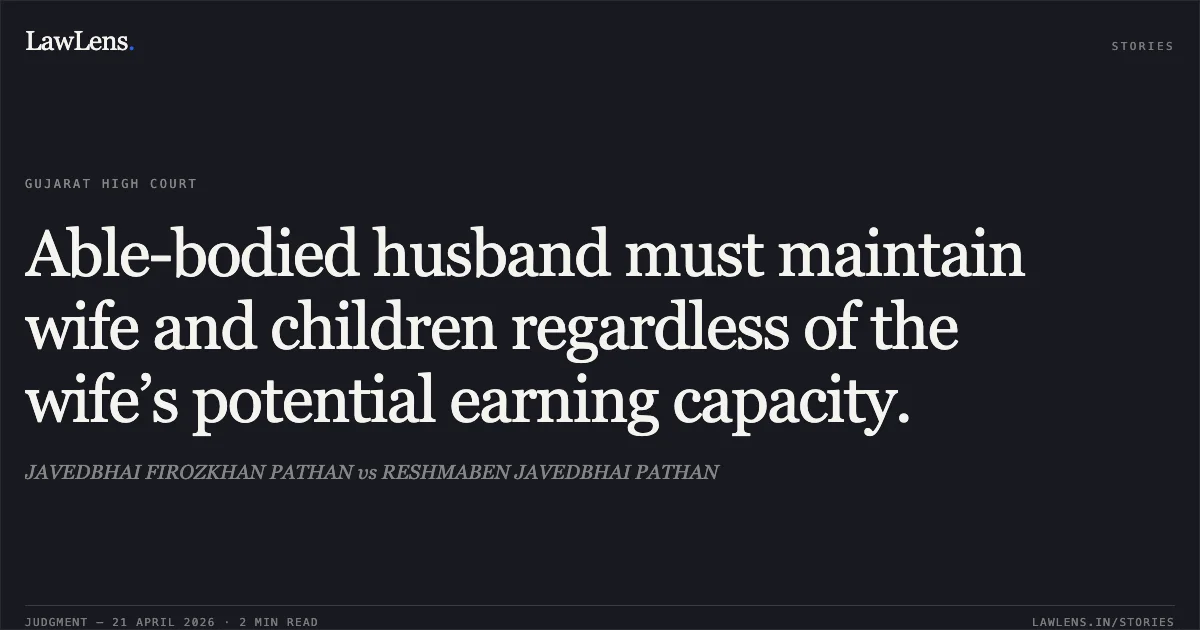
Source reference: p. 4It rejected the husband's argument regarding his limited income, noting that as an able-bodied man, he cannot escape the legal and ethical obligation to maintain his wife and child.
Source reference: p. 6The court found that the husband failed to produce evidence proving the wife was gainfully employed or capable of maintaining her prior standard of living.
Source reference: p. 5While the husband contested the ownership of the vehicle (Esher truck), the court held that the Family Court’s assessment of a Rs. 20,000 monthly income was reasonable given the facts and circumstances.
Source reference: p. 5Regarding the scope of revision, the court determined that the trial judge provided well-founded reasons based on evidence and that there was no "palpable error" or arbitrary exercise of discretion that would warrant interference.
Source reference: p. 7Holding
The High Court dismissed the revision application and confirmed the Family Court's order dated August 18, 2011, directing the applicant to pay Rs. 7,500 per month in maintenance.
The court held that the husband is bound by law to provide financial support and cannot avoid this obligation on the grounds of supporting other relatives or claiming lack of permanent employment.
Source reference: p. 6-7All interim reliefs were vacated, and the rule was discharged.
Source reference: p. 8Acts & Sections Cited
3 provisions across 1 statute referred to in this judgment. Each provision opens on LawLens.
Code of Criminal Procedure, 19733
Original Court PDF
JAVEDBHAI FIROZKHAN PATHANvsRESHMABEN JAVEDBHAI PATHAN
Click to open original judgment
Original judgment, available to read, download and summarize on LawLens.in


![Subsequent exoneration does not retrospectively invalidate a finalized promotion select list.. UNNIKRISHNAN M vs M/o Environment And Forests. CAT - ['Ernakulam']. LawLens](/stories/thumbnails/subsequent-exoneration-does-not-retrospectively-invalidate-a-finalized-promotion-select-li-ce80a0e84f2f4887857271e8b4341c42.webp)