Facts
The applicants (wife and minor son) and respondent no. 1 (husband) were married on May 20, 2005.
Source reference: p. 2The wife alleged that after six months of marriage, she was subjected to mental and physical cruelty, dowry demands of ₹7,00,000, and assault.
Source reference: p. 2She was subsequently driven out of the matrimonial home and resided with her parents.
Source reference: p. 2In 2013, she filed a maintenance application under Section 125 of the CrPC.
Source reference: p. 2On July 16, 2018, the Family Court, Ahmedabad, awarded ₹1,200 per month to the wife but rejected the claim for the minor child, as the child moved to the husband's custody during the pendency of the proceedings.
Source reference: p. 3The wife challenged this order via a revision application, seeking enhancement of the maintenance amount.
Source reference: p. 3Issues
1. Whether the High Court can decide a criminal revision application on merits in the absence of the applicant’s counsel.
Source reference: p. 12. Whether the maintenance of ₹1,200 per month awarded to the wife was just and adequate in light of the husband's income and prevailing economic conditions.
Source reference: p. 3-4Law Applied
The court exercised its revisional jurisdiction under Section 397 read with Section 401 of the Code of Criminal Procedure, 1973.
Source reference: p. 1-2It relied on Taj Mohammad v. State of Uttar Pradesh (2023) to proceed in the absence of the applicant's advocate by perusing the record.
Source reference: p. 1It relied on the principles from Bhuwan Mohan Singh v. Meena (2015) and Anju Garg v. Deepak Kumar Garg (2022), which establish that a husband has a sacrosanct moral and legal obligation to maintain his wife and cannot evade this duty if he is able-bodied.
Source reference: p. 4-5It further followed Rajnesh v. Neha (2021) and Reema Salkan v. Sumer Singh Salkan (2019), which mandate that maintenance must be determined considering the standard of living, inflation, and high cost of living.
Source reference: p. 5Reasoning
The court noted that while the husband's income was approximately ₹6,000–₹7,000 in 2013, the Family Court eventually assessed his income at ₹15,000 per month.
Source reference: p. 3-4The Court found that the Family Court erred by awarding a "meagre" sum of ₹1,200 per month, which failed to account for spiraling inflation and the husband's actual earning capacity.
Source reference: p. 4Although the minor child was residing with the father (thereby justifying the denial of maintenance for the child), the Court held that the wife was entitled to a reasonable amount that reflects the husband’s socio-economic status.
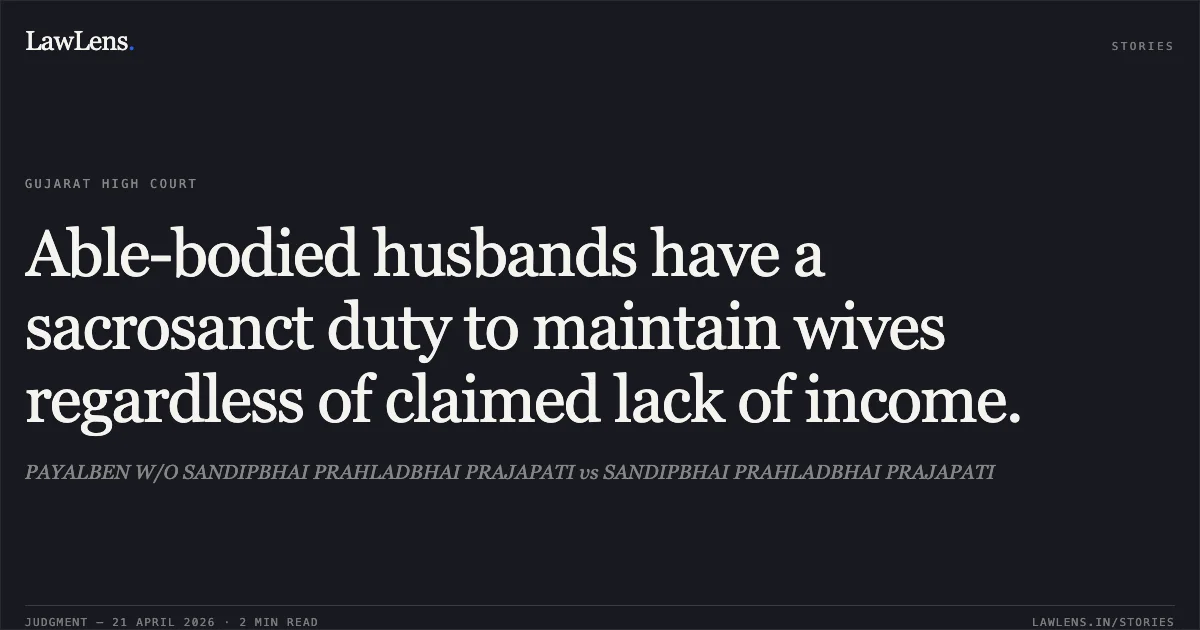
Source reference: p. 4-5The Court emphasized that an able-bodied husband is legally bound to support his wife and cannot plead a lack of income to avoid this liability.
Source reference: p. 5Holding
The High Court held that the maintenance awarded by the Family Court was inadequate and constituted a revisable error.
The Court partly allowed the application and enhanced the maintenance for the wife from ₹1,200 per month to ₹3,000 per month, effective from the date of the original application.
Source reference: p. 4-5The respondent-husband was directed to pay the arrears and continued monthly maintenance at the revised rate.
Source reference: p. 4Acts & Sections Cited
2 provisions across 1 statute referred to in this judgment. Each provision opens on LawLens.
Code of Criminal Procedure, 19732
Original Court PDF
PAYALBEN W/O SANDIPBHAI PRAHLADBHAI PRAJAPATIvsSANDIPBHAI PRAHLADBHAI PRAJAPATI
Click to open original judgment
Original judgment, available to read, download and summarize on LawLens.in


