Facts
The petitioners challenged the dismissal, for non-prosecution, of Ex. CRL No. 226/2023, an execution proceeding for maintenance, after they could not provide the judgment debtor’s current address or whereabouts.
Source reference: para. 1, 5The petitioners relied on a Family Court order awarding interim maintenance of ₹4,000 per month to each petitioner from 26 November 2019, together with litigation expenses; they also referred to an order under the Protection of Women from Domestic Violence Act, 2005.
Source reference: para. 2–4They sought restoration of the execution and steps to trace the judgment debtor.
Source reference: para. 1Issues
Whether an execution proceeding for maintenance may be dismissed or closed because the judgment debtor is untraceable and the decree holder cannot provide a current address.
Source reference: para. 5, 9, 13(c), 14Whether the executing court must take available measures, including police assistance and enquiries into the judgment debtor’s residence, employment and assets, to facilitate enforcement.
Source reference: para. 13(e), 15Law Applied
Article 226 of the Constitution and Section 528 of the Bharatiya Nagarik Suraksha Sanhita, 2023, provided the basis for the petition.
Source reference: para. 1The Court relied on Rajnesh v. Neha, (2021) 2 SCC 324, for the principles that maintenance orders must be effectively enforced and may be executed under the applicable statutory provisions or as money decrees under Sections 51, 55, 58 and 60 read with Order XXI of the Code of Civil Procedure, 1908.
Source reference: para. 6(i)It relied on Kuldip Kaur v. Surinder Singh, (1989) 1 SCC 405, for the rule that coercive measures are modes of enforcement, whereas the maintenance liability is discharged only by actual payment.
Source reference: para. 6(ii)It relied on Rahul S. Shah v. Jinendra Kumar Gandhi, (2021) 6 SCC 418, for directions concerning timely execution and police assistance where necessary.
Source reference: para. 6(iii)The Court also applied the continuing-liability principle recognised in Shantha @ Ushadevi v. B.G. Shivananjappa, (2005) 4 SCC 468, and Poongodi v. Thangavel, (2013) 10 SCC 618, and the rule against allowing a person to benefit from their own wrong, as stated in Union of India v. Major General Madan Lal Yadav (Retd.), (1996) 4 SCC 127.
Source reference: para. 8, 10The Court referred to enforcement under Section 20(6) of the DV Act and Section 125(3) read with Section 128 of the CrPC, noting the corresponding BNSS provisions as Sections 144(3) and 147.
Source reference: para. 13(e)Reasoning
The Court reasoned that the judgment debtor’s alleged evasion could not convert the petitioners’ inability to provide a current address into a ground for terminating execution: that would allow the debtor to benefit from the difficulty his own conduct created.
Source reference: para. 9, 13(c)–(d)Because maintenance liability continues until actual payment, dismissing the execution without exhausting available enforcement processes would leave the award unsatisfied and undermine its purpose.
Source reference: para. 10, 13(a)–(b), 14The executing court was therefore required to consider lawful means of tracing and serving the debtor, including police assistance and enquiries into residence, employment and assets, rather than confining itself to the address supplied by the decree holders.
Source reference: para. 13(e), 15Holding
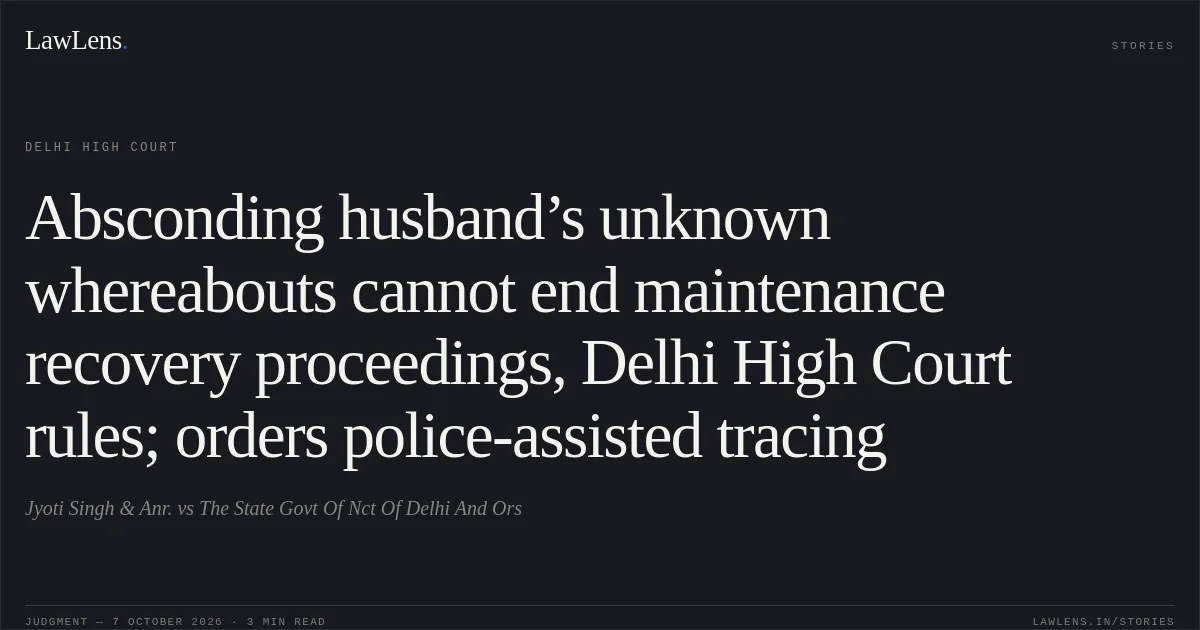
The Court held that the judgment debtor’s unavailability, by itself, was not a proper ground to close the maintenance execution and that the petitioners should not be compelled to commence fresh proceedings.
It set aside the order dated 5 February 2026 and restored Ex. CRL No. 226/2023 to its original number and position. The Family Court was directed to take effective steps to trace and serve the judgment debtor, including seeking appropriate police assistance from the SHO, PS Shakarpur, who was directed to file a status report, and to enquire into the debtor’s residence, employment and assets.
Source reference: para. 16The petition was allowed and the pending application disposed of.
Source reference: para. 17Acts & Sections Cited
10 provisions across 4 statutes referred to in this judgment. Each provision opens on LawLens.
Bharatiya Nagarik Suraksha Sanhita, 20233
Protection of Women from Domestic Violence Act, 20051
Code of Criminal Procedure, 19732
Code of Civil Procedure, 19084
Original Court PDF
Jyoti Singh & Anr.vsThe State Govt Of Nct Of Delhi And Ors
Click to open original judgment
Original judgment, available to read, download and summarize on LawLens.in