Facts
The Petitioner, employed as a Rula Mistry since 1998, suffered an industrial accident in 2002 involving a steel blade penetrating his hand and spine
Source reference: para. 2-3Following hospitalization in March 2007, he reported for duty on 09.03.2007 but was allegedly refused reinstatement and terminated without notice
Source reference: para. 4The Management claimed the Petitioner abandoned his service effective 29.01.2007
Source reference: para. 20The Labour Court, via an Award dated 17.02.2011, upheld the Management's plea of abandonment and denied relief
Source reference: para. 6During the pendency of the Writ Petition, the workman expired in 2022 and was substituted by his legal representatives
Source reference: para. 10Notably, in parallel ESIC proceedings, the Management paid ₹15,000 as compensation for the accident, acknowledging the injury occurred during employment
Source reference: para. 9, 58Issues
1. Whether the Learned Labour Court was justified in denying any relief to the Petitioner/Workman against the management based on the plea of abandonment?
Source reference: para. 122. Whether the termination of the Petitioner’s services amounted to illegal retrenchment in violation of Section 25F of the Industrial Disputes Act, 1947?
Source reference: para. 13, 42Law Applied
The Court primarily applied the Industrial Disputes Act, 1947, specifically Section 2(k) defining "industrial dispute" [para. 32], Section 2A deeming individual discharge/dismissal as an industrial dispute [para. 34], and Section 2(oo) defining "retrenchment" as termination for any reason other than punishment [para. 41].
Source reference: para. 32, 34, 41It relied on the principle that abandonment must be intentional and proved by the employer through cogent evidence, typically requiring a domestic inquiry
Source reference: para. 14, 48Regarding relief, the Court followed B.S.N.L. v. Bhurumal (2014) and Jagbir Singh v. Haryana State Agriculture Marketing (2009), which establish that reinstatement is not automatic and monetary compensation may be preferred
Source reference: para. 65-66It further applied the compensation quantum parameters set in Amit Kumar Dubey v. M.P.P.K.V.V. Co. Ltd. (2025), mandating that compensation must bear a nexus to the length of service
Source reference: para. 69Reasoning
The Court found the Labour Court's finding of "abandonment" perverse and unsupported by evidence.
Source reference: para. 45-46It noted that the Management failed to prove the service of call-back letters, whereas the workman proved his protest against termination via registered post
Source reference: para. 45-46The Court observed that the Management's offer to take the workman back during proceedings contradicted the plea of abandonment
Source reference: para. 50Crucially, the Court highlighted that the workman's absence was medically justified by the "foreign object" (steel blade) remaining in his body, a fact corroborated by medical records and the Management’s payment of accident compensation
Source reference: para. 55-58The Court held that refusal to allow the workman to resume duties constituted oral termination, which, in the absence of a notice, pay in lieu, or a domestic inquiry, was a patent violation of Section 25F of the Act
Source reference: para. 42-43, 48Holding
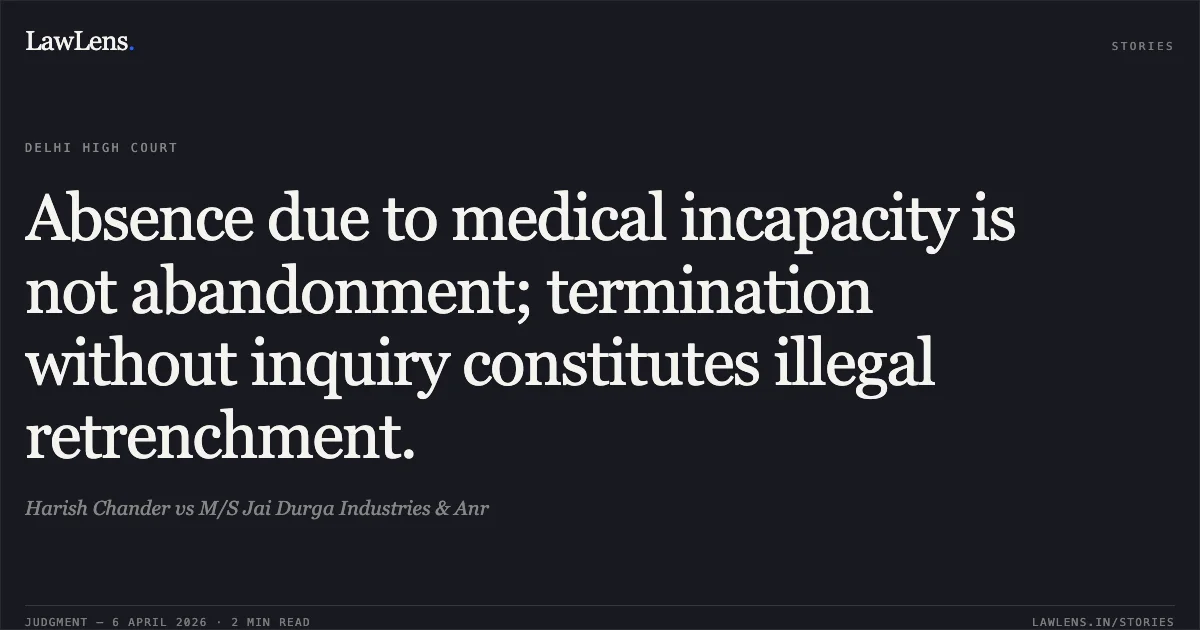
The Court quashed the Impugned Award, holding the termination illegal
However, noting the lapse of 19 years since termination and the death of the workman in 2022, the Court ruled that reinstatement was impractical
Source reference: para. 67Applying the "pro-rata per year of service" principle from Amit Kumar Dubey, the Court directed the Respondent/Management to pay a consolidated compensation of ₹20,00,000 (Twenty Lakhs) to the Petitioner’s legal representatives within six months
Source reference: para. 70-71Failure to pay within the stipulated time attracts interest at 9% per annum from the date of default
Source reference: para. 71Acts & Sections Cited
4 provisions across 2 statutes referred to in this judgment. Linked provisions open on LawLens.
Industrial Disputes Act, 19473
Employees1
Original Court PDF
Harish ChandervsM/S Jai Durga Industries & Anr
Click to open original judgment
Original judgment, available to read, download and summarize on LawLens.in


