Facts
The first respondent/claimant filed a motor accident claim alleging that, on 30 January 2019, he was travelling as a pillion rider on a motorcycle when a Maruti Alto car bearing Registration No. TN-37-CV-6673, coming from the opposite direction, collided with the motorcycle near K. Paramathi Selvapuram Bus Stop, Karur–Coimbatore Main Road.
Source reference: paras. 2.1–2.4, 8; pp. 2–7He sustained serious fractures to his hand, leg and hip, underwent surgeries, and remained hospitalised for approximately one month.
Source reference: paras. 2.1–2.4; pp. 2–7An FIR was registered against the car driver under Sections 279 and 338 IPC, and the driver subsequently pleaded guilty and was convicted by the criminal court.
Source reference: paras. 2.1–2.4, 8; pp. 2–7The Motor Accident Claims Tribunal held that the car driver was negligent, assessed the claimant’s permanent disability at 50%, fixed his monthly income at ₹12,000, added 40% towards future prospects, applied a multiplier of 16, and awarded ₹16,12,800 towards permanent disability, in addition to compensation under other heads.
Source reference: para. 5; p. 4The insurer challenged the award under Section 173 of the Motor Vehicles Act, disputing negligence, disability, income, future prospects, medical expenses and the alleged duplication of compensation.
Source reference: para. 6; p. 5Issues
1. Whether the Tribunal was justified in holding that the accident resulted from the rash and negligent driving of the insured car driver, rather than the negligence of the motorcycle rider.
Source reference: para. 7(1); pp. 5–62. Whether the assessment of the claimant’s permanent disability at 50% was legally and evidentially sustainable, particularly when the disability was assessed by a doctor who was not the treating doctor and without reference to a Medical Board.
Source reference: para. 7(2); pp. 5, 8–93. Whether the monthly income of ₹12,000 and the addition of 40% towards future prospects were excessive or legally impermissible.
Source reference: para. 7(3); pp. 5, 9–104. Whether the amounts awarded under pain and suffering, loss of amenities, loss of enjoyment of life, future treatment, medical expenses and other heads were excessive, overlapping or unsupported by evidence.
Source reference: para. 7(4); pp. 5, 11–135. Whether the Tribunal’s award warranted appellate interference.
Source reference: para. 7(5); p. 5Law Applied
The appeal was considered under Section 173 of the Motor Vehicles Act, which permits appellate scrutiny of an award of the Motor Accident Claims Tribunal.
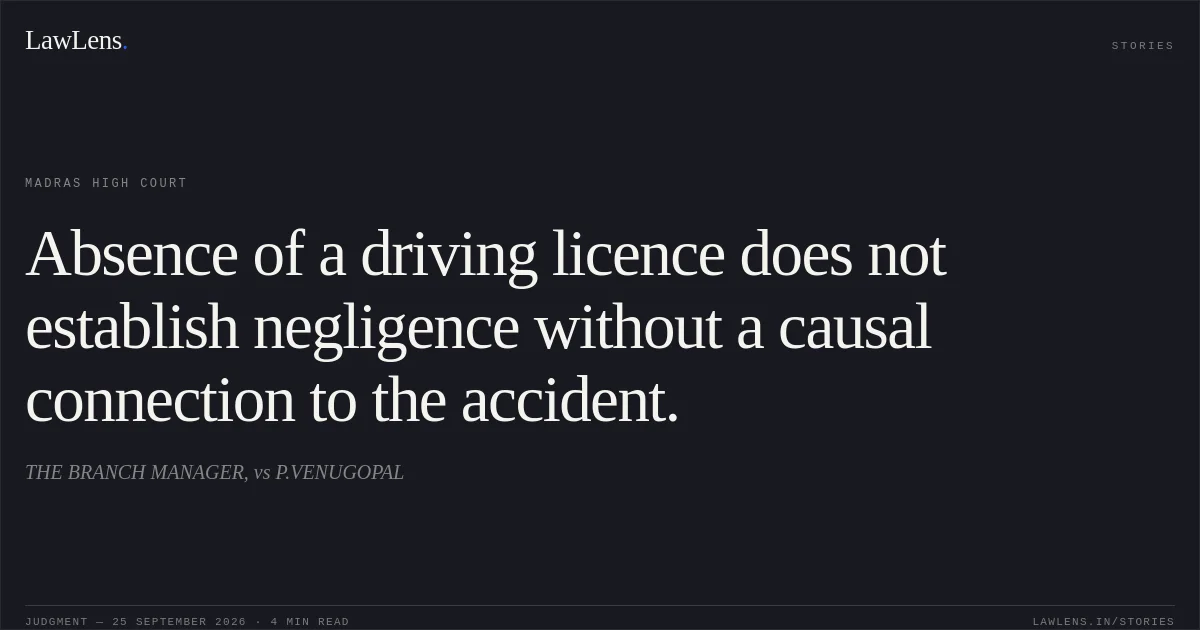
Source reference: p. 1The Court applied the principle that negligence must be established on the evidence and that the mere absence of a driving licence does not prove that the unlicensed driver caused the accident; a causal connection between the alleged licence violation and the accident must be shown.
Source reference: para. 8; pp. 6–7It further applied the principle that a doctor who examines and assesses an injured claimant may give evidence regarding permanent disability even if he was not the treating doctor, and that the absence of a Medical Board, by itself, does not invalidate such evidence.
Source reference: para. 10; p. 8In assessing loss of earning capacity, the Court accepted the multiplier method and held, consistent with National Insurance Co. Ltd. v. Pranay Sethi, that a self-employed person may receive an appropriate addition for future prospects; for a claimant aged about 40 years, the Tribunal’s 40% addition was upheld.
Source reference: paras. 11–12; pp. 9–10The Court also distinguished pecuniary compensation for loss of earning capacity from non-pecuniary damages for pain, suffering and loss of amenities, permitting separate awards under those heads.
Source reference: para. 16; p. 11Appellate interference was limited to cases involving patent legal error, disregard of material evidence, perversity or wholly unreasonable findings.
Source reference: para. 20; p. 13Reasoning
The Court upheld the finding of negligence because the claimant’s version was supported by the FIR, the criminal court’s conviction of the car driver, and the absence of any contrary evidence.
Source reference: paras. 8–9; pp. 6–7The insured vehicle’s owner remained ex parte, while the insurer failed to prove that the motorcycle rider’s alleged lack of a driving licence caused the collision; therefore, the insurer could not avoid liability merely by relying on the Motor Vehicle Report.
Source reference: paras. 8–9; pp. 6–7The 50% disability assessment was accepted because the examining doctor had assessed the claimant’s functional limitations, including impotence and erectile dysfunction resulting from the injuries, and the insurer produced no contrary medical evidence.
Source reference: para. 10; p. 8The Court found the monthly income of ₹12,000 reasonable for a self-employed labourer in the circumstances and upheld the 40% addition for future prospects under the principles applicable to self-employed persons.
Source reference: paras. 11–12; pp. 9–10The multiplier calculation—₹12,000 plus 40% future prospects, multiplied by 12, 16 and 50% disability—was therefore sustained.
Source reference: para. 14; p. 10The Court further held that compensation for permanent loss of earning capacity did not overlap with compensation for pain, suffering, loss of amenities or future treatment, and found the medical expenses and other amounts supported by the treatment records and nature of the injuries.
Source reference: paras. 15–19; pp. 10–13Holding
The appeal was dismissed and the Tribunal’s award dated 8 December 2021 in M.C.O.P. No.74 of 2019 was confirmed.
The insurer was directed to deposit the entire award amount, after adjustment of any amount already deposited, together with interest at 7.5% per annum from the date of the claim petition until deposit, within six weeks of receiving the judgment.
Source reference: para. 21(ii); p. 14Upon deposit, the claimant was permitted to withdraw the amount according to the apportionment ordered by the Tribunal.
Source reference: para. 21(iii); p. 14There was no order as to costs, and the connected miscellaneous petition was closed.
Source reference: paras. 21(iii)–(iv); p. 14Acts & Sections Cited
3 provisions across 2 statutes referred to in this judgment. Each provision opens on LawLens.
Motor Vehicles Act, 19881
Indian Penal Code, 18602
Original Court PDF
THE BRANCH MANAGER,vsP.VENUGOPAL
Click to open original judgment
Original judgment, available to read, download and summarize on LawLens.in