Facts
On 27 September 2017, Maheshbhai was travelling in the general compartment of a train towards Surat via Ahmedabad. The claimants alleged that, owing to overcrowding and a sudden jerk, he fell from the train between Sabarmati and Ahmedabad Railway Stations, sustained grievous injuries, and later died on 31 October 2017 after prolonged hospitalisation.
Source reference: p.1, paras. 1, 5His parents filed a claim under Section 16 of the Railway Claims Tribunal Act, 1987. The Railway Claims Tribunal held that he was a bona fide passenger and that the death resulted from an “untoward incident”; it awarded ₹8 lakhs with 9% interest.
Source reference: p.1, para. 1The Gujarat High Court reversed the award under Section 23 of the 1987 Act, principally because no railway ticket or sufficient details of the train journey had been produced and there was no direct evidence of the fall.
Source reference: p.1, para. 1; p.8, para. 7Issues
Whether the deceased could be treated as a bona fide passenger despite the non-recovery or non-production of his railway ticket.
Source reference: pp. 9–11, paras. 9–10Whether the evidence established that the deceased suffered injuries and died as a result of an “untoward incident” attracting compensation under Section 124-A of the Railways Act, 1989.
Source reference: pp. 5–7, paras. 5–8Whether the delayed investigation report prepared under Rule 6 of the Railway Passengers (Manner of Investigation of Untoward Incidents) Rules, 2003 could be relied upon against the claimants.
Source reference: p.12, para. 11Law Applied
The Court applied Section 124-A of the Railways Act, 1989, which imposes strict liability on the Railways to pay compensation for death or injury caused by an “untoward incident,” subject to the statutory exceptions.
Source reference: pp. 10–11, para. 10Under Section 123(c)(2), an accidental fall from a passenger train constitutes an untoward incident.
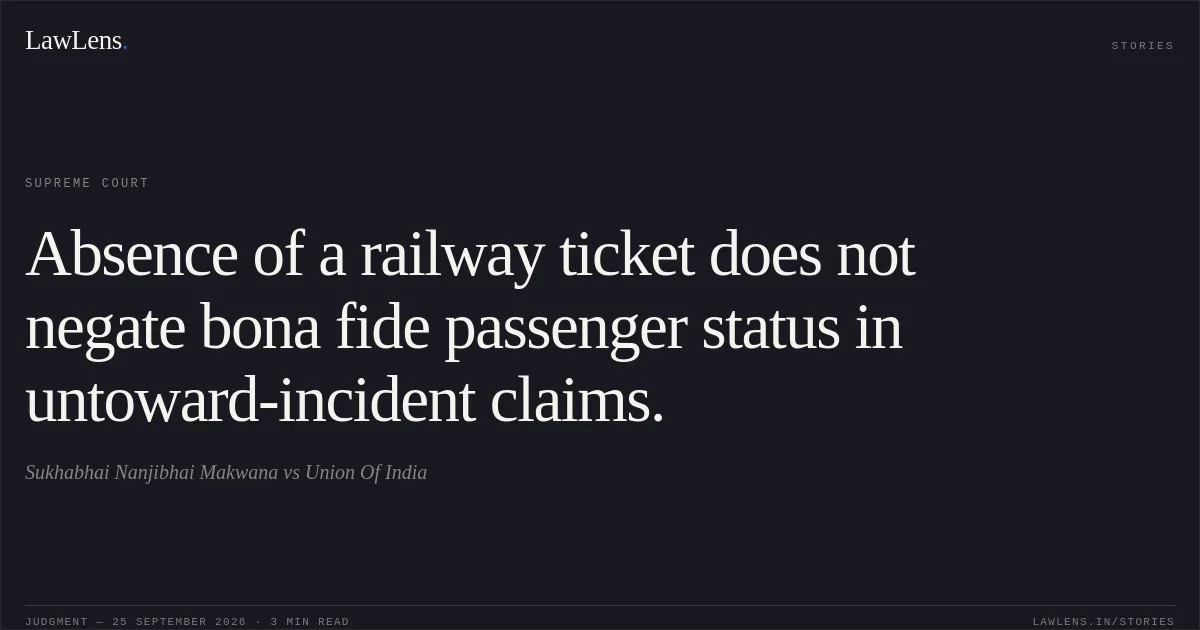
Source reference: pp. 1, 5, paras. 1, 5Relying on Union of India v. Rina Devi, 2018 INSC 469, the Court held that mere absence of a ticket does not disprove bona fide passenger status; the claimant may discharge the initial burden through an affidavit or sworn statement, after which the burden shifts to the Railways to rebut the claim on the basis of facts or surrounding circumstances.
Source reference: pp. 9–10, para. 9The Court also relied on Union of India v. Prabhakaran Vijaya Kumar, 2008 INSC 577, for the principle of strict liability under Section 124-A.
Source reference: p.11, para. 10Kalandi Charan Sahoo v. General Manager, South-East Central Railways, holding that unexplained delay in conducting the inquiry required under the 2003 Rules may operate against the Railways.
Source reference: p.12, para. 11Reasoning
The Court held that the father’s sworn statement that the deceased had purchased a ticket, together with the specific pleading that the ticket and other personal articles had been lost, discharged the claimants’ initial burden under Rina Devi.
Source reference: pp. 8–10, paras. 8–9The Railways’ witnesses admitted that they had not searched the deceased’s pockets, and the deceased had remained hospitalised for more than a month, making the loss or non-preservation of the ticket reasonably probable.
Source reference: pp. 7–8, 10–11, paras. 6, 8, 10The Court therefore concluded, on a preponderance of probabilities, that he was a bona fide passenger.
Source reference: no citationThe evidence that he was found injured near the railway line, coupled with the claimants’ account that he had fallen from the train while standing near the door in a crowded compartment, supported the Tribunal’s finding of an accidental fall and untoward incident.
Source reference: pp. 5–8, paras. 5–8The Railways’ evidence did not establish a self-inflicted injury or otherwise rebut the claim.
Source reference: no citationFurther, the investigation report was prepared approximately seven months after the incident, only after the claim proceedings commenced, without any explanation for the delay; consequently, the Court declined to rely on it.
Source reference: p.12, para. 11Holding
The Supreme Court held that the deceased was a bona fide passenger and that his death resulted from an untoward incident attracting the Railways’ strict liability under Section 124-A of the Railways Act, 1989.
The non-production of the railway ticket was insufficient to defeat the claim, and the delayed investigation report could not be relied upon against the claimants.
Source reference: pp. 11–12, paras. 10–11The High Court’s order dated 15 July 2025 was set aside, the Tribunal’s award dated 17 June 2022 granting ₹8 lakhs with 9% interest was restored, and the Railways were directed to satisfy the award within thirty days.
Source reference: p.13, para. 12The appeal was allowed with no order as to costs.
Source reference: p.13, para. 12Acts & Sections Cited
3 provisions across 2 statutes referred to in this judgment. Each provision opens on LawLens.
Railway Claims Tribunal Act, 19872
Railways Act, 19891
Original Court PDF
Sukhabhai Nanjibhai MakwanavsUnion Of India
Click to open original judgment
Original judgment, available to read, download and summarize on LawLens.in