Facts
The Appellant (plaintiff) entered into an Agreement to Sell dated 22.06.2003 with the Respondent (defendant) for a property in Punjab for ₹12,50,000/-, paying ₹9,00,000/- as earnest money
Source reference: para. 2The agreement was extended twice, but the Respondent failed to execute the Sale Deed [paras. 3-4]. The Appellant sued for specific performance.
Source reference: paras. 3-4The Respondent contended the documents were merely collateral security for a separate travel arrangement and that the Appellant converted blank signed papers into an agreement
Source reference: para. 6The Trial Court found the agreement valid but declined specific performance because the contract only mentioned "refund of earnest money" in case of default
Source reference: para. 7The First Appellate Court reversed this, granting specific performance [para. 8]. However, the High Court set aside the decree, viewing the absence of a specific performance clause and a non-disclosed ₹2,00,000/- transaction as evidence that the deal was not a genuine sale
Source reference: para. 10Issues
1. Whether a contract can be specifically enforced despite the presence of an earnest money refund clause and the absence of an express clause for enforcement through court
Source reference: para. 14, 162. Whether the High Court exceeded its jurisdiction under Section 100 of the CPC by disturbing concurrent findings of fact without a finding of perversity
Source reference: para. 14, 22Law Applied
The court applied Section 23 of the Specific Relief Act, 1963, which stipulates that a contract may be enforced even if a sum is named as payable for its breach, provided the sum was intended to secure performance rather than give an option to default
Source reference: para. 18It relied on M.L. Devender Singh v. Syed Khaja (1973) 2 SCC 515, affirming that naming damages does not defeat specific performance unless the sum was a substitute for performance
Source reference: paras. 19-20Regarding appellate jurisdiction, the court applied Section 100 of the Code of Civil Procedure, 1908, following Sir Chunilal v. Mehta & Sons Ltd. (1962), which limits Second Appeals to substantial questions of law and prohibits interference with findings of fact unless they are perverse or unsupported by evidence
Source reference: para. 15Reasoning
The Supreme Court held that the High Court’s construction of the refund clause was erroneous; the clause was a deterrent to ensure performance, not an "option to walk away"
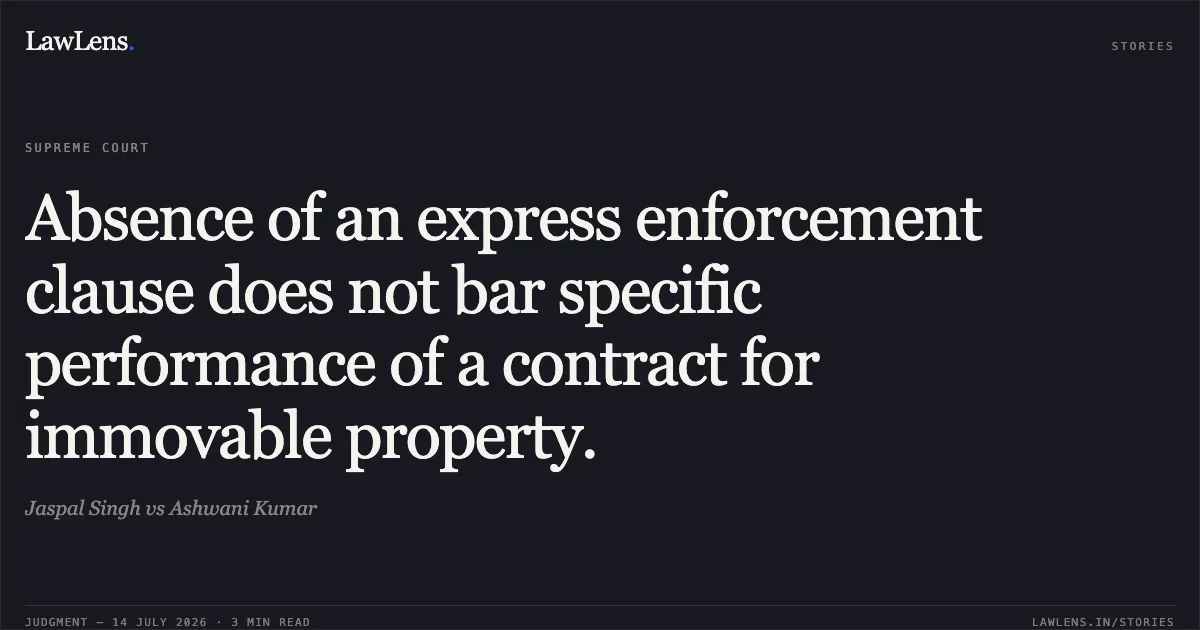
Source reference: para. 21Under Section 23 of the 1963 Act, the absence of an express enforcement clause does not bar specific performance
Source reference: para. 20Furthermore, the Court found that the High Court improperly reappreciated evidence to revive the Respondent's "fraud/travel agent" defense, which had been rejected by both lower courts
Source reference: para. 23The Court noted that the Appellant’s failure to disclose a separate ₹2,00,000/- loan was a collateral matter and did not prove the Agreement to Sell was a sham
Source reference: para. 24The High Court further erred by treating the sale of an undivided share and the extension of timelines as suspicious, whereas such transactions are legally valid and the extensions were mutual
Source reference: paras. 25-26By displacing concurrent findings of fact without finding them "perverse," the High Court transgressed its Section 100 CPC limits
Source reference: para. 27Holding
The Supreme Court allowed the appeals, quashing the High Court’s judgment [paras. 29-30]. It held that the refund clause did not bar specific performance
The Court restored the judgment and decree of the First Appellate Court, confirming the Appellant was entitled to specific performance of the contract [para. 29]. The findings that the agreement was valid, the Appellant was ready and willing, and the fraud defense was unproven were reinstated
Source reference: para. 28Acts & Sections Cited
2 provisions across 2 statutes referred to in this judgment. Each provision opens on LawLens.
Code of Civil Procedure, 19081
Specific Relief Act, 19631
Original Court PDF
Jaspal SinghvsAshwani Kumar
Click to open original judgment
Original judgment, available to read, download and summarize on LawLens.in


