Facts
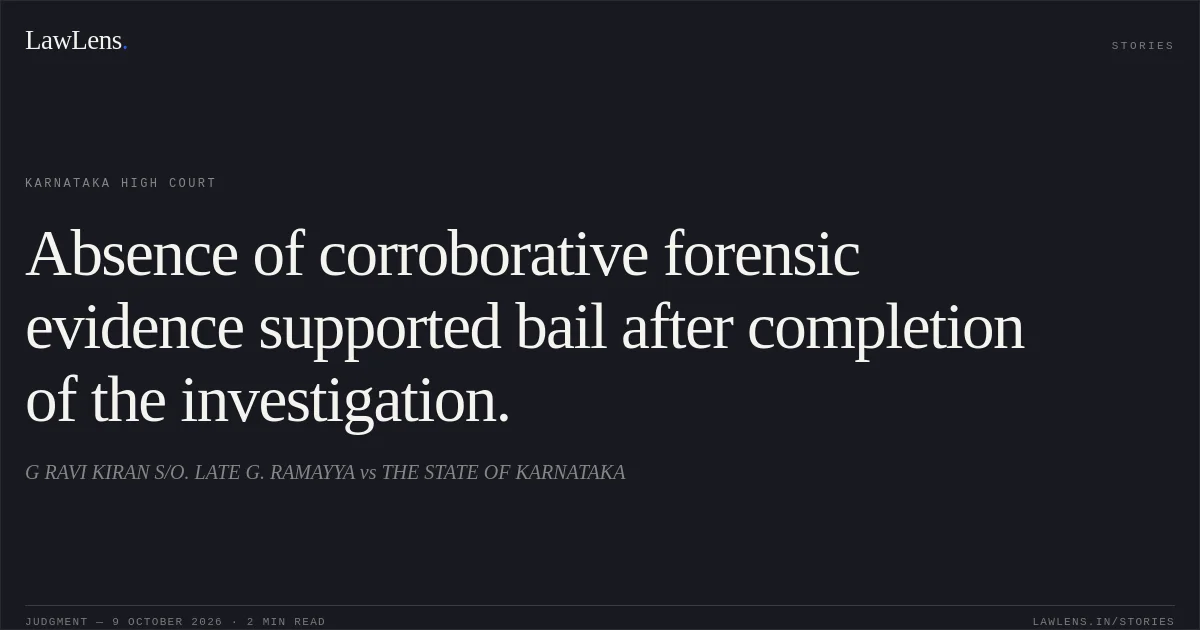
The petitioner, a lecturer at the victim’s college, sought regular bail in Crime No. 100/2026 of Ballari Women Police Station.
Source reference: pp. 2–5The victim, then a second-year PUC student, alleged that she and the petitioner had been in a relationship and that he repeatedly had sexual intercourse with her against her will, including on a promise of marriage.
Source reference: pp. 2–5The petitioner was arrested and remanded to judicial custody.
Source reference: pp. 2–5After the investigation was completed and the charge sheet filed, he sought bail; the prosecution opposed, citing the allegations, risk of witness tampering, and possibility of further offences.
Source reference: pp. 2–5The FSL report stated that seminal stains, spermatozoa, skin or tissue, and blood stains were not detected on the seized articles.
Source reference: p. 5Issues
Whether the petitioner had made out a case for regular bail in light of the allegations, the victim’s statement, and the available forensic material
Source reference: pp. 5–6Whether the risks of witness tampering or repetition of offences warranted refusing bail
Source reference: p. 4Law Applied
The Court considered the petitioner’s application under Section 439 of the Code of Criminal Procedure, 1973, read with Section 483 of the Bharatiya Nagarik Suraksha Sanhita, 2023.
Source reference: p. 2In deciding bail, it stated that the Court must consider the nature and circumstances of the offence; the petitioner’s position in relation to the victim and witnesses; the likelihood of absconding, repeating offences, or tampering with witnesses; and the petitioner’s character and antecedents.
Source reference: p. 6A bail court need not conduct a mini-trial or finally assess the prosecution evidence.
Source reference: p. 6Reasoning
The Court acknowledged that the victim’s statement alleged repeated sexual intercourse on a promise of marriage, but also considered that the FSL examination had detected none of the listed biological materials on the seized articles.
Source reference: pp. 5–6Taking that forensic result into account alongside the nature and gravity of the allegations, the Court found that the petitioner had made out a case for bail and that there were no reasonable and sufficient grounds, at that stage, to believe him guilty.
Source reference: pp. 5–6It addressed the prosecution’s concerns through conditions prohibiting witness tampering and involvement in similar offences.
Source reference: pp. 5–6, 7–8Holding
The Court allowed the petition and directed the petitioner’s release on bail in Crime No. 100/2026, subject to a personal bond of ₹2,00,000 with two sureties for the like amount, and conditions that he not threaten or tamper with prosecution witnesses and not involve himself in similar offences.
Breach of the conditions would entitle the prosecution to seek cancellation of bail.
Source reference: pp. 7–8The Court clarified that its observations were confined to disposal of the bail petition.
Source reference: pp. 7–8Acts & Sections Cited
7 provisions across 4 statutes referred to in this judgment. Each provision opens on LawLens.
Code of Criminal Procedure, 19731
Bharatiya Nagarik Suraksha Sanhita, 20232
Bharatiya Nyaya Sanhita, 20233
Indian Penal Code, 18601
Original Court PDF
G RAVI KIRAN S/O. LATE G. RAMAYYAvsTHE STATE OF KARNATAKA
Click to open original judgment
Original judgment, available to read, download and summarize on LawLens.in