Facts
The Appellant was convicted by the Trial Court under Sections 376(2)(j) and 450 of the IPC for the rape and house trespass of a 90-year-old woman suffering from advanced dementia
Source reference: p. 1-2The victim’s son (PW-8) discovered the Appellant on top of the victim with his trousers lowered; however, due to the victim's mental state and subsequent death, no direct testimony of penetration was available
Source reference: p. 2-3Medical evidence did not conclusively prove penile penetration, but forensic reports confirmed the presence of the Appellant's semen on the victim's apparel
Source reference: p. 6The Appellant challenged the conviction, arguing the evidence only established an "attempt" rather than the completed offence
Source reference: p. 4Issues
1. Whether the testimony of the sole eyewitness (PW-8) and the forensic evidence were sufficient to establish the essential ingredient of "penetration" required for a conviction of rape under Section 375 of the IPC
Source reference: p. 3, 62. Whether, in the absence of proof of penetration, the Appellant’s acts constituted an "attempt to commit rape" punishable under Section 511 read with Section 376 of the IPC
Source reference: p. 4, 10Law Applied
The court applied Section 375 of the IPC, noting that after the 2013 Amendment, "manipulation" resulting in penetration of any body part constitutes rape, though penetration remains a sine qua non
Source reference: p. 5, 7It relied on Koppul Venkat Rao v. State of A.P. to affirm that even slight penetration is necessary for a rape conviction
Source reference: p. 7-8It further applied Section 511 of the IPC regarding "attempts" and the distinction between preparation and attempt as defined in State of M.P. v. Mahendra Alias Golu
Source reference: p. 9-10Finally, the court invoked Section 106 of the Indian Evidence Act, 1872, holding that when incriminating facts (like semen on the victim) are especially within the knowledge of the accused, the failure to provide an explanation serves as an additional link in the circumstantial chain
Source reference: p. 11-12Reasoning
The Court observed that while the 2013 Amendment expanded the definition of rape to include manipulation (Section 375(c)), the prosecution failed to prove actual penetration beyond a reasonable doubt because the eyewitness did not see the act itself and the medical report was inconclusive
Source reference: p. 6, 8However, the Court determined that the Appellant had moved past the stage of "preparation" into "attempt"
Source reference: p. 10By applying Section 106 of the Evidence Act, the Court found that the presence of the Appellant's semen on the victim's clothes was a fact only the Appellant could explain; his silence and total denial allowed the Court to infer that an attempted act of penetration occurred
Source reference: p. 11-13Thus, while the completed offence of rape was not proved, the evidence of ejaculation and physical positioning established an attempt to commit rape
Source reference: p. 13Holding
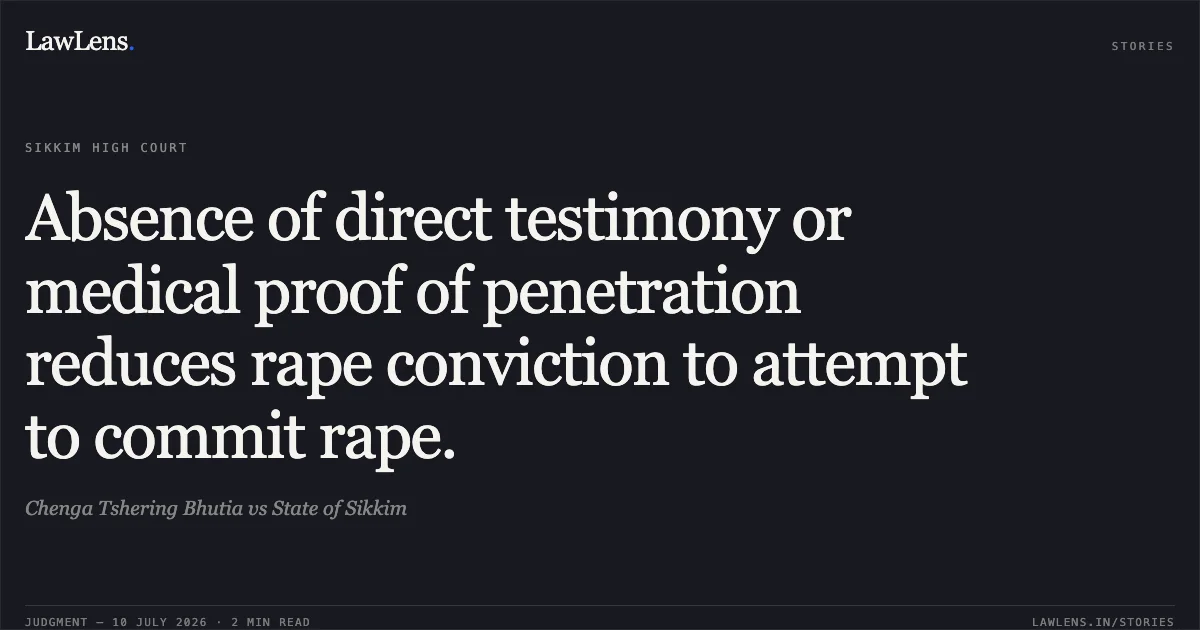
The High Court partly allowed the appeal, setting aside the conviction under Section 376(2)(j) IPC and altering it to a conviction under Section 511 read with Section 376 IPC for "attempt to commit rape"
The sentence of rigorous life imprisonment was modified to rigorous imprisonment for five (5) years, and the sentence under Section 450 IPC (house trespass) was also reduced to five (5) years, to run concurrently
Source reference: p. 14Acts & Sections Cited
4 provisions across 1 statute referred to in this judgment. Each provision opens on LawLens.
Indian Penal Code, 18604
Original Court PDF
Chenga Tshering BhutiavsState of Sikkim
Click to open original judgment
Original judgment, available to read, download and summarize on LawLens.in


