Facts
The Appellant’s deceased husband, Umesh Raj Sahagal, was traveling from Bijwasan to Pataudi Road on 27.02.2020 with a valid journey ticket.
Source reference: p. 2His body was subsequently discovered near the tracks between Pataudi Road and Jataula Railway Stations.
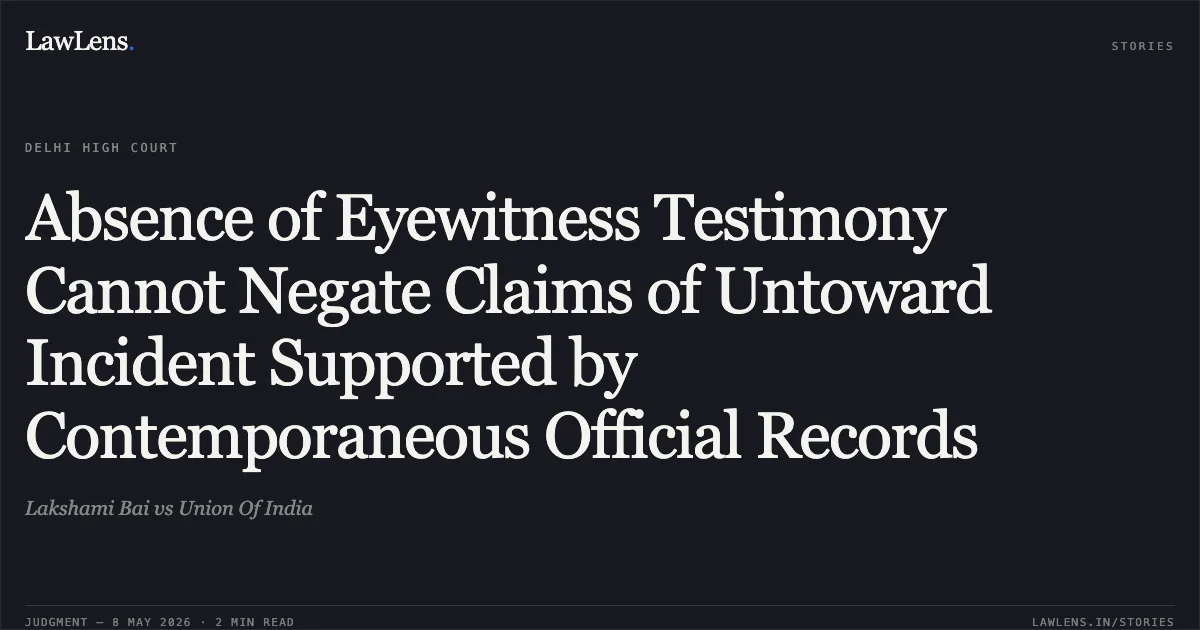
Source reference: p. 2The Railway Claims Tribunal (RCT) found the deceased to be a bona fide passenger but dismissed the claim on the ground that the Appellant failed to prove the death occurred due to an "untoward incident" under Section 123(c) of the Railways Act, citing a lack of eyewitnesses and conclusive evidence regarding the fall.
Source reference: p. 1-2, 4Issues
1. Whether the death of the deceased occurred in an “untoward incident” within the meaning of Section 123(c) read with Section 124-A of the Railways Act, 1989.
Source reference: p. 3Law Applied
The court applied Section 123(c) and Section 124-A of the Railways Act, 1989, which establish a regime of "strict liability" for the Railways to compensate victims of "untoward incidents," including accidental falls from trains.
Source reference: p. 5-6The court relied on Union of India v. Rina Devi, establishing that the initial burden on the claimant is discharged by filing an affidavit of relevant facts, shifting the burden to the Railways.
Source reference: p. 5Furthermore, it applied Union of India v. Prabhakaran Vijaya Kumar, which mandates a liberal and beneficial interpretation of Section 124-A, ensuring compensation unless the Railways proves a statutory exception such as suicide, self-inflicted injury, or criminal act.
Source reference: p. 5-6Reasoning
The High Court held that the Tribunal erred by requiring proof beyond a reasonable doubt rather than the "preponderance of probabilities" applicable to beneficial legislation.
Source reference: p. 5The Court observed that contemporaneous records—including the Station Master’s memo, the gateman’s statement, and the inquest report—consistently termed the event a "railway track accident".
Source reference: p. 3The Court rejected the Tribunal's reliance on the absence of eyewitnesses, noting that direct testimony is often unavailable in railway accidents and must be inferred from surrounding circumstances.
Source reference: p. 4Since a valid ticket was recovered from the deceased and the DRM report failed to establish any statutory exceptions (such as suicide or trespassing), the Court concluded that the death was a result of an "untoward incident".
Source reference: p. 4-6Holding
The Court set aside the Tribunal's judgment dated 15.07.2022, holding that the deceased's death squarely falls within the definition of an "untoward incident" under the Act.
The appeal was allowed, and the matter was remanded to the Tribunal to assess the compensation amount and ensure disbursement within two months. The parties were directed to appear before the Tribunal on 18.05.2026.
Source reference: p. 6Acts & Sections Cited
2 provisions across 2 statutes referred to in this judgment. Each provision opens on LawLens.
Railway Claims Tribunal Act, 19871
Railways Act, 19891
Original Court PDF
Lakshami BaivsUnion Of India
Click to open original judgment
Original judgment, available to read, download and summarize on LawLens.in