Facts
The complainant, a businessman, lent ₹50,000 to one Dilipbhai Maheta, who failed to return it
Source reference: p. 2The complainant filed a private complaint before the JMFC, Vadodara, who directed an inquiry under Section 202 CrPC to be conducted by Accused No. 2 (PSI N.G. Vaghela)
Source reference: p. 2, 9Accused No. 2 allegedly demanded ₹20,000 (settled at ₹15,000) to facilitate the recovery of the money
Source reference: p. 3On 07.08.2001, a trap was set by the Anti-Corruption Bureau (ACB) for the delivery of ₹10,000 to Accused No. 1 (Ramesh, a writer for Accused No. 2)
Source reference: p. 3During the trap, Accused No. 1 allegedly fled upon seeing the raiding party and threw the tainted currency into a water-filled pit
Source reference: p. 5, 11The Special Judge, Vadodara, acquitted the respondents on 31.05.2006
Source reference: p. 1The State appealed this acquittal under Section 378 of the CrPC
Source reference: p. 1Issues
1. Whether the prosecution proved the twin requirements of "demand" and "acceptance" of illegal gratification beyond reasonable doubt as required under the Prevention of Corruption Act
Source reference: p. 14-152. Whether the findings of the trial court were perverse or patently illegal, warranting interference by the High Court in an appeal against acquittal
Source reference: p. 7, 15Law Applied
The court applied Sections 7, 12, 13(1)(d), and 13(2) of the Prevention of Corruption Act
Source reference: p. 3In an appeal against acquittal, the High Court should not disturb the lower court's findings if they are "reasonable and plausible," even if a different view is possible (Ram Kumar v. State of Haryana)
Source reference: p. 7Ramesh Babulal Doshi v. State of Gujarat
Source reference: p. 15-16the presumption of innocence is doubled upon acquittal and that strict procedural compliance regarding the recovery of tainted money is mandatory
Source reference: p. 14, 16Reasoning
The Court observed that the prosecution’s case suffered from significant evidentiary gaps.
Source reference: p. 6, 9, 15Firstly, the Shadow Panch No. 1, the only independent eyewitness to the demand and acceptance, died before his examination, leaving only the complainant’s uncorroborated testimony
Source reference: p. 6, 9, 15Secondly, the recovery of the money was suspicious; the notes were found in a public water pit rather than on the person of the accused, and there were contradictions between witnesses regarding whether the recovered notes were wet or dry
Source reference: p. 10, 11, 15Thirdly, the Court found it "highly improbable" that the complainant would agree to pay a ₹20,000 bribe to recover a ₹50,000 debt, especially when the case was already under the supervisory jurisdiction of the JMFC
Source reference: p. 9The Court noted that the Investigating Officer’s testimony was inconsistent with the prosecution's story, failing to prove that Accused No. 2 had even requested the money
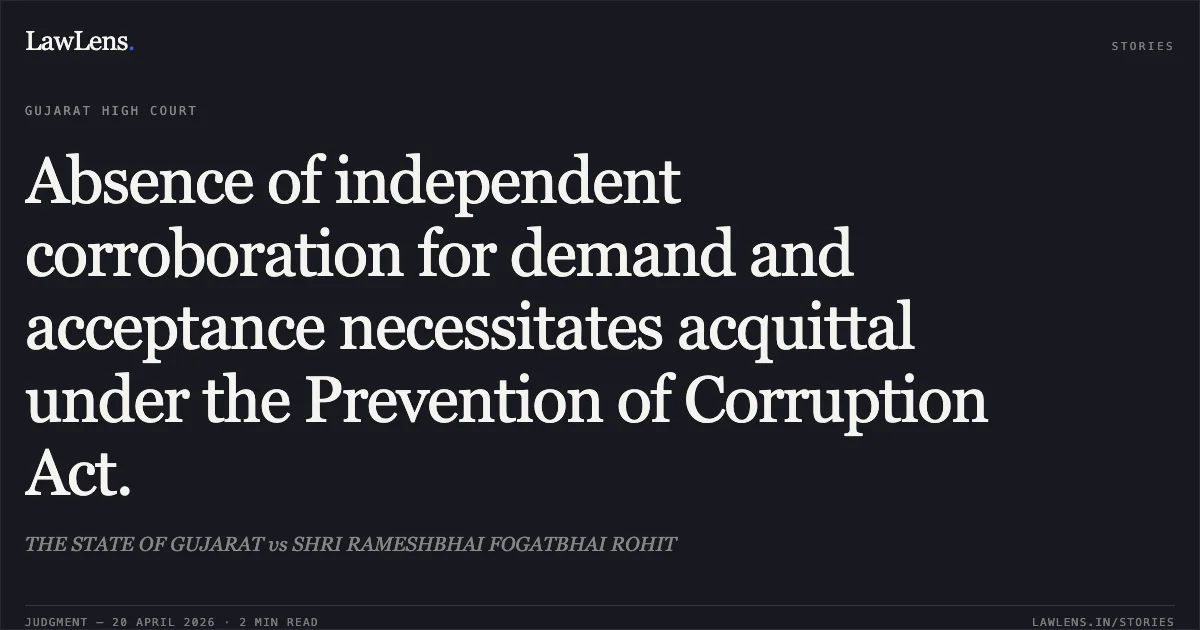
Source reference: p. 10, 14Since "demand" is the foundation of a corruption charge, its lack of independent corroboration proved fatal
Source reference: p. 14Holding
The High Court held that the prosecution failed to prove the charges beyond a reasonable doubt and that the trial court's reasoning was neither perverse nor manifestly erroneous
The Court affirmed that the presumption of innocence is strengthened following an acquittal
Source reference: p. 16The appeal was dismissed, and the judgment of acquittal passed by the Special Judge, Vadodara, was upheld. The bail bonds of the respondents were cancelled.
Source reference: p. 16Acts & Sections Cited
9 provisions across 2 statutes referred to in this judgment. Each provision opens on LawLens.
Prevention of Corruption Act, 19883
Code of Criminal Procedure, 19736
Original Court PDF
THE STATE OF GUJARATvsSHRI RAMESHBHAI FOGATBHAI ROHIT
Click to open original judgment
Original judgment, available to read, download and summarize on LawLens.in