Facts
On 9 November 2012, Uday Singh and several members of his party went to a temple to perform worship. The accused allegedly objected, claiming ownership of the temple, and opened indiscriminate fire. Vijay Singh allegedly fired at Uday Singh, who sustained a firearm injury to the abdomen and subsequently died. The prosecution alleged that Vijay Singh, Udayveer Singh, Amar Singh, Megh Singh, Shankar Singh and Jitendra Singh were armed with firearms and acted with a common object, while Devendra Singh, Kalla alias Ramkishore Chauhan and Amreshi Singh Chauhan were allegedly armed with lathi, farsa and axe respectively
Source reference: paras. 2–5The Sessions Court convicted the firearm-carrying accused under Sections 148 and 302/149 of the IPC, while Vijay Singh was separately convicted under Section 302 IPC. They were sentenced to life imprisonment for murder and one year’s rigorous imprisonment under Section 148 IPC. The Sessions Court acquitted Devendra Singh, Kalla and Amreshi Singh of all charges
Source reference: para. 1The convicted accused challenged their convictions, and the State appealed against the acquittal
Source reference: para. 3Shankar Singh died during the appeal, resulting in abatement of the appeal to his extent
Source reference: para. 2Issues
1. Whether the testimony of the alleged eyewitnesses could be relied upon despite their close relationship with the deceased, absence of injuries to them, inconsistencies concerning the trajectory of the bullet, and alleged delays in recording their statements?
Source reference: paras. 7–292. Whether the evidence established that the accused formed an unlawful assembly armed with deadly weapons and shared the common object of committing Uday Singh’s murder, thereby attracting Sections 148 and 302/149 IPC?
Source reference: paras. 13–18, 303. Whether Vijay Singh could be held individually liable under Section 302 IPC, or whether his conviction was required to be altered to Section 302/149 IPC because the fatal shot could not be attributed to him with certainty?
Source reference: para. 304. Whether the acquittal of Devendra Singh, Kalla alias Ramkishore Chauhan and Amreshi Singh Chauhan warranted interference in the State’s appeal?
Source reference: paras. 31–37Law Applied
The Court applied Sections 148 and 302/149 IPC: Section 148 penalises rioting while armed with a deadly weapon, and Section 149 fixes constructive liability on every member of an unlawful assembly for an offence committed in prosecution of its common object. Section 302 IPC governs punishment for murder.
Source reference: no citationThe Court relied on State (Delhi Administration) v. Laxman Kumar, (1985) 4 SCC 476, and Wilson Fernandes v. Nitin Pandurang, (2004) 2 MWN (Cri) DCC 32 (Bom), for the principle that minor discrepancies or variations which do not affect the core of otherwise reliable testimony should not result in rejection of the evidence
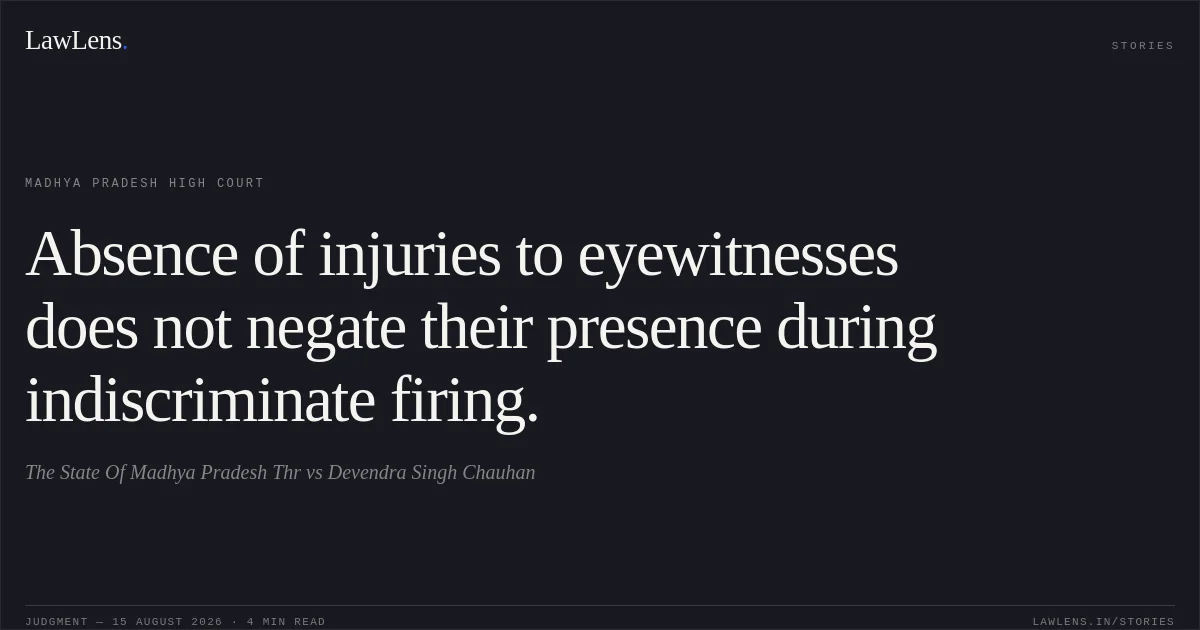
Source reference: para. 12It also applied the principle that absence of injury to an eyewitness does not, by itself, establish that the witness was not present or did not observe the incident
Source reference: paras. 16–18In an appeal against acquittal, interference is justified only where the trial court’s view is perverse, palpably wrong, legally or factually unsustainable, or has resulted in miscarriage of justice; the Court relied on Shivajirao Sahabrao Bobade v. State of Maharashtra, 1973 SCC (Cri) 1033
Source reference: para. 36The Court further recognised the evidentiary restriction under Section 162 CrPC concerning statements made to police during investigation
Source reference: para. 26Reasoning
The Court found the medical evidence consistent with the prosecution version. Although the entry and exit wounds suggested a downward trajectory, the deceased had suffered a spinal fracture, and the bullet could have deflected after striking the bone; therefore, the medical evidence did not contradict the ocular account
Source reference: paras. 7–11The minor improvement regarding the accused being on the temple roof was not sufficient to discard the otherwise consistent testimony. The prompt Dehati Nalishi named the principal accused and identified material eyewitnesses, while the alleged delay in recording some police statements was adequately explained
Source reference: paras. 19, 24–25The recovery of empty cartridges from both the ground floor and roof, bullet marks on the temple walls and idol, and the bloodstained area supported the assertion of indiscriminate firing.
Source reference: paras. 17–18The Court reasoned that such firing was inconsistent with the deceased being the sole target and supported the presence of other members of the complainant party, who could reasonably have escaped injury by taking shelter
Source reference: paras. 17–18Since all convicted accused were armed and participated in the coordinated firing, the fatal shot could not be attributed exclusively to Vijay Singh, but the collective conduct proved the common object of the unlawful assembly. Accordingly, Vijay Singh’s individual conviction under Section 302 IPC was altered to Section 302/149 IPC
Source reference: para. 30In contrast, the prosecution evidence did not establish the specific participation or common object of Devendra Singh, Kalla and Amreshi Singh. The eyewitnesses were either silent about their roles or materially contradicted one another regarding the weapons allegedly carried and the acts attributed to them.
Source reference: paras. 33–37In the absence of direct or inferential proof of their involvement, the trial court’s acquittal was not shown to be perverse or unsustainable
Source reference: paras. 33–37Holding
The appeals against conviction were disposed of with a limited modification: Vijay Singh’s conviction was altered from Section 302 IPC to Section 302/149 IPC, while the convictions and sentences of Jitendra Singh, Amreshi Singh, Megh Singh Chauhan and Udayveer Singh under Sections 148 and 302/149 IPC were upheld
The appeal concerning Shankar Singh stood abated due to his death
Source reference: para. 39The State’s appeal against the acquittal of Devendra Singh, Kalla alias Ramkishore Chauhan and Amreshi Singh Chauhan was dismissed
Source reference: para. 37The appellants on bail were directed to surrender before the trial court by 31 August 2026 to undergo the remaining sentence, failing which coercive measures could be taken.
Source reference: para. 40Acts & Sections Cited
6 provisions across 2 statutes referred to in this judgment. Each provision opens on LawLens.
Indian Penal Code, 18605
Code of Criminal Procedure, 19731
Original Court PDF
The State Of Madhya Pradesh ThrvsDevendra Singh Chauhan
Click to open original judgment
Original judgment, available to read, download and summarize on LawLens.in