Facts
The appellant was convicted by the Trial Court under Sections 376 (rape) and 341 (wrongful restraint) of the IPC and sentenced to seven years of rigorous imprisonment.
Source reference: para 1The prosecution alleged that on September 3, 2001, the appellant forcibly raped the victim in his marai (cottage), an act purportedly witnessed by her husband (P.W. 4) and neighbors.
Source reference: para 5Procedurally, the Trial Court failed to sign the original charge memo, and the successor judge "corrected" it nearly two years later without formally framing or reading over a charge for Section 341 IPC.
Source reference: paras 8-11Evidence revealed the appellant had filed a criminal case against the victim’s family one day prior to the alleged incident.
Source reference: para 47The medical examination of the victim found no marks of violence and no spermatozoa.
Source reference: para 36Issues
1. Whether the Trial Court erred in convicting the appellant under Section 341 IPC despite failing to frame a formal charge and read it over to the accused.
Source reference: paras 11-122. Whether the ocular testimony of the victim and witnesses was sufficient to sustain a conviction under Section 376 IPC in light of contradictory medical evidence and a pre-existing land dispute/litigation.
Source reference: paras 17, 50Law Applied
The court applied Section 211 and 218 of the Cr.P.C., which mandate that a separate charge be framed for each distinct offence.
Source reference: para 13It applied Section 216 of the Cr.P.C. regarding the court's power to alter or add charges before judgment.
Source reference: para 13Regarding evidence, the court relied on the principle that while ocular evidence generally prevails, if medical evidence completely rules out the possibility of the ocular version being true, the ocular evidence may be disbelieved (State of Uttarakhand v. Darshan Singh).
Source reference: para 48It further observed that documents must be proved by authors or those familiar with the handwriting, deprecating the practice of using "Sankat Mochan" witnesses (clerks) to mark exhibits (Sukhi Yadav v. State of Bihar).
Source reference: paras 44-45Reasoning
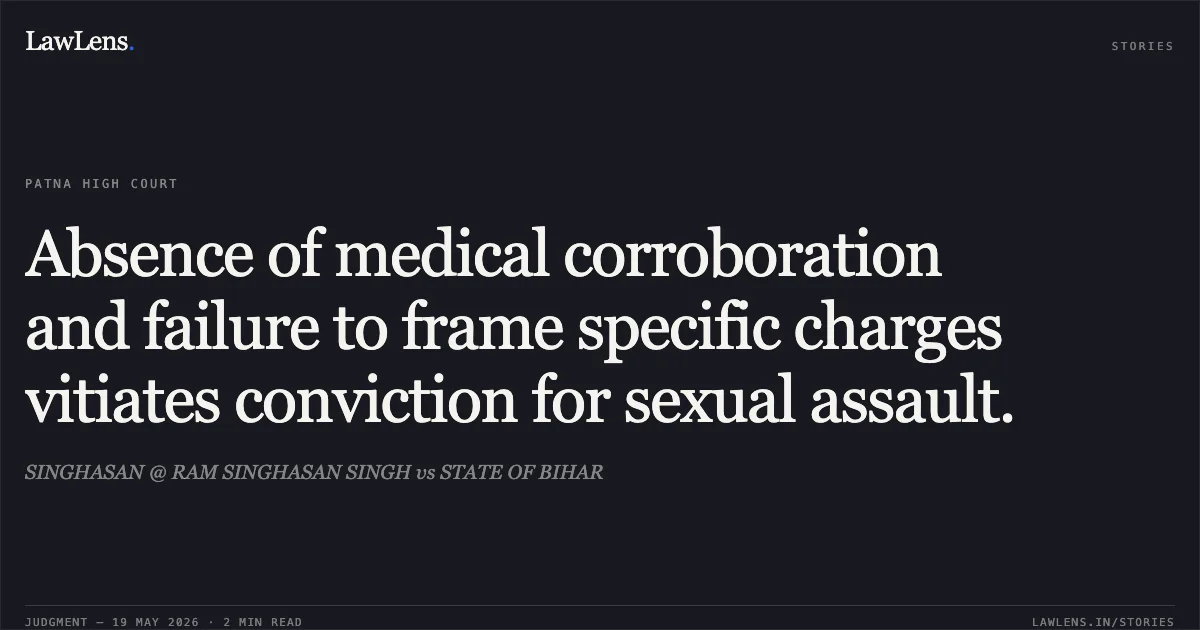
The High Court found the Trial Court's procedure fundamentally flawed as no charge under Section 341 IPC was ever read to the appellant, causing prejudice.
Source reference: para 12Upon re-evaluating the evidence, the Court noted that P.W. 4 (husband) was likely a hearsay witness rather than an eyewitness.
Source reference: para 32Crucially, the medical report (Ext. 1) showed no injuries to the victim's private parts or body, and no spermatozoa were found, contradicting the victim’s claim of a struggle and forcible rape.
Source reference: para 50Furthermore, defense evidence (D.W. 2) showed the appellant was being medically examined for injuries 26 kilometers away shortly after the alleged incident, pursuant to a police requisition made the day before the alleged rape, rendering his presence at the crime scene highly improbable.
Source reference: para 54The Court concluded the case was a "counterblast" to the appellant's previously filed complaint.
Source reference: para 61Holding
The Court answered both issues in the affirmative, holding that the prosecution failed to prove the guilt of the appellant beyond a reasonable doubt.
The High Court set aside the Trial Court's judgment of conviction dated May 29, 2004, and the order of sentence dated June 10, 2004. The appellant was acquitted of all charges (Sections 376 and 341 IPC), and his bail bonds were discharged.
Source reference: paras 64-66Acts & Sections Cited
10 provisions across 2 statutes referred to in this judgment. Each provision opens on LawLens.
Indian Penal Code, 18603
Code of Criminal Procedure, 19737
Original Court PDF
SINGHASAN @ RAM SINGHASAN SINGHvsSTATE OF BIHAR
Click to open original judgment
Original judgment, available to read, download and summarize on LawLens.in