Facts
The appellant was accused of committing rape on a two-year-old minor victim on October 9, 2005
Source reference: para. 4Witness PW3 discovered the minor sitting on the appellant's lap without undergarments; the victim later told her mother (PW2) that the accused had "pierced her"
Source reference: para. 20-21Medical examination by PW6 revealed contusion around the vaginal orifice, though the hymen remained intact
Source reference: para. 22The Special Court (Additional Sessions Judge-I, Thiruvananthapuram) convicted the appellant under Section 376(2)(f) of the IPC on February 16, 2016, sentencing him to 10 years of rigorous imprisonment
Source reference: para. 6The appellant challenged this on the grounds that the legal requirement of "penetration" for rape was not established
Source reference: para. 7Issues
1. Whether the prosecution established the essential ingredient of "penetration" required to constitute an offence under Section 376 IPC prior to the 2013 Amendment
Source reference: para. 19, 232. Whether the evidence warranted a conviction for the completed offence of rape or the lesser offence of attempt to commit rape under Section 511 read with Section 376 IPC
Source reference: para. 19, 27-28Law Applied
The court applied Section 375 of the IPC (pre-2013 amendment), which mandates "penetration" as the sine qua non for rape
Source reference: para. 23It relied on Sakshi v. Union of India and Aman Kumar v. State of Haryana, establishing that for rape to occur, some part of the penis must enter the labia of the pudendum.
Source reference: para. 8, 10The court also invoked Section 511 of the IPC regarding criminal attempts, citing Madan Lal v. State of Jammu and Kashmir and Koppula Venkat Rao v. State of A.P. to distinguish between the completed act and an unsuccessful attempt characterized by overt acts like rubbing or ejaculation without penetration
Source reference: para. 14-17The court further applied the rule of res gestae under Section 6 of the Evidence Act regarding the spontaneity of statements made immediately following a transaction
Source reference: para. 25-26Reasoning
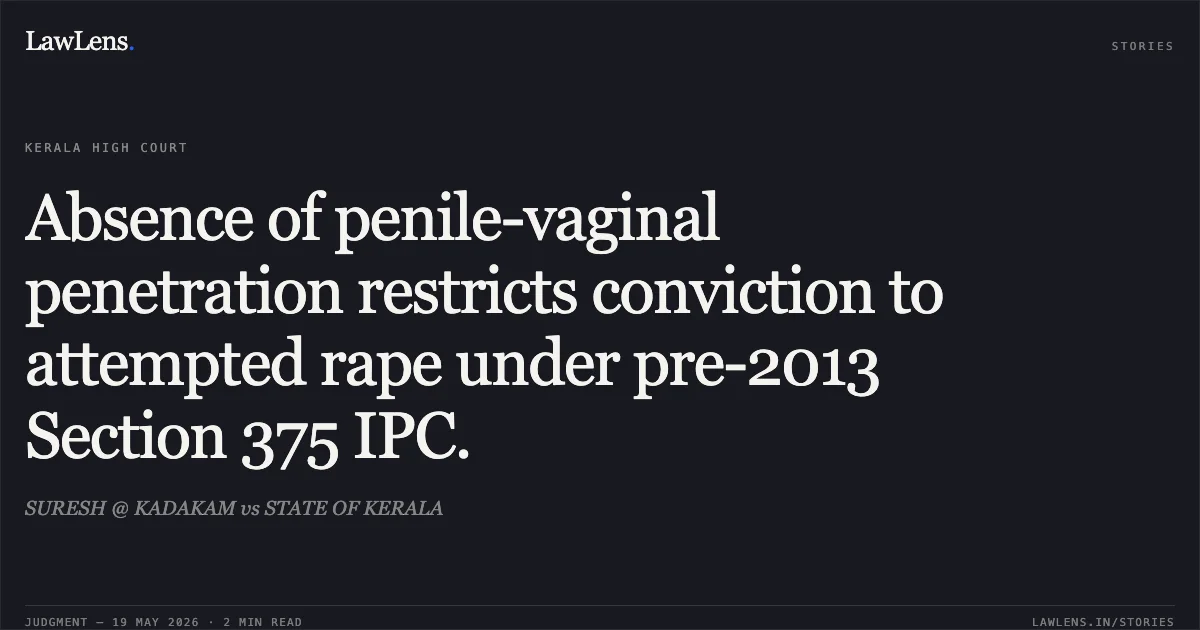
The High Court observed that because the incident occurred in 2005, the stricter pre-2013 definition of rape applied, necessitating proof of penile-vaginal penetration
Source reference: para. 23While the trial court relied on Chenthamara v. State of Kerala to suggest "penile accessing" of the vulva sufficed for rape, the High Court found that the medical evidence (intact hymen and mere contusion) and witness testimonies did not conclusively prove penetration occurred
Source reference: para. 24, 27However, the court held that the accused’s overt acts—removing the child's clothes, placing her on his lap, and causing contusion through contact—constituted a clear attempt to commit rape
Source reference: para. 27The victim's statement to her mother was considered relevant as it explained the physical injury, even if the strict criteria for res gestae as a hearsay exception were debated
Source reference: para. 21, 33Holding
The High Court allowed the appeal in part. It set aside the conviction under Section 376 IPC and instead convicted the appellant under Section 511 read with Section 376 IPC for attempt to commit rape
The sentence was reduced from 10 years to 5 years of rigorous imprisonment, with the fine increased to Rs. 50,000, of which Rs. 30,000 is to be paid to the victim as compensation. The court ordered the appellant to surrender immediately to undergo the modified sentence
Source reference: para. 29, 30Acts & Sections Cited
8 provisions across 2 statutes referred to in this judgment. Each provision opens on LawLens.
Code of Criminal Procedure, 19733
Indian Penal Code, 18605
Original Court PDF
SURESH @ KADAKAMvsSTATE OF KERALA
Click to open original judgment
Original judgment, available to read, download and summarize on LawLens.in


