Facts
The deceased, Shyamshree alias Bhuriben, married accused No. 2 (Vinodbhai) three years prior to the incident.
Source reference: p. 2, 7It was alleged that the accused (husband, mother-in-law, and father-in-law) subjected her to mental and physical torture for failing to conceive and trivial domestic issues.
Source reference: p. 2, 7On May 11, 2007, the deceased sustained severe burn injuries after pouring kerosene on herself.
Source reference: p. 2The complainant (father) alleged the deceased gave an oral dying declaration at the hospital implicating the accused.
Source reference: p. 8However, medical evidence suggested the deceased was unconscious and unable to speak.
Source reference: p. 15-16Accused No. 2 also sustained burns while allegedly attempting to save her.
Source reference: p. 13The trial court acquitted the respondents on April 9, 2008, leading to this State appeal.
Source reference: p. 1Issues
1. Whether the prosecution proved beyond reasonable doubt that the accused's conduct amounted to abetment of suicide under Section 306 of the IPC.
Source reference: p. 17-182. Whether the oral dying declaration allegedly made to the parents was reliable given the medical reports of the deceased's condition.
Source reference: p. 16-173. Whether there existed a proximate and direct causal link between the alleged harassment and the act of suicide.
Source reference: p. 18-20Law Applied
The Court applied Sections 498(A), 306, and 114 of the Indian Penal Code.
Source reference: p. 1For abetment under Section 306 read with Section 107 IPC, the prosecution must prove "instigation," which requires a "culpable mental state" and a "positive act" to provoke or facilitate suicide.
Source reference: p. 18-19The court relied on Mahendra K.C. v. State of Karnataka regarding the definition of instigation as "goading or provoking".
Source reference: p. 21The court relied on Amalendu Pal v. State of West Bengal, establishing that harassment without a positive act proximate to the time of occurrence is insufficient for conviction.
Source reference: p. 22The court applied the principle from Chandrappa v. State of Karnataka that an appellate court should not disturb an acquittal if two reasonable views are possible.
Source reference: p. 27-29Reasoning
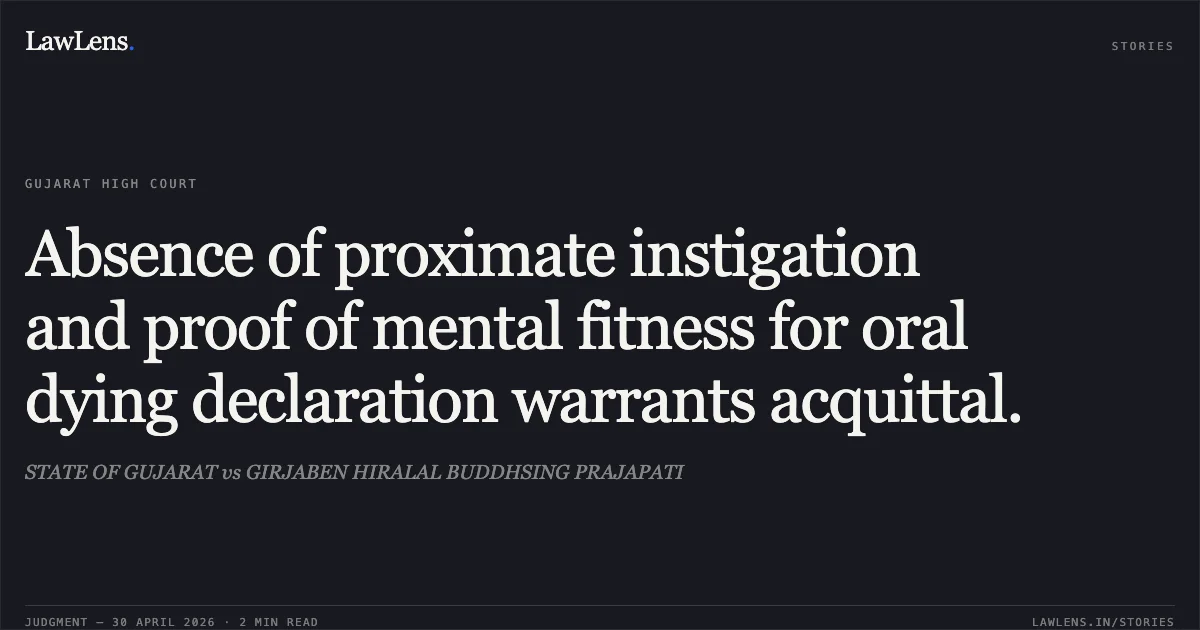
The Court found that the prosecution failed to establish a direct nexus between the alleged harassment and the suicide.
Source reference: p. 16While the parents claimed the deceased spoke to them at the hospital, the medical record (Exh. 45) contained an endorsement by the doctor stating the patient was "not conscious and unable to give a statement" at 10:45 p.m.
Source reference: p. 16The investigating officer admitted no formal dying declaration could be recorded.
Source reference: p. 14Furthermore, the prosecution failed to examine the treating doctor or produce medical case papers regarding the deceased’s fitness.
Source reference: p. 16The Court noted that accused No. 2 sustained injuries while trying to save the deceased, which contradicted the theory of instigation.
Source reference: p. 13The alleged harassment regarding infertility was deemed remote and lacked the "live and immediate nexus" required by law to constitute instigation under Section 107 IPC.
Source reference: p. 20Holding
The High Court dismissed the appeal and upheld the judgment of acquittal.
It held that the prosecution failed to prove "instigation" or "mens rea" necessary for Section 306 IPC.
Source reference: p. 19, 21The Court found no patent perversity in the trial court’s reasoning, concluding that the view taken by the trial judge was reasonable and plausible.
Source reference: p. 24, 30The respondents were cleared of all charges under Sections 498(A), 306, and 114 of the IPC.
Source reference: p. 30-31Acts & Sections Cited
6 provisions across 2 statutes referred to in this judgment. Each provision opens on LawLens.
Indian Penal Code, 18604
Code of Criminal Procedure, 19732
Original Court PDF
STATE OF GUJARATvsGIRJABEN HIRALAL BUDDHSING PRAJAPATI
Click to open original judgment
Original judgment, available to read, download and summarize on LawLens.in