Facts
The complainant (O.P. No. 2) married petitioner no. 2 in 2003. She alleged that after three months of marriage, the petitioners demanded ₹2 lakhs as additional dowry and subjected her to physical and mental torture
Source reference: para. 3It was further alleged that on 13.07.2009, the petitioners attempted to murder her and drove her out of the matrimonial home
Source reference: para. 3The trial court convicted the petitioners under Section 498A IPC, sentencing them to 2 years R.I.
Source reference: para. 2, 7The Appellate Court upheld the conviction of the husband and brother-in-law while acquitting the parents-in-law
Source reference: para. 8The petitioners moved the High Court in revision, contending the case arose from a domestic dispute regarding the complainant’s inability to conceive and her demand to adopt her nephew, rather than dowry cruelty
Source reference: para. 9, 13Issues
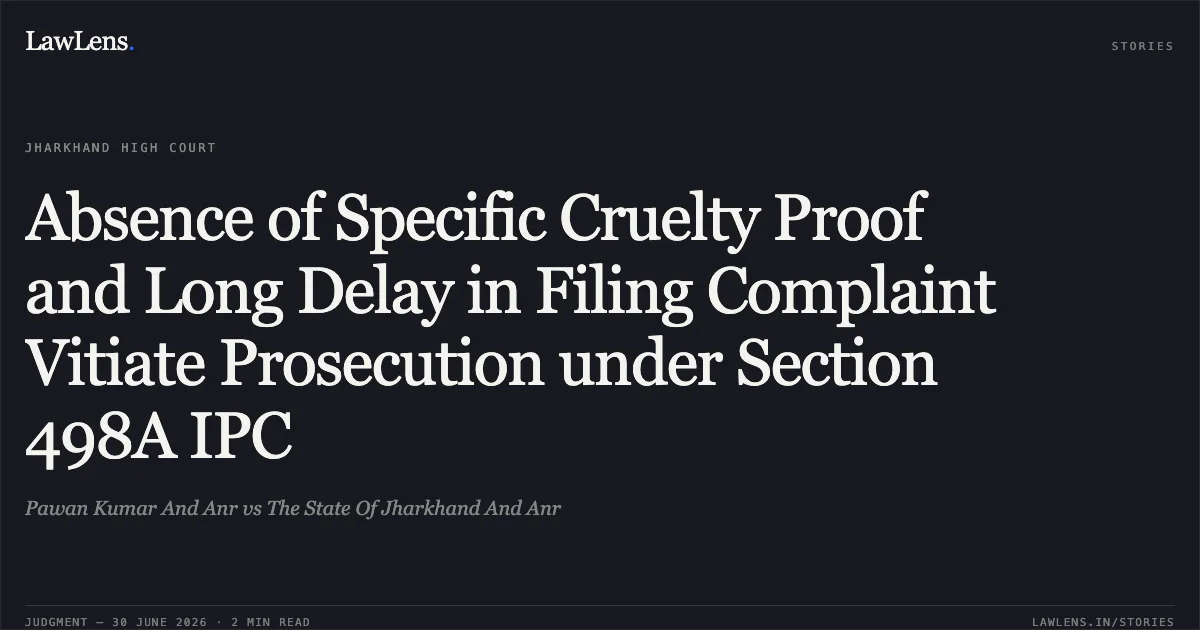
1. Whether the ingredients of "cruelty" as defined under Section 498A of the IPC were established given the 6-year delay in filing the complaint and the lack of specific evidence regarding dowry demands
Source reference: para. 9, 162. Whether the lower courts failed to record and explain incriminating circumstances to the accused under Section 313 Cr.P.C., thereby vitiating the trial
Source reference: para. 9, 16Law Applied
The court primarily applied Section 498A of the Indian Penal Code (IPC), which defines "cruelty" as any willful conduct likely to drive a woman to suicide or cause grave injury, or harassment to coerce her or her relatives to meet unlawful demands for property or valuable security
Source reference: para. 16The court also considered the procedural requirements of Section 313 of the Code of Criminal Procedure (Cr.P.C.), which mandates that the accused be given an opportunity to explain every incriminating circumstance appearing in evidence against them
Source reference: para. 9, 16Reasoning
The High Court found that the prosecution failed to substantiate the dowry demand with cogent evidence. The court noted that the marriage lasted 6 years (2003–2009) without any prior police report or Panchayati (village council) meeting regarding dowry
Source reference: para. 12, 15Evidence from D.W.-1 and D.W.-2, including medical records (Exhibits A, A/1, A/2), established that the complainant was undergoing infertility treatment at BHU Hospital and the dispute likely originated from her desire to adopt her nephew, which the husband resisted
Source reference: para. 13, 15The court observed that the lower courts were "influenced by their emotions" rather than the legal definition of cruelty
Source reference: para. 17Furthermore, the court identified a fatal procedural lapse: the trial court failed to bring specific incriminating circumstances to the petitioners' notice during their Section 313 Cr.P.C. examination, which is essential to sustain a conviction
Source reference: para. 9, 16Holding
The Court answered the issues in the negative, holding that the prosecution failed to prove the offence under Section 498A IPC beyond reasonable doubt.
Consequently, the High Court set aside the judgments of the trial and appellate courts, acquitted the petitioners of all charges, and discharged them from their bail bonds
Source reference: para. 17, 18Acts & Sections Cited
1 provisions across 1 statute referred to in this judgment. Each provision opens on LawLens.
Code of Criminal Procedure, 19731
Original Court PDF
Pawan Kumar And AnrvsThe State Of Jharkhand And Anr
Click to open original judgment
Original judgment, available to read, download and summarize on LawLens.in