Facts
The appellant’s daughter, Induben, died by self-immolation on August 2, 2009, at her matrimonial home.
Source reference: para. 2–2.2The appellant filed an FIR against the husband (Respondent No. 2) and in-laws (Respondents No. 3 and 4) under Section 306 r/w 114 of the IPC, alleging physical and mental cruelty led to the suicide.
Source reference: para. 2–2.2The Trial Court (Fast Track Court No. 2, Jamnagar) acquitted the accused on September 29, 2010, finding insufficient evidence of abetment.
Source reference: para. 1The appellant challenged this acquittal. During the appeal, Respondent No. 3 passed away, causing the appeal to abate against him.
Source reference: para. 8Issues
1. Whether the Trial Court was justified in its judgment of acquittal based on the evidence on record.
Source reference: para. 122. Whether the prosecution established the ingredients of abetment of suicide under Section 306 of the IPC beyond reasonable doubt.
Source reference: para. 133. Whether the presumption under Section 113A of the Indian Evidence Act was applicable to the facts of the case.
Source reference: para. 10.1, 13Law Applied
The court applied Section 306 of the IPC regarding abetment of suicide and Section 114 regarding common intent.
Source reference: para. 1, 2It examined Section 113A of the Indian Evidence Act, which allows a court to presume abetment by the husband or relatives if a woman commits suicide within seven years of marriage, provided she was subjected to cruelty.
Source reference: para. 10.1, 13The court further relied on appellate standards for reviewing acquittals established in Chandrappa v. State of Karnataka and Ramesh v. State of Karnataka, emphasizing the "double presumption of innocence" for an acquitted accused.
Source reference: para. 16, 17Reasoning
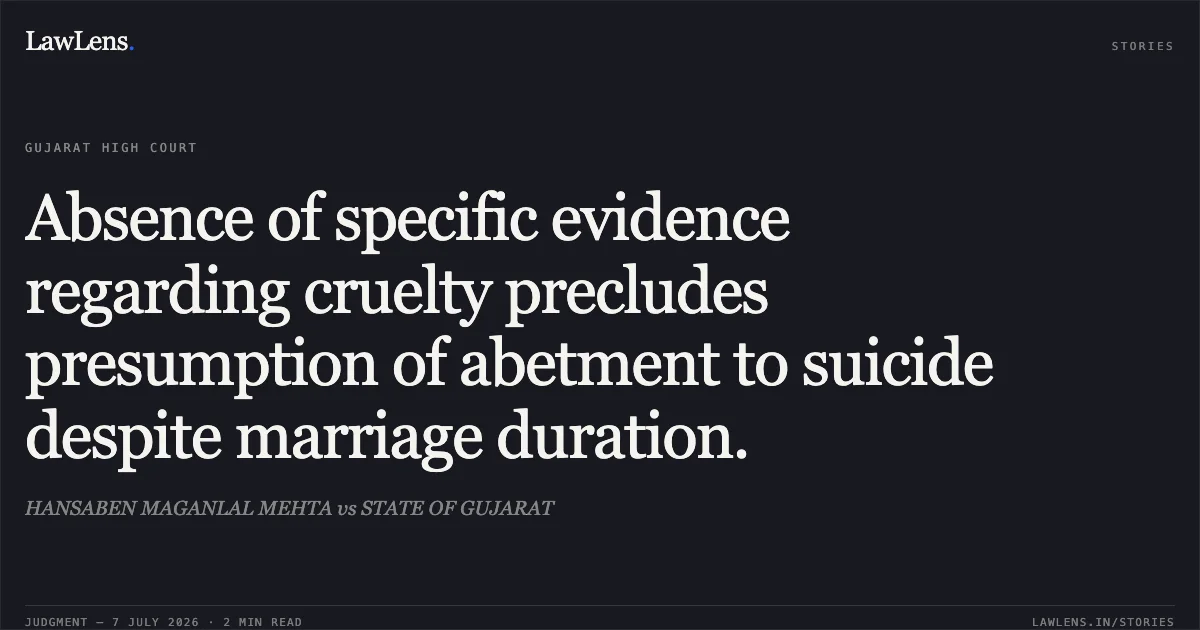
The High Court observed that while the marriage was of short duration, the prosecution failed to provide cogent evidence of harassment or "cruelty" as defined under law.
Source reference: para. 13The primary witness (PW-1) initially alleged murder, but police investigation confirmed suicide in a room locked from the inside.
Source reference: para. 13Witness testimonies, including those of the victim’s father (PW-2) and cousin (PW-3), did not support the allegations of ill-treatment.
Source reference: para. 13The Court reasoned that the mere occurrence of suicide within seven years of marriage does not trigger an automatic conviction under Section 113A of the Evidence Act without evidence linking the defendants' actions to the victim's decision to end her life.
Source reference: para. 13It was noted that the husband and mother-in-law were not present at the scene during the incident.
Source reference: para. 13Holding
The High Court held that the prosecution failed to prove the charges beyond reasonable doubt and that the Trial Court's view was a reasonable and plausible conclusion based on the lack of credible evidence.
The High Court dismissed the appeal and confirmed the Trial Court’s judgment of acquittal. The bail bonds were ordered cancelled.
Source reference: para. 19, 20Acts & Sections Cited
6 provisions across 2 statutes referred to in this judgment. Each provision opens on LawLens.
Code of Criminal Procedure, 19734
Indian Penal Code, 18602
Original Court PDF
HANSABEN MAGANLAL MEHTAvsSTATE OF GUJARAT
Click to open original judgment
Original judgment, available to read, download and summarize on LawLens.in