Facts
The appellant (husband) married the victim, Swarna Paul, in 1982.
Source reference: p.2On October 20, 1994, the victim committed suicide by hanging in her matrimonial home.
Source reference: p.6, 7The victim's brother (de facto complainant) lodged an FIR alleging that the appellant and his sister (accused no. 2) inflicted physical and mental torture, ultimately killing and hanging the victim.
Source reference: p.2The Trial Court convicted the appellant under Sections 498A and 306 IPC, sentencing him to three and seven years of rigorous imprisonment, respectively.
Source reference: p.1, 2The appellant challenged this conviction, highlighting that the incident occurred 12 years after marriage with no prior complaints, and that the testimony of the sole alleged eyewitness (P.W. 1) was unreliable and not recorded during investigation.
Source reference: p.3, 12Issues
1. Whether the prosecution proved the ingredients of "abetment" under Section 107 of the IPC to sustain a conviction under Section 306 IPC.
Source reference: p.15, 182. Whether the evidence established "cruelty" as defined under Section 498A IPC beyond reasonable doubt.
Source reference: p.213. Whether the testimony of a hostile witness (the daughter, P.W. 12) could be relied upon to support or negate the prosecution’s case.
Source reference: p.17, 18Law Applied
The Court primarily applied Section 306 (Abetment of suicide) and Section 498A (Cruelty) of the IPC, alongside the definition of "abetment" under Section 107 IPC.
Source reference: p.18, 19The Court relied on Naresh Kumar v. State of Haryana, establishing that Section 306 requires clear mens rea and a positive act of instigation rather than mere harassment.
Source reference: p.5, 12The Court cited Neeraj Dutta v. State (Govt. of NCT of Delhi) regarding the evidentiary value of hostile witnesses, holding that their testimony is not automatically rejected but must be weighed with circumspection.
Source reference: p.4, 17The Court applied the principle from Kashibai v. State of Karnataka that abetment requires evidence of incessant harassment leaving the victim no other option but suicide.
Source reference: p.13Reasoning
The Court found that the prosecution failed to establish a direct link between the appellant’s conduct and the victim's suicide.
Source reference: no citationThe testimony of P.W. 1 was deemed unreliable as he was not examined by the police and his claims of seeing the appellant assault the victim were not corroborated by other neighbours.
Source reference: p.12, 15The family members (P.W. 5 and 6) admitted to harboring a "grudge" and "dissatisfaction" against the appellant, which weakened their credibility regarding allegations of dowry and torture.
Source reference: p.9, 22Crucially, the daughter (P.W. 12) turned hostile, testifying that her parents had a cordial relationship and suggesting the victim was depressed due to financial demands from the de facto complainant.
Source reference: p.11, 21Medical evidence (Post-mortem and Inquest reports) showed no external injuries other than the ligature mark, contradicting claims of a merciless assault prior to death.
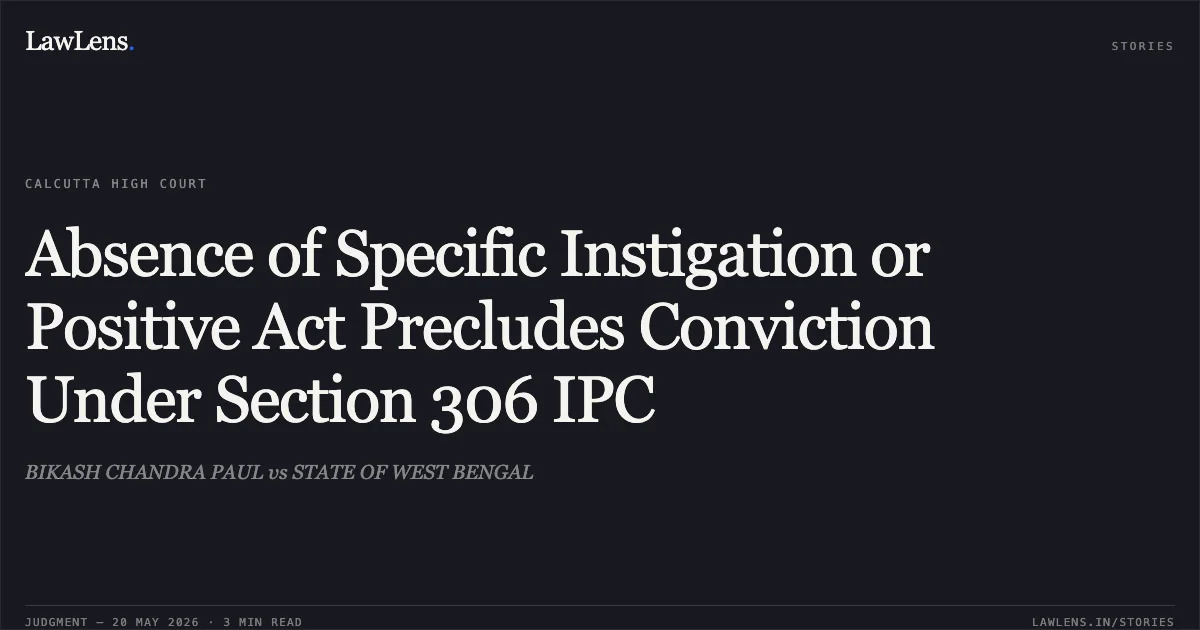
Source reference: p.9, 22The Court reasoned that without evidence of "instigation" or "intentional aid" under Section 107, the conviction for abetment could not stand.
Source reference: p.20Holding
The Court answered the issues in the negative, holding that the prosecution failed to prove the charges beyond reasonable doubt.
It held that neither the active act of commission nor the mens rea required for abetment was present.
Source reference: p.20, 23The High Court set aside the judgment and order of conviction dated June 06/10, 2009; the appellant was acquitted of all charges under Sections 498A and 306 IPC and discharged from his bail bonds.
Source reference: p.23Acts & Sections Cited
6 provisions across 2 statutes referred to in this judgment. Each provision opens on LawLens.
Indian Penal Code, 18604
Code of Criminal Procedure, 19732
Original Court PDF
BIKASH CHANDRA PAULvsSTATE OF WEST BENGAL
Click to open original judgment
Original judgment, available to read, download and summarize on LawLens.in