Facts
The Appellant-State challenged the acquittal of the Respondent-accused for offences under Sections 498A and 306 of the Indian Penal Code (IPC).
Source reference: p.1-2The complainant, Ramilaben, alleged that her daughter, Sunitaben, married the respondent approximately six years prior to the incident.
Source reference: p.6It was alleged that after one year of marriage, the respondent subjected the deceased to cruelty because "he did not like her," leading her to commit suicide by hanging on August 20, 2010.
Source reference: p.1-2Procedurally, an Accidental Death (A.D.) entry was initially recorded, but the Investigating Officer failed to include those preliminary statements in the charge-sheet.
Source reference: p.6-7The trial court (6th Additional Sessions Judge, Bhavnagar) acquitted the accused on June 8, 2012, citing insufficient evidence of cruelty or abetment.
Source reference: p.1Issues
1. Whether the trial court was justified in passing the judgment of acquittal based on the evidence on record.
Source reference: p.6, para 112. Whether the prosecution proved the ingredients of Sections 498A and 306 of the IPC beyond reasonable doubt.
Source reference: p.5, para 103. Whether there was any manifest illegality or perversity in the appreciation of evidence by the trial court.
Source reference: p.6, para 11Law Applied
The Court applied Sections 498A (matrimonial cruelty) and 306 (abetment of suicide) of the IPC, noting that for a conviction, there must be a specific act or omission by the accused that drives the deceased to suicide.
Source reference: p.8It considered Section 113A of the Indian Evidence Act, 1872, clarifying that the presumption of abetment is not automatic upon the occurrence of suicide and requires foundational evidence of harassment.
Source reference: p.8-9The Court further relied on Chandrappa v. State of Karnataka (2007), Rajesh Prasad v. State of Bihar (2022), and Ramesh v. State of Karnataka (2024), which dictate that an appellate court should not disturb an acquittal if two reasonable views are possible, given the "double presumption" of innocence in favour of the accused.
Source reference: p.10-11Reasoning
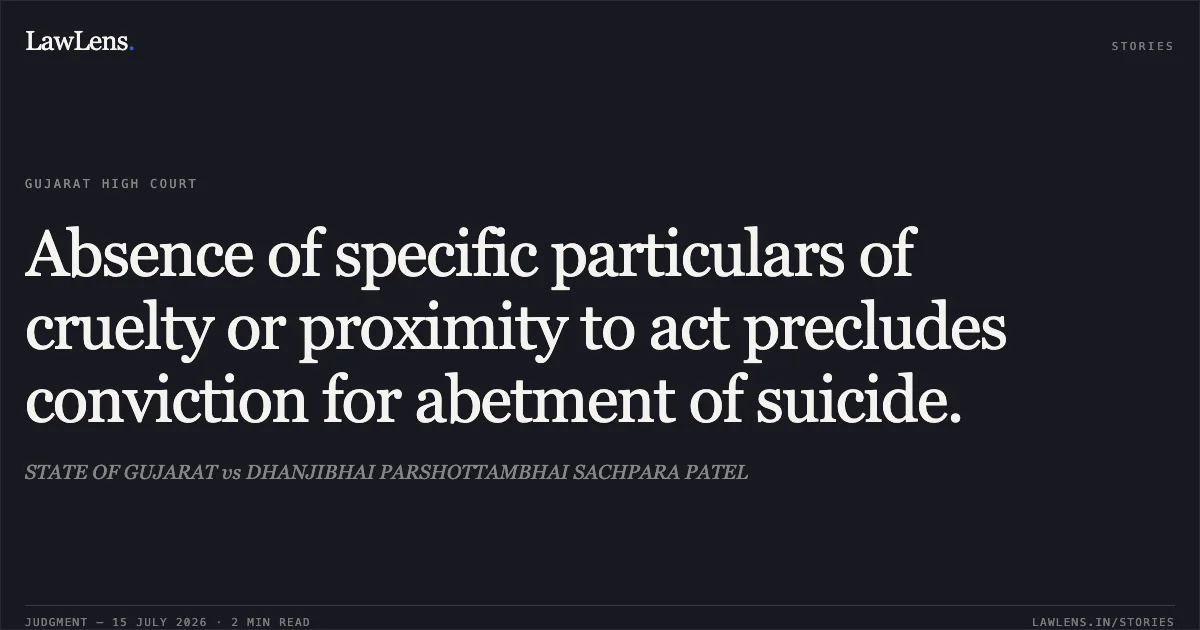
The High Court observed that the prosecution’s witnesses, including the mother (Ramilaben), failed to provide specific particulars or instances of harassment or physical cruelty.
Source reference: p.7The only concrete allegation was a lack of household expenses leading to domestic quarrels, which did not meet the legal threshold for "cruelty" under Section 498A.
Source reference: p.7The Investigating Officer's testimony revealed significant procedural lapses, such as recording all witness statements in a single hour and failing to examine independent witnesses from the village.
Source reference: p.7The Court highlighted that the respondent was financially stable and had even provided funds to the complainant, contradicting the motive of financial harassment.
Source reference: p.7Applying the Chandrappa principles, the Court found that the trial court’s view was a "possible" one and was neither perverse nor illegal, as the prosecution failed to establish a direct link between the accused's conduct and the suicide.
Source reference: p.8-9, 12Holding
The High Court dismissed the appeal and confirmed the trial court's order of acquittal.
It held that the prosecution miserably failed to prove the charges beyond reasonable doubt and that the appellate court found no "firm and weighty grounds" to discard the trial court's reasoning.
Source reference: p.12-13The respondent's bail bond was ordered to be cancelled.
Source reference: p.13Acts & Sections Cited
4 provisions across 2 statutes referred to in this judgment. Each provision opens on LawLens.
Code of Criminal Procedure, 19733
Indian Penal Code, 18601
Original Court PDF
STATE OF GUJARATvsDHANJIBHAI PARSHOTTAMBHAI SACHPARA PATEL
Click to open original judgment
Original judgment, available to read, download and summarize on LawLens.in