Facts
The petitioner, owner of passenger bus No. DD-02-9061 registered in Diu, claimed to have paid Gujarat motor-vehicle tax of ₹20,376 for 25 July–1 August 2023 through a check-post e-receipt.
Source reference: para. 2, p. 2The vehicle was detained at Surat on 6 September 2023 for alleged violations under Sections 177, 180 and 181 of the Motor Vehicles Act, 1988, and a penalty of ₹11,500 was imposed.
Source reference: para. 2, p. 2The authority subsequently demanded tax of ₹53,20,000 for the period from 1 January 2013 to 31 September 2023; a subsequent notice allegedly enhanced the demand to ₹1,30,54,235.
Source reference: paras. 2.1–2.3, pp. 2–3; para. 3, p. 4The petitioner filed a statutory appeal under Section 14 of the Gujarat (Bombay) Motor Vehicles Tax Act, 1958, but did not deposit the required 25% pre-deposit, leaving the appeal at the filing stage.
Source reference: paras. 2.3, 6, pp. 3, 10During inspection, the vehicle was found to have been altered from a registered 40+1-seater bus into a 38-sleeper bus; its chassis and engine markings allegedly differed from the registered manufacturer details.
Source reference: para. 8(B), pp. 11–12Its last fitness certificate was valid only until 12 January 2013, and no subsequent certificate was produced.
Source reference: para. 8(C), p. 12Issues
1. Whether the respondents could levy Gujarat motor-vehicle tax for the period 2013–2023 on the basis that the vehicle was “used or kept for use” in Gujarat, despite the petitioner’s assertion that it was not continuously used in the State.
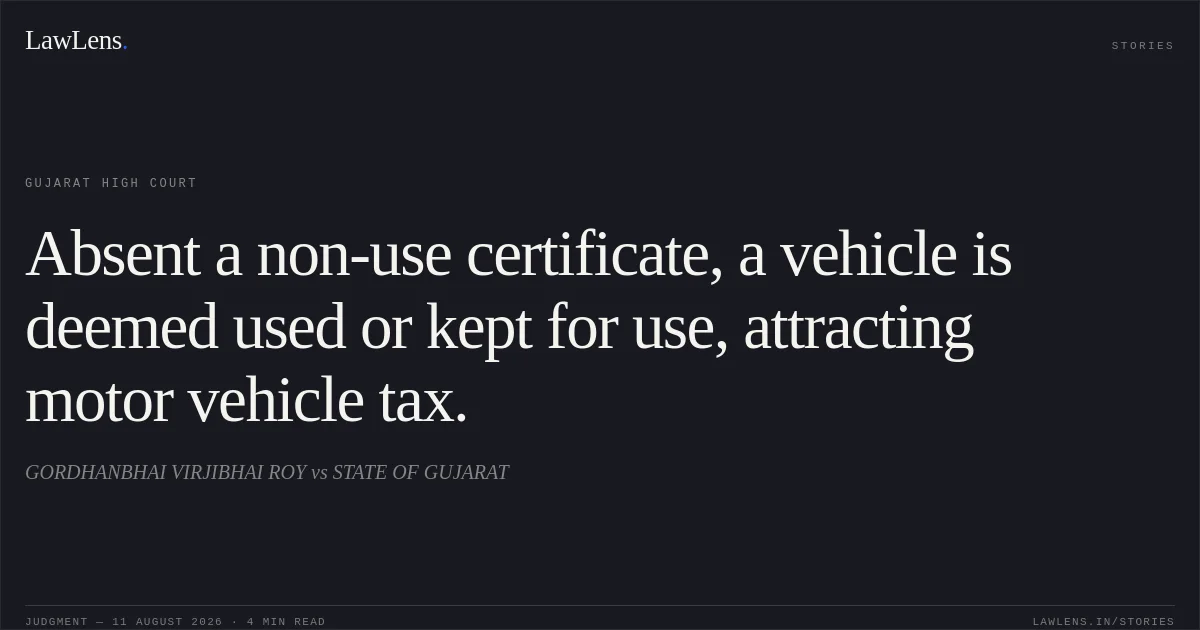
Source reference: paras. 16–21, pp. 22–312. Whether, in the absence of a prescribed non-use certificate, Section 3(2) of the Gujarat (Bombay) Motor Vehicles Tax Act, 1958 created a presumption or deeming fiction that the vehicle was used or kept for use in Gujarat.
Source reference: paras. 17–21, pp. 27–313. Whether the petitioner could challenge the tax demand in writ jurisdiction when a statutory appeal was available and had been filed without the mandatory pre-deposit.
Source reference: paras. 6–7, p. 104. Whether the petitioner’s alteration of the vehicle and absence of a valid fitness certificate affected his claim against the tax demand.
Source reference: paras. 9–15, pp. 13–21Law Applied
The Court applied Section 3(1) of the Gujarat (Bombay) Motor Vehicles Tax Act, 1958, which levies tax on motor vehicles “used or kept for use” in Gujarat, and Section 3(2), which deems a vehicle to be used or kept for use unless the taxation authority certifies its non-use in the prescribed manner.
Source reference: paras. 17–18, pp. 23–29Section 4 governs payment and computation of the tax, including the applicable rates for designated and sleeper omnibuses.
Source reference: para. 17, pp. 24–27Rules 5(1) and 21 of the Gujarat Motor Vehicles Tax Rules, 1959 require prescribed declarations regarding non-use or temporary entry of a vehicle.
Source reference: para. 20, p. 30Under Sections 52 and 56 of the Motor Vehicles Act, 1988, structural alterations require statutory compliance and approval, while a transport vehicle must possess a valid certificate of fitness; Rule 62 of the Central Motor Vehicles Rules, 1989 prescribes the validity and periodic renewal of fitness certificates.
Source reference: paras. 9–15, pp. 13–21The Court relied on State of Gujarat v. Akhil Gujarat Pravasi V.S. Mahamandal, 2004 (5) SCC 155, holding that actual quantum of use is not decisive where a vehicle is “used or kept for use” in the State and that a statutory non-use mechanism may validly govern liability.
Source reference: para. 19, pp. 28–30Section 14 of the Gujarat Tax Act and the applicable rules require a statutory appeal to be accompanied by the prescribed pre-deposit.
Source reference: paras. 2.3, 4.7 and 6, pp. 3, 8, 10Reasoning
The Court held that the statutory scheme placed the burden on the petitioner to obtain and produce a valid non-use certificate if the bus had not been used or kept for use in Gujarat.
Source reference: paras. 18–20, pp. 27–30No such certificate from Gujarat or Diu was produced, nor were tax receipts for the period from July 2013 to August 2023 shown.
Source reference: para. 16, p. 22; para. 20, p. 30Consequently, the deeming fiction under Section 3(2) operated, and the vehicle was presumed to have been used or kept for use in Gujarat during the relevant period.
Source reference: para. 21, p. 31The petitioner’s position was further weakened by the admitted overstaying after 25 July 2023, the absence of a fitness certificate after January 2013, the unauthorised conversion from a 40+1-seater to a 38-sleeper bus, and discrepancies in the chassis, engine and manufacturer details.
Source reference: paras. 8(B)–(D), 11, 15–16, pp. 11–12, 16, 21–22The Court rejected the argument based on the general burden of proof, reasoning that the petitioner had not first demonstrated statutory compliance and bona fides through the requisite permissions, fitness records and non-use documentation.
Source reference: para. 23, p. 32Although the statutory appeal was available, it remained incomplete because the petitioner had not made the mandatory pre-deposit; nevertheless, since he insisted on a decision on merits, the Court examined and rejected the challenge.
Source reference: paras. 6–7, p. 10Holding
In the absence of a prescribed non-use certificate, the bus was deemed under Section 3(2) of the Gujarat (Bombay) Motor Vehicles Tax Act, 1958 to have been used or kept for use in Gujarat from 2013 to 2023, making the tax demand legally sustainable in principle.
The petitioner’s challenge to the levy was rejected, and the writ petition was dismissed/rejected without granting relief against the impugned tax orders.
Source reference: para. 24, p. 33Acts & Sections Cited
13 provisions across 2 statutes referred to in this judgment. Each provision opens on LawLens.
Motor Vehicles Act, 1988
Bharatiya Sakshya Adhiniyam, 20231
Original Court PDF
GORDHANBHAI VIRJIBHAI ROYvsSTATE OF GUJARAT
Click to open original judgment
Original judgment, available to read, download and summarize on LawLens.in