Facts
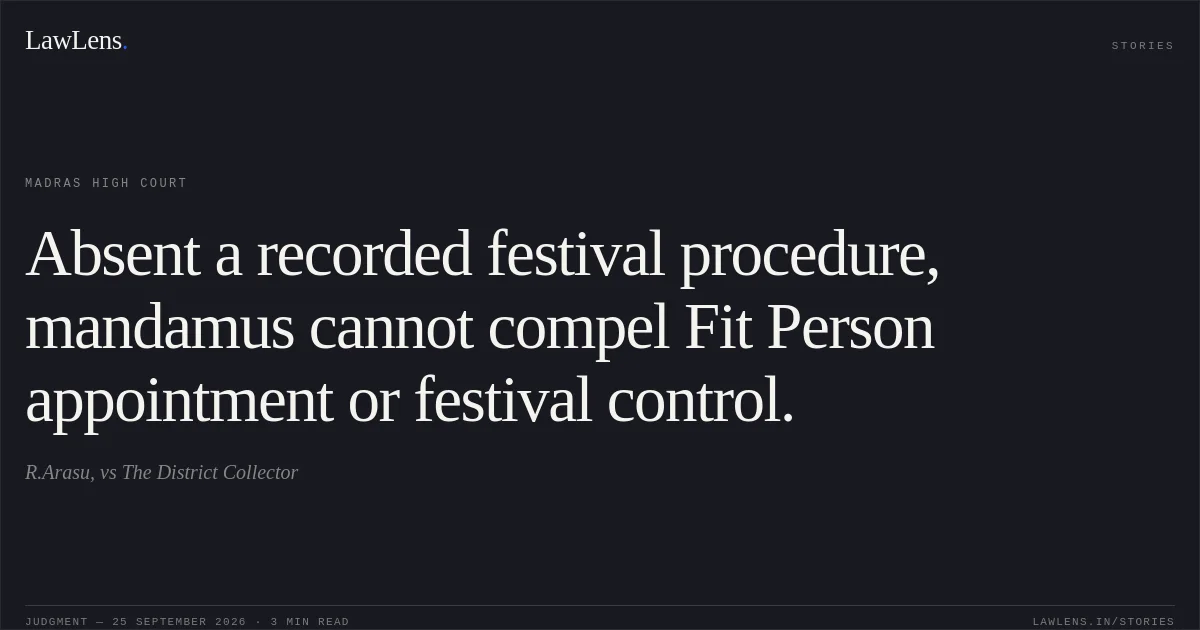
The petitioner sought a writ of mandamus directing the District Collector and HR&CE authorities to appoint a Fit Person to administer four temples at Surakundu Village, Melur Taluk, and to conduct the Purattasi festival through that Fit Person. He also sought restraint against respondents 6–10 from collecting temple funds or receiving the first honour, directions to hand over the temple accounts, records and village-chest key, and police protection for the festival.
Source reference: p.2; para.1The petitioner claimed that the temples were exclusively associated with five traditional Karais of the village and alleged that a sixth Karai belonging to the Scheduled Caste community had been excluded from the festival.
Source reference: p.4; para.4Respondents 6–10 disputed the petitioner’s entitlement, asserting that he belonged to the same Karai as the sixth respondent and had been removed from his former position because of alleged misuse and failure to account for temple funds.
Source reference: p.5; para.5The temples were treated as non-listed temples falling within the purview of the HR&CE Department, and no recorded procedure governing the festival was shown to exist.
Source reference: p.6; para.9Issues
Whether the Court should issue a writ of mandamus directing the HR&CE authorities to appoint a Fit Person, regulate the conduct of the temple festival, prevent respondents 6–10 from collecting funds or receiving honours, and provide consequential administrative and police directions
Source reference: p.2; para.1Whether the competing claims concerning the right to receive the first honour and other customary privileges could be adjudicated in the writ proceedings
Source reference: p.7; para.12Whether the petitioner or the private respondents should pursue statutory remedies under Sections 63 and 64 of the Hindu Religious and Charitable Endowments Act, 1959
Source reference: p.7; paras.10–12Law Applied
The Court exercised its jurisdiction under Article 226 of the Constitution but held that mandamus could not be granted where the administration and festival procedure of the non-listed temples were not governed by any recorded or established procedure.
Source reference: p.6; para.9Section 64 of the Hindu Religious and Charitable Endowments Act, 1959 provides the statutory mechanism for framing an appropriate scheme for the management of a religious institution and its festivals.
Source reference: p.7; para.10Section 63 of the Act provides the appropriate forum for resolving questions concerning customary rights, including the right to receive the first honour.
Source reference: p.7; para.12Reasoning
The Court found that the petition involved disputed questions regarding the village Karais, the petitioner’s former status, the participation of the Scheduled Caste community, the collection and accounting of temple funds, the festival date, and entitlement to honours.
Source reference: pp.4–6; paras.3–8Since the temples were non-listed but within the HR&CE Department’s jurisdiction and there was no recorded procedure governing the festival, the Court considered it inappropriate to create an ad hoc administrative arrangement or grant the extensive mandamus sought.
Source reference: p.6; para.9Instead, it directed the parties to use the statutory mechanisms: the petitioner could seek framing of a management and festival scheme under Section 64, while claims relating to first honours could be raised before the Joint Commissioner under Section 63.
Source reference: p.7; paras.10–12Holding
The Court dismissed the writ petition without costs, declining to appoint a Fit Person or issue the requested directions concerning festival management, collection of funds, temple records, honours or police protection.
The petitioner was granted liberty to approach the HR&CE Department under Section 64 for framing an appropriate scheme, and the private parties were permitted to participate in those proceedings. All parties were also granted liberty to approach the Joint Commissioner under Section 63 regarding recognition of the first right and first honours.
Source reference: p.7; paras.10–13Acts & Sections Cited
2 provisions across 1 statute referred to in this judgment. Each provision opens on LawLens.
TAMIL NADU HINDU RELIGIOUS AND CHARITABLE ENDOWMENTS ACT, 19592
Original Court PDF
R.Arasu,vsThe District Collector
Click to open original judgment
Original judgment, available to read, download and summarize on LawLens.in