Facts
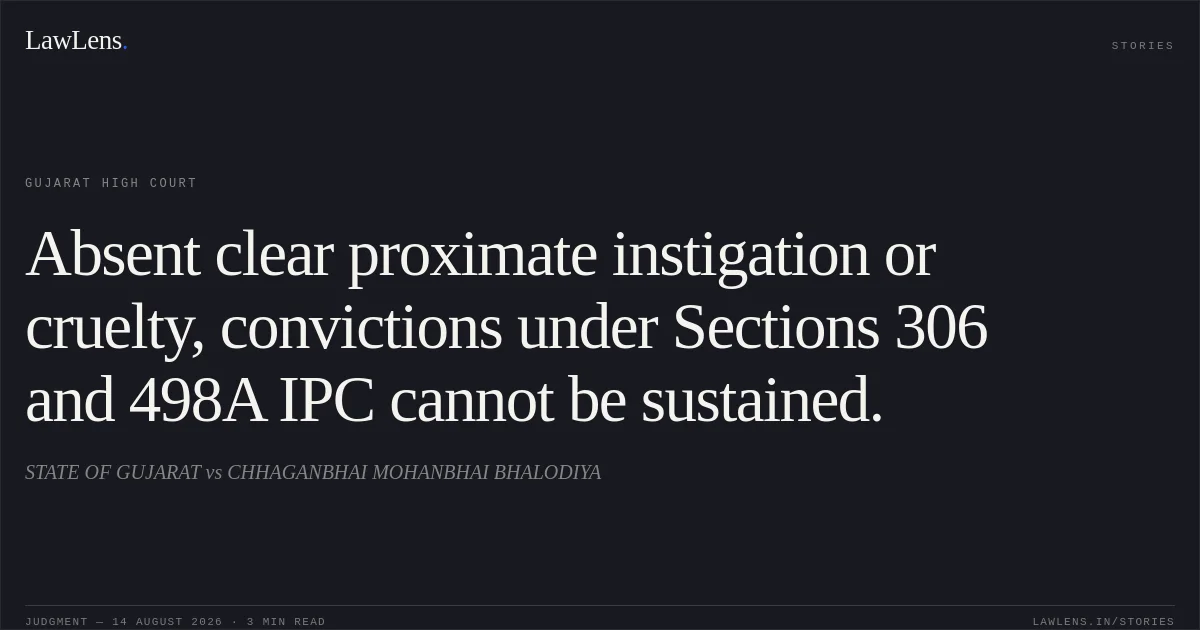
The deceased, Bhavna, married Nilesh Chhaganbhai Bhalodiya in 2003. The respondents were her father-in-law and mother-in-law. The prosecution alleged that the deceased suffered mental illness and was subjected to physical and mental cruelty by the respondents, including being called “mad” and being blamed for medical expenses. She died by hanging at her residence on 11 September 2013.
Source reference: p.1–3; para. 1–5An accidental-death case was initially registered; on the following day, her brother lodged an FIR alleging offences under Sections 498A, 323 and 306 of the IPC. After investigation, a charge-sheet was filed and the respondents were tried in Sessions Case No. 7 of 2014. The trial Court acquitted them of all charges by judgment dated 5 August 2016. During pendency of the State’s appeal against acquittal, respondent no. 1 died on 15 November 2016, and the appeal against him abated.
Source reference: p.1–3; para. 1–5Issues
Whether the trial Court was justified in acquitting the respondents of offences under Sections 498A, 323 and 306 of the IPC.
Source reference: p.6; para. 10Whether the prosecution proved beyond reasonable doubt that the respondents subjected the deceased to cruelty or abetted her suicide.
Source reference: p.7–9; paras. 12–14Whether the acquittal disclosed any illegality, irregularity or perversity warranting appellate interference.
Source reference: p.6; para. 10; p.9–12; paras. 15–20Law Applied
The Court applied Sections 498A, 323 and 306 of the IPC, requiring proof of cruelty, voluntarily causing hurt, and abetment of suicide, respectively.
Source reference: p.8–12; paras. 13–18In relation to Section 306 IPC, the Court relied on Gangula Mohan Reddy v. State of Andhra Pradesh, (2010) 1 SCC 750, for the rule that a clear, proximate act of instigation or abetment leading to suicide must be proved beyond reasonable doubt.
Source reference: p.8–12; paras. 13–18In an appeal against acquittal under Section 378 of the CrPC, the appellate Court has full power to reappreciate the evidence, but must consider the strengthened or “double” presumption of innocence in favour of the acquitted accused. Where two reasonable views are possible, the acquittal should not be disturbed unless the trial Court’s findings are manifestly illegal or perverse. These principles were drawn from Chandrappa v. State of Karnataka, (2007) 4 SCC 415; Rajesh Prasad v. State of Bihar, (2022) 3 SCC 471; Babu Sahebagouda Rudragoudar v. State of Karnataka, (2024) 8 SCC 149; and Ramesh v. State of Karnataka, (2024) 9 SCC 169.
Source reference: p.8–12; paras. 13–18Reasoning
The Court found that the deceased’s history of mental illness and extensive medical treatment was admitted and supported by medical records. The evidence did not establish that the respondents had subjected her to cruelty or physical violence; the post-mortem doctor found no internal or external injuries apart from the injury to the neck associated with the hanging.
Source reference: p.6–9; paras. 11–14, 19–20The evidence of the complainant and his wife did not establish the statutory ingredients of Sections 498A or 306 IPC, particularly any specific and proximate act of instigation causing the suicide. On the contrary, the material indicated that the respondents had arranged and supported the deceased’s medical treatment. The Court therefore held that the prosecution evidence was insufficient to prove guilt beyond reasonable doubt.
Source reference: p.6–9; paras. 11–14, 19–20Applying the restricted principles governing an appeal against acquittal, it found that the trial Court’s view was reasonable and neither perverse nor manifestly erroneous.
Source reference: p.6–9; paras. 11–14, 19–20Holding
The Court answered the issues in favour of the respondents. It held that the prosecution failed to prove the offences under Sections 498A, 323 and 306 IPC beyond reasonable doubt and that the trial Court had rightly acquitted the accused.
The State’s appeal was dismissed, and the trial Court’s judgment of acquittal was confirmed. The appeal against respondent no. 1 had already abated due to his death; the bail bond was cancelled, and the record and proceedings were directed to be returned to the trial Court.
Source reference: p.12–13; paras. 20–21Acts & Sections Cited
4 provisions across 2 statutes referred to in this judgment. Each provision opens on LawLens.
Code of Criminal Procedure, 19732
Indian Penal Code, 18602
Original Court PDF
STATE OF GUJARATvsCHHAGANBHAI MOHANBHAI BHALODIYA
Click to open original judgment
Original judgment, available to read, download and summarize on LawLens.in