Facts
The petitioner, a U.S.-residing medical practitioner, married Respondent No. 2 on 16 October 2007. The parties thereafter lived separately, and the petitioner claimed that the marriage had been annulled by a Missouri court in 2015.
Source reference: pp. 1–4; paras. 2–9Respondent No. 2 subsequently filed a complaint alleging cruelty, dowry demands, demands for an Innova vehicle and approximately ₹16–17 crores, physical and sexual abuse, and non-return of jewellery allegedly entrusted to the petitioner’s sister-in-law. FIR No. 184/2019 was registered at P.S. Kirti Nagar under Sections 498A and 406 read with Section 34 IPC.
Source reference: pp. 1–4; paras. 2–9After investigation, a charge-sheet was filed against the petitioner under Sections 498A and 406 IPC, although charges had not yet been framed and cognizance had not been taken.
Source reference: p. 4; para. 10The petitioner sought quashing of the FIR and consequential proceedings on the grounds of abuse of process, the foreign annulment decree, delay and limitation, and absence of the ingredients of criminal breach of trust.
Source reference: pp. 4–8; paras. 11–23Issues
Whether the allegations in the complaint and charge-sheet, taken at face value, disclosed a prima facie case against the petitioner under Sections 498A and 406 read with Section 34 IPC.
Source reference: p. 9; para. 25Whether the prosecution was barred by limitation under Section 468 CrPC, having regard to the alleged last acts of cruelty in 2012 and the dates of the complaint and FIR.
Source reference: pp. 9, 12–18; paras. 25, 32–50Whether the proceedings under Section 406 IPC could be quashed against the petitioner for want of allegations showing entrustment, dominion over the jewellery, and dishonest misappropriation by him.
Source reference: pp. 19–22; paras. 51–57Law Applied
The Court applied Section 482 CrPC, under which quashing is an exceptional remedy to be exercised sparingly where the allegations do not disclose an offence or continuation of proceedings would constitute an abuse of process.
Source reference: pp. 9–11; paras. 26–28Under Neeharika Infrastructure (P) Ltd. v. State of Maharashtra, the High Court should not assess the reliability of allegations at the FIR stage, while under Rajiv Thapar v. Madan Lal Kapoor, accused-produced material must be of sterling and unimpeachable quality to justify quashing.
Source reference: pp. 9–11; paras. 26–28Sections 468–473 CrPC govern limitation: offences punishable with imprisonment exceeding one year but not exceeding three years ordinarily carry a three-year limitation under Section 468(2)(c); Section 498A constitutes a continuing offence, with a fresh limitation period arising from each act of cruelty under Arun Vyas v. Anita Vyas.
Source reference: pp. 12–18; paras. 33–50The relevant date is institution of the prosecution or lodging of the FIR, not the date of cognizance, under Sarah Mathew v. Institute of Cardio Vascular Diseases and Roma Ahuja v. State.
Source reference: pp. 12–18; paras. 33–50Section 473 CrPC permits delayed cognizance where the delay is properly explained or such cognizance is necessary in the interests of justice, particularly in matrimonial cruelty cases, as recognised in Vanka Radhamanohari v. Vanka Venkata Reddy and Arun Vyas.
Source reference: pp. 16–18; paras. 46–49Sections 405–406 IPC require entrustment or dominion over property and subsequent dishonest misappropriation or conversion by the accused; Abhishek Saxena v. State of U.P. restated these ingredients.
Source reference: pp. 19–23; paras. 51–60Further, partial or offence-wise quashing is permissible under Ishwar Pratap Singh v. State of U.P., Hitesh Verma v. State of Uttarakhand, and Arun Singh v. State of U.P.
Source reference: pp. 19–23; paras. 51–60Reasoning
The Court held that the allegations of repeated abuse, demands for money and a vehicle, the alleged demand of ₹16–17 crores, physical and sexual cruelty, and the specific incidents in April and December 2012 were sufficiently particularised to disclose a prima facie case under Section 498A IPC.
Source reference: pp. 11–12; paras. 29–31The foreign annulment decree, visa records and immigration-lawyer communications did not conclusively disprove the alleged acts in India and therefore could not be evaluated as a defence at the Section 482 stage.
Source reference: p. 12; para. 31Although the alleged last acts of cruelty appeared prima facie to fall beyond the three-year limitation period, the petitioner had not produced complete travel and immigration records necessary to calculate the exclusion under Section 470(4)(a) CrPC.
Source reference: pp. 14–18; paras. 42–50Further, the explanation based on the complainant’s continuing hope of reconciliation and the 2014–2015 communications required consideration under Section 473 CrPC; limitation therefore was not an automatic ground for quashing the Section 498A prosecution.
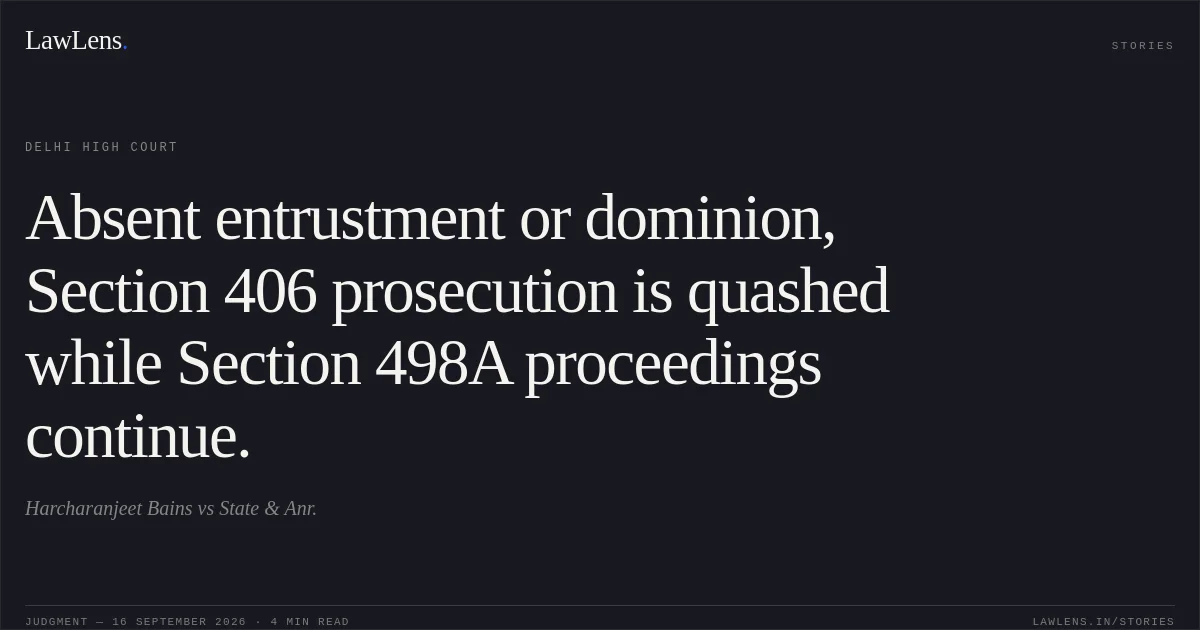
Source reference: pp. 14–18; paras. 42–50In contrast, the complaint alleged that the jewellery had been entrusted to the petitioner’s sister-in-law and remained in her custody; it did not allege entrustment to the petitioner, his dominion over the articles, a demand for return made to him, or dishonest misappropriation by him.
Source reference: pp. 19–22; paras. 53–60The charge-sheet likewise supplied no material establishing these essential ingredients against the petitioner.
Source reference: pp. 19–22; paras. 53–60Since the defect concerned the absence of the legal ingredients of Section 406 IPC, rather than merely insufficient evidence, partial quashing was warranted.
Source reference: pp. 19–22; paras. 53–60Holding
The petition was partly allowed. The FIR, charge-sheet and all consequential proceedings were quashed against the petitioner insofar as they related to Section 406 IPC.
The prosecution under Section 498A read with Section 34 IPC was permitted to continue.
Source reference: pp. 23–24; paras. 62–64Before taking cognizance of the remaining offence, the Trial Court was directed to independently determine the limitation plea by considering the date of institution of the prosecution, any period excludable under Section 470 CrPC, and the applicability of Section 473 CrPC, without being influenced by the High Court’s prima facie observations.
Source reference: p. 24; para. 67Acts & Sections Cited
17 provisions across 4 statutes referred to in this judgment. Each provision opens on LawLens.
Code of Criminal Procedure, 1973
Indian Penal Code, 18604
Hindu Marriage Act, 19552
Original Court PDF
Harcharanjeet BainsvsState & Anr.
Click to open original judgment
Original judgment, available to read, download and summarize on LawLens.in