Facts
The Petitioner lodged an FIR alleging that accused persons kidnapped his minor daughter for marriage
Source reference: p. 2, para. 2(i)Following her rescue, the victim's statement was recorded under Section 183 of the Bharatiya Nagarik Suraksha Sanhita (BNSS) before the S.D.J.M., Kendrapara
Source reference: p. 2, para. 2(ii)The Petitioner subsequently moved an application for a "further statement" or "re-recording" of the victim's statement, contending that the initial statement was made under police pressure and in the presence of the accused, and that mandatory medical examination and child-friendly procedures under the POCSO Act were ignored
Source reference: p. 2-4, paras. 2(ii), 3(iii-vi)The learned S.D.J.M. rejected this application on 08.01.2026 citing significant delay and the risk of tutoring
Source reference: p. 7, para. 5The Petitioner challenged this order before the High Court under Section 482 Cr.P.C. / Section 528 BNSS.
Source reference: no citationIssues
1. Whether there is a statutory bar against recording a witness's statement under Section 183 BNSS (formerly Section 164 Cr.P.C.) more than once.
Source reference: p. 8, para. 62. Whether the learned Magistrate erred in rejecting the prayer for re-recording the minor victim's statement based on delay and fear of tutoring.
Source reference: p. 10, para. 11Law Applied
The Court applied Section 183 of the BNSS (corresponding to Section 164 Cr.P.C.) regarding the judicial recording of statements during investigation, emphasizing that its primary object is to ensure voluntariness and authenticity
Source reference: p. 8, para. 6It relied on Bhima Mallik v. State of Orissa, Showkat Ali v. State, and Archana v. UT of J&K to establish that there is no statutory bar to recording a statement more than once if circumstances demand
Source reference: p. 8, para. 7The Court also applied the principle of judicial discretion under Section 482 Cr.P.C./Section 528 BNSS, which mandates interference only in cases of patent perversity or miscarriage of justice, while cautioning against the dilution of judicial records through repeated "favourable versions"
Source reference: p. 9-10, paras. 8, 11Reasoning
The Court reasoned that while jurisdictional power to re-record a statement exists, its exercise is not a matter of right but must be justified by compelling circumstances
Source reference: p. 9, para. 8In this case, although the Petitioner alleged procedural lapses (non-compliance with POCSO safeguards), the Court noted that the victim was produced before a Magistrate after staying at a 'Sakhi' shelter home and was handed over to her father immediately after her statement
Source reference: p. 9, para. 9The three-month delay in filing the application for re-recording was deemed a critical factor, as it introduced the possibility of external influence or tutoring
Source reference: p. 10, para. 10The Court further observed that a Section 183 statement is not substantive evidence; its veracity can be tested during trial through cross-examination, and thus, procedural irregularities at the investigation stage do not inherently necessitate a re-recording of the judicial statement
Source reference: p. 10, para. 10Holding
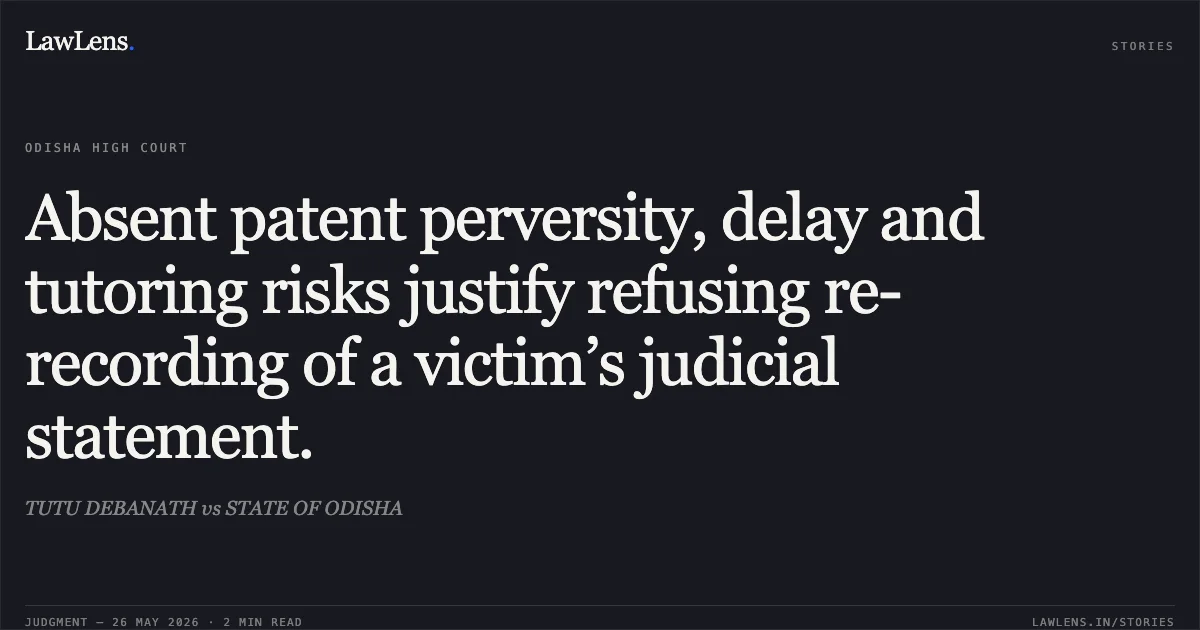
The High Court held that while a second statement is legally permissible, the Magistrate’s refusal based on delay and the risk of tutoring was a valid exercise of discretion
The High Court dismissed the petition, holding that the S.D.J.M.’s order did not suffer from patent perversity or illegality and clarified that the victim remains free to disclose true facts during the trial.
Source reference: p. 11-12, para. 12-14Acts & Sections Cited
11 provisions across 4 statutes referred to in this judgment. Each provision opens on LawLens.
Code of Criminal Procedure, 19733
Bharatiya Nagarik Suraksha Sanhita, 20232
Bharatiya Nyaya Sanhita, 20232
Protection of Children from Sexual Offences Act, 20124
Original Court PDF
TUTU DEBANATHvsSTATE OF ODISHA
Click to open original judgment
Original judgment, available to read, download and summarize on LawLens.in