Facts
An FIR, C.R. No. 1-53/2008, was registered at Pandu Police Station for offences under Sections 406, 409, 420, 465, 467, 471, 114 and 120-B of the IPC.
Source reference: p.2, para. 2.1The prosecution alleged that, between 1 July 1997 and 31 March 2002, the accused, acting in collusion and misusing their positions in cooperative societies, fabricated documents, forged signatures and misappropriated approximately Rs.1,48,72,235.
Source reference: p.2, para. 2.1After investigation, the police filed a chargesheet in Criminal Case No. 3147 of 2009, asserting a prima facie case against the accused.
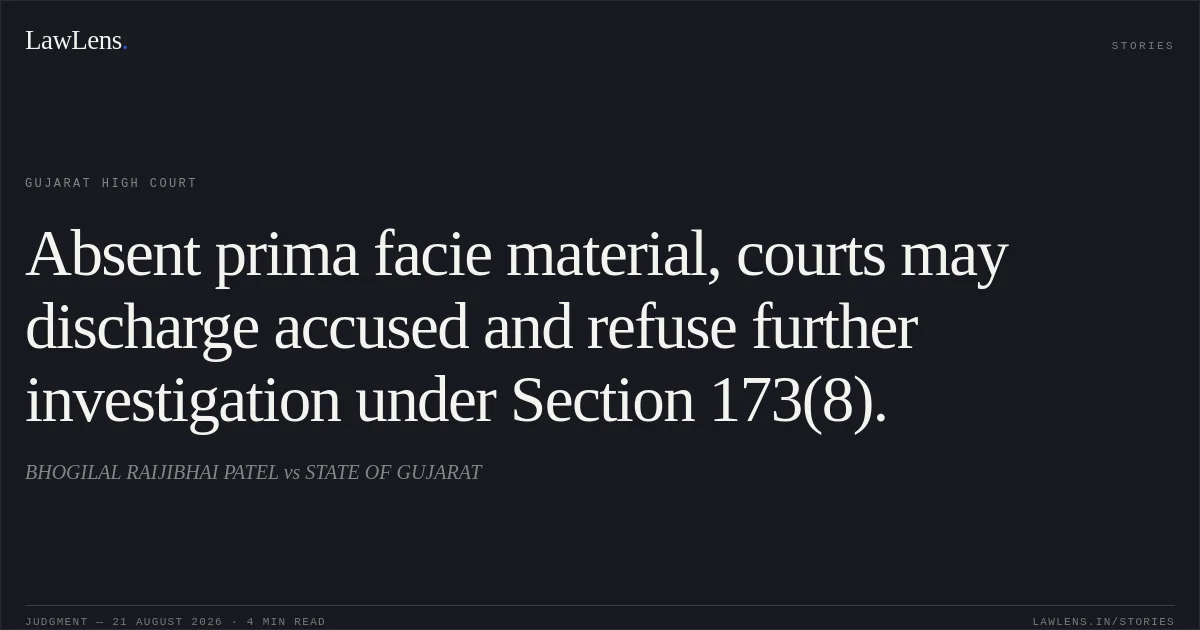
Source reference: p.2, para. 2.3Six accused filed an application under Section 239 of the CrPC seeking discharge.
Source reference: p.1, para. 1The prosecution subsequently sought further investigation under Section 173(8) of the CrPC.
Source reference: p.3, paras. 2.4–2.6By a common order dated 13 June 2011, the Judicial Magistrate allowed the discharge application and rejected the application for further investigation.
Source reference: p.1, para. 1; p.3, paras. 2.4–2.6The State challenged that order in Criminal Revision Application No. 395 of 2011.
Source reference: p.1, para. 1Separately, Bhogilal Raijibhai Patel and Bhogilal Prabhudas Patel sought quashing of the criminal case on the ground that their role was identical to that of the six accused who had been discharged.
Source reference: p.1, para. 1; p.7, para. 5Issues
Whether the Magistrate erred in discharging the six accused under Section 239 of the CrPC when the prosecution alleged that prima facie material existed against them?
Source reference: p.3, para. 3; p.9, para. 6Whether the Magistrate ought to have permitted further investigation under Section 173(8) of the CrPC, particularly for obtaining handwriting-expert evidence and collecting further documents?
Source reference: p.4, paras. 3.5–3.6; p.9, para. 6Whether the High Court, in revision, could interfere with the Magistrate’s reasoned order in the absence of a patent illegality, perversity or miscarriage of justice?
Source reference: p.8, para. 6Whether the criminal proceedings against the two petitioners should be quashed because their role was at par with the accused who had already been discharged?
Source reference: p.9, para. 6; p.10, para. 7Law Applied
Section 239 of the CrPC permits discharge of an accused in a warrant case instituted on a police report where, upon consideration of the police report and accompanying documents, the charge is groundless.
Source reference: pp.4–5, paras. 3.5–3.8; p.9, para. 6Section 173(8) permits further investigation after submission of a police report, but such power must be founded on a legitimate investigative necessity and cannot be invoked merely to undertake a fishing or roving inquiry.
Source reference: pp.4–5, paras. 3.5–3.8; p.9, para. 6Revisional jurisdiction under Section 397 of the CrPC is supervisory and is exercised to correct patent defects, jurisdictional errors, perversity, non-consideration of material evidence or manifest illegality, and not to re-appreciate evidence as an appellate court.
Source reference: p.8, para. 6The Court relied on Amit Kapoor v. Ramesh Chander, (2012) 9 SCC 460, for these principles.
Source reference: p.8, para. 6The parties also relied upon the report under Section 93 and the legal effect of Section 103 of the Gujarat Cooperative Societies Act, 1961, as well as M/s. Karamchand Ganga Prasad v. Union of India, AIR 1971 SC 1244, concerning the relevance of civil adjudications in criminal proceedings.
Source reference: pp.6–7, para. 4.2Reasoning
The High Court found that the Magistrate had passed a detailed and reasoned order.
Source reference: p.9, para. 6The Magistrate specifically recorded that the investigation had not collected evidence showing that the accused were members of the concerned cooperative society during the relevant period and that no witness statement or documentary material connected them with the alleged offence.
Source reference: p.9, para. 6The State could not identify any material document or witness statement that had been ignored by the Magistrate.
Source reference: p.9, para. 6The proposed handwriting examination and collection of additional documents did not, by themselves, justify further investigation under Section 173(8), particularly when no foundational material linking the accused to the alleged crime had been shown.
Source reference: p.4, para. 3.5; p.9, para. 6Applying the restrictive principles governing revision, the Court held that the Magistrate’s findings did not disclose perversity, palpable error, failure to consider relevant material or consideration of irrelevant material.
Source reference: p.9, para. 6The fact that some accused were unavailable or that absconding accused remained to be arrested could not establish the petitioners’ involvement.
Source reference: p.9, para. 6Since the petitioners’ roles were materially identical to those of the six accused who had been discharged, continuing proceedings against them would serve no useful purpose.
Source reference: p.9, para. 6; p.10, para. 7Holding
The Court answered the revision issue against the State and held that the Magistrate committed no jurisdictional or legal error in allowing the application under Section 239 of the CrPC and rejecting the prosecution’s application under Section 173(8).
Criminal Revision Application No. 395 of 2011 was rejected.
Source reference: p.10, para. 7Since the two petitioners were similarly situated to the discharged accused, Criminal Misc. Application No. 3076 of 2012 was allowed, and Criminal Case No. 3147 of 2009, together with all consequential proceedings, was quashed and set aside insofar as it concerned the petitioners.
Source reference: p.10, para. 7Rule was made absolute to that extent.
Source reference: p.10, para. 8Acts & Sections Cited
11 provisions across 2 statutes referred to in this judgment. Each provision opens on LawLens.
Code of Criminal Procedure, 19734
Indian Penal Code, 18607
Original Court PDF
BHOGILAL RAIJIBHAI PATELvsSTATE OF GUJARAT
Click to open original judgment
Original judgment, available to read, download and summarize on LawLens.in