Facts
On 28 February 2019, at approximately 12:00 midnight, the appellants allegedly assaulted Hamidan, aged about 65 years, at the roof of a house in Munga Nagar, Delhi.
Source reference: p.6–7, paras 16–17According to the prosecution’s sole reliable eyewitness, PW-1 Shahzad, Mohd. Ubesh struck Hamidan with a wooden danda approximately 1½ feet long, Saddam held her, and co-accused Salma slapped her.
Source reference: p.6–7, paras 16–17Hamidan was taken to GTB Hospital, where she remained under treatment for about seven days before dying on 7 March 2019.
Source reference: p.2, paras 3–4The post-mortem recorded seven ante-mortem injuries, predominantly contusions and abrasions, and attributed the cause of death to “septicemic shock consequent upon ante-mortem injury to head as a result of blunt force impact”.
Source reference: p.7–8, paras 19–20The Trial Court convicted both appellants under Sections 302/34 IPC and sentenced them to life imprisonment with a fine of ₹10,000 each.
Source reference: p.2–4, paras 2, 6In appeal under Section 415(2) BNSS, 2023, the appellants contended that the offence, at most, amounted to culpable homicide not amounting to murder under Section 304 Part II IPC.
Source reference: p.4–5, paras 7–12Issues
Whether the appellants’ acts constituted murder under any of the four clauses of Section 300 IPC, particularly Sections 300(1), (2), or (3), rather than culpable homicide not amounting to murder under Section 304 IPC.
Source reference: p.9–13, paras 22–28Whether the evidence established an intention to cause death or an intention to inflict a bodily injury sufficient in the ordinary course of nature to cause death.
Source reference: p.13–17, paras 28–38Whether, upon alteration of the conviction to Section 304 Part II IPC, the sentence already undergone was sufficient in the circumstances of the case.
Source reference: p.17–20, paras 39–47Law Applied
Section 299 IPC defines culpable homicide, while Section 300 IPC specifies when culpable homicide amounts to murder; where murder is not established, liability may fall under Section 304 Part I or Part II depending on whether the case involves intention or merely knowledge.
Source reference: p.9–10, paras 22–23, 39The Court applied the structured three-stage test stated in Sitaram Kuchhbedia v. Vimal Rana, 2026 SCC OnLine SC 293: first, whether the accused caused the death; second, whether the act constituted culpable homicide; and third, whether it fell within Section 300 or any of its exceptions.
Source reference: p.10–12, paras 23–25It relied on Pulicherla Nagaraju v. State of A.P., (2006) 11 SCC 444, for determining intention from factors including the weapon, manner and force of assault, part of the body targeted, premeditation, motive, and whether one or several blows were inflicted.
Source reference: p.13–14, para 29Under Virsa Singh v. State of Punjab, 1958 SCC OnLine SC 37, Section 300 “thirdly” requires proof of the injury, its nature, the intention to inflict that particular injury, and that the injury was sufficient in the ordinary course of nature to cause death.
Source reference: p.15–16, para 33The Court also relied on Dayanand v. State of Haryana, (2008) 15 SCC 717, regarding the limited application of Section 300 “secondly” where the accused knows of a particular disease or bodily condition rendering the injury likely to cause death.
Source reference: p.12, para 27.1Ganga Dass v. State of Haryana, 1994 Supp (1) SCC 534, where a delayed death from septicemia following a single blunt-force injury resulted in conviction under Section 304 Part II rather than Section 302 IPC.
Source reference: p.18, para 41Reasoning
The Court accepted that the appellants’ acts were causally connected with the injuries and death, thereby satisfying the foundation for culpable homicide.
Source reference: p.16–17, paras 34–38However, Section 300 “fourthly” was inapplicable because the prosecution did not allege an imminently dangerous act known to be likely, in all probability, to cause death.
Source reference: p.11, para 26Section 300 “secondly” was also not attracted: the deceased’s age, without proof of disease, infirmity, or the appellants’ knowledge of any such condition, did not establish the requisite knowledge contemplated by that clause.
Source reference: p.12, paras 27–27.2The circumstances likewise did not demonstrate an intention to kill under Section 300 “firstly”: the assault involved a single short wooden danda, only one appellant was armed, the remaining injuries were mainly simple contusions or abrasions, and the sutured forehead injury was neither described as grievous nor shown to be fatal.
Source reference: p.14–15, paras 30–32Section 300 “thirdly” was not established because no medical opinion stated that any injury, or the injuries collectively, was sufficient in the ordinary course of nature to cause death; indeed, the post-mortem doctor stated that injury no. 2 could not have caused death.
Source reference: p.16–17, paras 34–35The recorded cause of death was septicemic shock after a seven-day hospitalisation, and the Court treated the evidence as showing knowledge that the assault could cause death, but not an intention to cause death or a fatal injury.
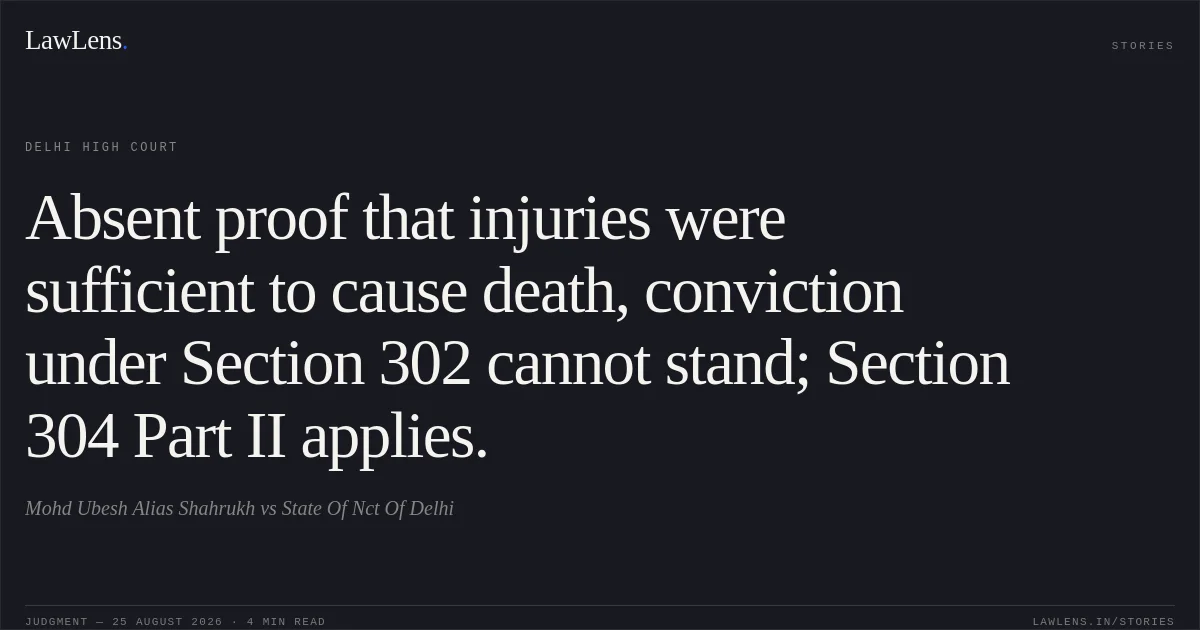
Source reference: p.17–18, paras 36–40Accordingly, the case fell under Section 304 Part II IPC.
Source reference: p.17–18, paras 36–40Holding
The High Court allowed the appeals in part by setting aside the appellants’ convictions under Section 302 IPC and their sentences of life imprisonment, and convicted them instead under Section 304 Part II IPC.
Considering the use of a 1½-foot wooden danda, the non-grievous nature of the injuries, septicemic shock as the cause of death, the appellants’ clean antecedents, satisfactory jail conduct, and the period already undergone—approximately four years by each appellant—the Court held that the sentence already served would meet the ends of justice.
Source reference: p.19–20, paras 43–46The appellants were consequently directed to be released forthwith, if not required in any other case.
Source reference: p.20, para 47Acts & Sections Cited
11 provisions across 3 statutes referred to in this judgment. Each provision opens on LawLens.
Bharatiya Nagarik Suraksha Sanhita, 20231
Indian Penal Code, 18606
Code of Criminal Procedure, 19734
Original Court PDF
Mohd Ubesh Alias ShahrukhvsState Of Nct Of Delhi
Click to open original judgment
Original judgment, available to read, download and summarize on LawLens.in
![Courts will not interfere with transfers absent mala fides or violation of statutory rules.. M Ramya vs EMPLOYEES STATE INSURANCE CORPORATION (ESIC). CAT - ['Chennai']. LawLens](/stories/thumbnails/courts-will-not-interfere-with-transfers-absent-mala-fides-or-violation-of-statutory-rules-a6845e9ca6f548fca284c51c8351957f.webp)
![Courts cannot direct one-time recruitment age relaxation absent authority in the governing rules or advertisement.. UT OF PUDUCHERRY vs M ANDAL. CAT - ['Chennai']. LawLens](/stories/thumbnails/courts-cannot-direct-one-time-recruitment-age-relaxation-absent-authority-in-the-governing-895d78fde47143e2a8ed0207c4b6a44f.webp)
![A review cannot correct an allegedly erroneous decision absent an error apparent on the record.. Ajit Kumar Jha vs RAILWAY BOARD. CAT - ['Delhi']. LawLens](/stories/thumbnails/a-review-cannot-correct-an-allegedly-erroneous-decision-absent-an-error-apparent-on-the-re-8ac952fd4eba470c92f7da20af72a220.webp)